Trump appoints ally and housing chief Bill Pulte as acting US intelligence director
Updated 1 hour ago

US president says most potential new Iranian leaders were killed in initial US‑Israeli strikes, others may be dead too
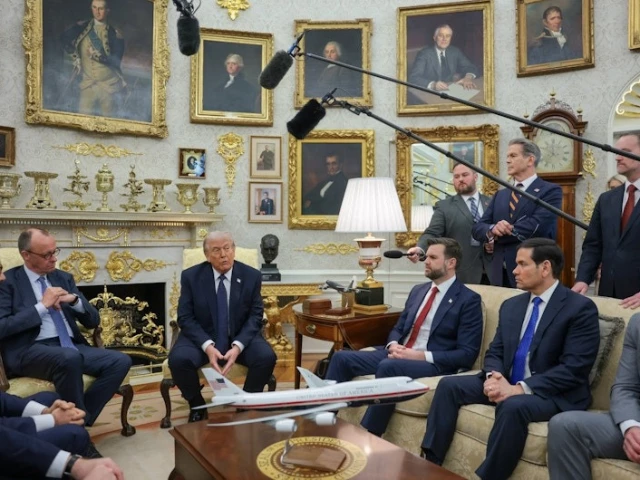
US President Donald Trump on Tuesday boasted of wide damage on Iran inflicted by the US-Israel attack, while denying that Israel had forced his hand into launching the war. "Just about everything's been knocked out," Trump said as he met German Chancellor Friedrich Merz, answering his first questions from reporters since the strikes began on Saturday.
Trump's administration has given conflicting reasons for going to war, with Secretary of State Marco Rubio saying Monday that the US did so only after learning that ally Israel was going to strike. But Trump walked that back, saying that he acted to prevent Tehran launching an assault first.
"Based on the way the negotiation was going, I think they (Iran) were going to attack first. And I didn't want that to happen," Trump said in the Oval Office. "So, if anything, I might have forced Israel's hand."
Read More: Iran war enters fourth day in 'smoke and blood' as global markets slide
The US president has also faced criticism for the lack of an apparent day-after plan for Iran, and he admitted that he was not sure how the situation would play out after the conflict. "I guess the worst case would be, we do this, and then somebody takes over who's as bad as the previous person, right?" Trump said, referring to Ayatollah Ali Khamenei.
Iran's supreme leader was killed in air strikes on the first day of the conflict. "I guess the worst case would be, we do this, and then somebody takes over who's as bad as the previous person, right?" said Trump. "That could happen. We don't want that to happen."
Trump also told protesters in Iran to hold off any major moves until the situation had stabilized. He has also used the recent deadly crackdown on protests in Iran as a justification for the war. "We've said, don't do it yet. If you're going to go out and protest, don't do it yet," Trump added.
He said that two waves of US-Israeli attacks on Iran had killed figures he had eyed as potential new leaders, adding that there had been a "substantial" new attack on a meeting to choose the new leadership. "Most of the people we had in mind are dead," he said. "Now we have another group. They may be dead also, based on reports."
Trump further said the reason there wasn’t an evacuation plan for embassies is that “it happened all very quickly.” “I thought we were going to have a situation where we were going to be attacked. They were getting ready to attack Israel. They were getting ready to attack others,” he said, referring to Iran.
He also said on Tuesday that he expects oil prices to fall once his administration’s military operations in Iran end. “As soon as this ends those prices are going to drop, I believe, lower than even before,” he said.
Earlier, Trump had said that it was too late for talks with Iran even though Tehran wants them, according to AFP.
"Their air defense, Air Force, Navy, and Leadership is gone. They want to talk. I said 'Too Late!'" Trump wrote in a Truth Social post, two days after saying he had agreed to talks, amid the joint Israeli-US bombardment of Iran.
'This is not Winston Churchill that we're dealing with'
Trump has renewed his criticism of Britain for initially holding off providing support for US strikes on Iran.
During his Oval Office remarks, he lambasted British Prime Minister Keir Starmer. "This is not Winston Churchill that we're dealing with," he said, referring to Britain's revered wartime leader.
Starmer said on Monday Britain did not take part in the assault on Iran by the United States and Israel because any British military action must have a "viable, thought-through plan" and he did not believe in "regime change from the skies".
But he has since allowed the US to use UK bases to launch what he called limited and defensive strikes to weaken Tehran's capabilities, after Iran hit US allies in the region with drones and missiles.
On Monday, a British base in Cyprus was hit by a drone that Cypriot officials said was likely launched by Iran-backed Lebanese group Hezbollah.
Trump says US will cut all trade with Spain
Trump said the US will cut off all trade with Spain after it refused to let the US military use its bases for missions linked to strikes on Iran.
"Spain has been terrible," Trump stated, adding that he had told Treasury Secretary Scott Bessent to "cut off all dealings" with Spain.
"We're going to cut off all trade with Spain. We don't want anything to do with Spain," he added.
Foreign Minister Jose Manuel Albares said Spain would not allow its military bases, which are jointly operated by the U.S. and Spain but under Spanish sovereignty, to be used for attacks on Iran, which Spain has condemned.
Fifteen US aircraft have left the Rota and Moron military bases in southern Spain since the attacks on Iran, maps by flight tracking website FlightRadar24 showed on Monday.
Iran says will hit all Mideast economic hubs if US-Israeli attacks persist
An Islamic Revolutionary Guard general warned Tuesday that continued US-Israeli attacks would see Iran conduct reprisals against "all economic centres" in the Middle East, AFP reported.
"We are saying to the enemy that if it decides to hit our main centres, we will hit all economic centres in the region," said Ebrahim Jabbari.
"We have closed the Strait of Hormuz. Currently, the price of oil is above $80 and will soon reach $200," he was quoted as saying by Iranian news agency ISNA, as
Brent crude climbed above $85 for the first time since July 2024.
Israel says hit ballistic missile production sites across Iran
Israel's military said on Tuesday its air force had struck industrial sites "throughout Iran" that were used to produce weapons including ballistic missiles, on the fourth day of a joint US-Israel attack on the Islamic republic, AFP reported.
"During strikes conducted throughout Iran, the IDF (military) targeted industrial sites used by the Iranian regime to produce weapons, particularly ballistic missiles," the military said in a statement.
Israeli Prime Minister Benjamin Netanyahu said Israel was continuing to pound Iran and vowed to hit Hezbollah with increasing force as the war in the Middle East raged for a fourth day.
"We continue to strike Iran with force. Our pilots are over the skies of Iran and Tehran, and also over the skies of Lebanon. Hezbollah made a very big mistake when it attacked us. We have already responded forcefully, and we will respond with even greater force," Netanyahu said at an air force base in central Israel, according to a statement from his office.
Hezbollah says it targeted Israeli tank on edge of Lebanese border village
Hezbollah said it targeted an Israeli tank on the edge of a Lebanese border village on Tuesday, hours after Israel's defence minister ordered his troops to take control of more strategic positions inside Lebanon, according to AFP.
In a statement, the pro-Iran armed group said: "In response to the criminal Israeli aggression... and after monitoring movements by the Israeli enemy army in Tel Nahas on the outskirts of Kfar Kila, our fighters targeted a Merkava tank with appropriate weapons and scored a direct hit."
Earlier on Tuesday, a Lebanese army source told AFP Israel was undertaking a ground incursion "from Kfar Kila and the Khiam plains" along the Lebanon-Israel border.
Israel, US strikes hit building of body to elect new Iran supreme leader: Iranian media
Israeli and US strikes on Tuesday hit the Tehran building of a body tasked with electing Iran's new supreme leader, local media reported.
"The American-Zionist criminals attacked the Assembly of Experts building in Qom," south of Tehran, according to the Tasnim news agency.
Local media showed footage of the building severely damaged in the strikes. Iran's supreme leader Ayatollah Ali Khamenei was killed in US and Israeli strikes on Saturday.
Funerals held for children killed at Iranian school in Minab
Iranian television showed the funerals of children killed in an US-Israeli strike on a girls' school in Minab, southern Iran, last week.
The UN human rights office on Tuesday urged what it called the forces behind the "horrific" attack to investigate, without saying who it believed was responsible.
The school was hit on the first day of US and Israeli attacks against the country. Iranian media said more than 150 were killed.
US embassy in Saudi Arabia warns of threat to eastern city
The US Embassy in Saudi Arabia has issued a security alert warning of a potential imminent missile or drone attack over the eastern city of Dhahran.
There is a US consulate in the city, where the headquarters of Saudi state oil giant Aramco are also located.
Iranian drones hit the US embassy in Riyadh earlier on Tuesday, causing minor damage and starting a fire. The US mission in Kuwait had previously been struck.
Washington responded by shutting those missions and ordering non-emergency government personnel and their families to leave countries across the Middle East.
US and Israel must end military action: Iran’s foreign ministry
Iran's foreign ministry spokesperson Esmaeil Baghaei called on the US and Israel to halt their military action. "They have to stop the war, it wasn't us who started the war, this military aggression was not our choice, our choice was diplomacy," he said, speaking at a weekly press conference in Tehran.
China urges resumption of talks on Iran nuclear issue
China respects Iran's "legitimate right to the peaceful use of nuclear energy," a Chinese foreign ministry spokesperson said on Tuesday, while urging a stop to US military actions in favour of returning to talks and negotiations.
US strikes on Iran "during ongoing negotiations ... violate international law and basic principles of international relations," Spokesperson Mao Ning said during a regular press briefing on Tuesday.
"The Iran nuclear issue should eventually return to the track of political and diplomatic settlement," she added.
Mao also said China will take necessary measures to ensure its own energy security, when asked about the potential impact of U.S. military actions in Venezuela and Iran on China's oil supply.
"Energy security is very important to the world economy, and all parties should ensure stable and smooth energy supply," she said.
Russia says no evidence Iran working on nuclear weapons
Russian Foreign Minister Sergei Lavrov said on Tuesday that Moscow had still not seen any evidence that Iran was developing nuclear weapons.
US President Donald Trump has said the war was needed to prevent Iran from developing a nuclear weapon and to thwart its long-range ballistic missile program.
Iran has denied it is seeking nuclear weapons and said the US and Israeli assault was unprovoked, occurring as Tehran and Washington were in negotiations on a nuclear accord.
Trump withdrew from a prior international agreement curbing Iran's nuclear programme during his first term in 2018, three years after it was signed.
Turkiye says making 'intense' efforts to end Mideast war
Turkish President Recep Tayyip Erdogan has said Turkiye was making "intense" diplomatic efforts to end the conflict roiling the Middle East, sparked by the Israeli-US strikes on Iran.
"Attacks on Iran, and missile and kamikaze drone attacks (by Iran) on neighbouring countries in the Gulf have fuelled instability," he said in a televised address on Tuesday. "Through peace-oriented diplomacy, we are making intense efforts to resolve issues at the negotiating table," he added.
Russia says Iran's Bushehr nuclear plant under threat
The Bushehr nuclear power plant in Iran is under threat as a result of the escalating conflict, the head of Russian state nuclear corporation Rosatom said on Tuesday, according to the RIA state news agency.
"There is certainly a threat to the plant," CEO Alexei Likhachev was cited as saying. "Explosions can be heard just kilometres away", he added, saying the plant itself was not being targeted.
Rosatom said on Saturday it had evacuated nearly 100 people from Iran, but its personnel have remained at the plant, which was built by Moscow in the Iranian port city of Bushehr.
Likhachev said the next stage of evacuations involving 150 to 200 people from the plant would happen when the situation permits, according to comments cited by the Interfax news agency.
IAEA confirms some damage to Iran's Natanz nuclear site
Earlier, it was reported that commercial satellite imagery had captured what appeared to be the first known strikes on an Iranian nuclear site since the start of the US-Israeli air operation. The UN nuclear watchdog IAEA has now confirmed there has been damage to Iran's Natanz Fuel Enrichment Plant.
Based on the latest available satellite imagery, IAEA can now confirm some recent damage to entrance buildings of Iran’s underground Natanz Fuel Enrichment Plant (FEP). No radiological consequence expected and no additional impact detected at FEP itself, which was severely… pic.twitter.com/7CS7BRZo1s
— IAEA - International Atomic Energy Agency ⚛️ (@iaeaorg) March 3, 2026
Meanwhile, Israeli troops were carrying out incursions along some parts of the Lebanese border, a Lebanese official told Reuters. Witnesses said the Lebanese army had pulled out of at least seven forward operating positions along the border.
Lebanon's state-run National News Agency confirmed the Lebanese army was evacuating "advanced positions" along the Israeli border after Israel’s military said its troops were operating in southern Lebanon in what it described as a “forward defence posture".
Separately, an attack by two drones early Tuesday on the US embassy in Riyadh sparked a small fire, a Saudi defence ministry spokesman said in a statement, while Iran pressed on with retaliatory strikes across the Gulf.
According to Reuters, there were no reported injuries, two of the people familiar with the matter said, given that the building was empty in the early morning hours.
The US and Israeli air war against Iran began with attacks against Tehran on Saturday, killing Iranian Supreme Leader Ali Khamenei, and prompting Iranian retaliation against Israel and missile attacks at Arab nations with US bases across the Middle East.
"The US Embassy in Riyadh was attacked by two drones, according to initial assessments. The attack resulted in a limited fire and minor material damage to the building," the statement said.
Two witnesses told AFP they saw fire engines around the embassy.
Earlier, witnesses said they had seen smoke over the building housing the US mission and heard loud explosions in the diplomatic quarter, home to foreign embassies in the Saudi capital.
A source close to the Saudi army, speaking on condition of anonymity to discuss the sensitive issue, told AFP that Saudi air defences intercepted four drones targeting Riyadh's diplomatic quarter in the attack.
In the aftermath, the US embassy issued shelter in place notifications for Jeddah, Riyadh and Dhahran and limited non-essential travel to any military installations in the region.
Read: Mideast aflame as war rages
Later on Tuesday, the Saudi defence ministry said it had intercepted more than half a dozen drones near the capital Riyadh and the city of Al-Kharj.
"Eight drones were intercepted and destroyed near the cities of Riyadh and Al-Kharj," said defence ministry spokesman Major General Turki al-Malki on X.
Official Spokesperson for the Ministry of Defense of the Kingdom of #SaudiArabia, Major General Turki Al-Maliki: Interception and destruction of 8 drones near the cities of Riyadh and Al-Kharj.🇸🇦🇸🇦🇸🇦 https://t.co/593ACF180w
— Khalid A Alorair (@alorair) March 3, 2026
US CENTCOM has said in a post on X that American forces have destroyed Islamic Revolutionary Guard Corps facilities, air defences, missile and drone launch sites, and military airfields.
"US forces have destroyed Islamic Revolutionary Guard Corps (IRGC) command and control facilities, Iranian air defense capabilities, missile and drone launch sites, and military airfields during sustained operations."
U.S. forces have destroyed Islamic Revolutionary Guard Corps command and control facilities, Iranian air defense capabilities, missile and drone launch sites, and military airfields during sustained operations. We will continue to take decisive action against imminent threats… pic.twitter.com/0aHEyVHf5e
— U.S. Central Command (@CENTCOM) March 3, 2026
The attacks in Saudi Arabia coincided with a wave of missiles and drones launched at Gulf states, with the UAE defence ministry saying it was dealing with a barrage of ballistic missiles coming from Iran.
In Qatar, the military intercepted two ballistic missiles early Tuesday morning, the country's defence ministry said in a statement.
Iran's salvos have hit ports, airports, residential buildings and hotels along with military sites across the wealthy region of oil giants.
On Monday, smoke poured out of Kuwait City's US embassy, an AFP correspondent saw.
Later, a Kuwait-based diplomat and a Western diplomat, speaking on condition of anonymity, told AFP the embassy had been damaged by several drones, while a second Kuwait-based diplomat said the building had been struck directly.
‘WWIII on the cards’
World War III will break out if US President Donald Trump “continues his insane course of criminally changing political regimes,” the deputy chairman of Russia’s powerful Security Council said on Monday.
Speaking in an interview with the Russian state news agency Tass, Dmitry Medvedev described Washington’s actions as “a war by the US and its allies to preserve global dominance.”
“If Trump continues his insane course of criminally changing political regimes, it will undoubtedly begin. And any event could be the trigger. Any event,” he warned.
Read: US embassy attack in Riyadh sparks fire as Saudi Arabia intercepts Iran drones
According to Medvedev’s assessment, the vulnerability of US and Israeli officials “has significantly increased” since Iran declared a holy war.
“The fact that the Iranians haven’t responded too seriously yet means they don’t have many opportunities. But they know how to wait; they are an ancient civilization,” he said.
Medvedev, who served as Russian president from 2008 to 2012, stressed that Trump had made a “grave mistake.”
“With his decision, he put all Americans under potential threat, even despite the fact that the Iranian regime is not liked in neighboring Arab countries.
'Iran war won't take years'
Meanwhile, Israeli Prime Minister Benjamin Netanyahu has said that the US and Israel's war against Iran may take "some time", but it will not take years.
President Donald Trump initially projected the war to last four to five weeks, but added it could go on longer, and has since sought to justify a broad, open-ended war on Iran.
Netanyahu rejected the idea of the conflict lasting years, like previous wars in the region.
Read: Over 90% of global netizens condemn US-Israel aggression on Iran: survey
"I said it could be quick and decisive. It may take some time, but it's not going to take years. It's not an endless war," Netanyahu said on Fox News' "Hannity" program.
Netanyahu said the US and Israel's war against Iran was creating a scenario for the Iranian people to topple their government.
"Now, of course, it's up to the people of Iran in the final count to change the government, but we are creating - America and Israel together are creating - the conditions for them to do so," he said.
As the war entered its fourth day on Tuesday, explosions shook buildings across Tel Aviv as air defenses intercepted incoming Iranian missiles.
Israel attacked the complex that houses Iran's state broadcaster IRIB in Tehran and targeted Hezbollah militants in towns across Lebanon.
The Islamic Revolutionary Guard Corps said on Tuesday that its naval forces had destroyed the main command building and headquarters of a US airbase in Bahrain in what it described as the 14th wave of “Operation Promise of the Truth 4”.
The IRGC said in a statement that it had launched a large-scale drone and missile attack on the base in the Sheikh Isa area early in the morning, with 20 drones and three missiles striking their intended targets.
The US State Department and the White House did not immediately respond to requests for comment.
US Secretary of State Marco Rubio on Monday warned that “the hardest hits are yet to come from the US military” in the offensive against Iran.
Asked how long he expected the United States to be engaged in Iran, Rubio told reporters that he did not know, and that he did not rule out the possibility that Trump might deploy US troops to fight a ground war in the Middle East.
"We believe the objectives we have set for this mission, the destruction of their ballistic missile capabilities, both launch capibilities and manufacturing can be achieved without ground forces," Rubio said.
"Right now we are not postured for ground forces. But obviously the president has those options and he is not going to rule out anything."
The US and Israeli air war against Iran began with attacks against Tehran on Saturday, which killed Iranian Supreme Leader Ali Khamenei. Retaliation from Iran and its proxy Hezbollah has dragged the wider Gulf region into the conflict, killing hundreds of civilians in Iran, Israel and Lebanon.
The US military said it had struck more than 1,250 targets in Iran and destroyed 11 Iranian ships. Six US service personnel have been killed so far, all in Iran's retaliatory attacks over the weekend on Kuwait.
Kuwait mistakenly shot down three American F-15E fighter jets during an Iranian attack, US Central Command said. All six crew members ejected and were safely recovered.
The conflict has thrown global air transport into chaos and shut down shipping through the Strait of Hormuz, where one-fifth of the world's oil trade skirts the Iranian coast, sending oil prices surging.
Major Gulf hubs, including the world's busiest international airport Dubai, which usually handles over 1,000 flights a day, remained closed for a fourth day due to the conflict. That has left tens of thousands of passengers stranded as aviation faced its biggest test since the COVID-19 pandemic.
Asian airline shares extended losses on Tuesday, with carriers closely monitoring fuel price spikes and many seeing a surge in bookings as passengers switch from Middle Eastern airlines.
Global oil and gas shipping rates soared, with supertanker costs in the Middle East hitting all-time highs, after Tehran targeted ships passing through the Strait of Hormuz, according to shipping data and industry sources on Tuesday.
War widens to Lebanon
Trump has said the US faced an imminent threat from Iran that justified the war, although he gave no specifics and some US lawmakers said he has shown no evidence to back that assessment.
US Secretary of State Marco Rubio told reporters on Monday that the United States acted preemptively because it knew of close ally Israel's plan to strike Iran and knew Tehran would respond, putting US bases at risk.
"We knew that that would precipitate an attack against American forces, and we knew that if we didn't preemptively go after them before they launched those attacks, we would suffer higher casualties," Rubio said.
In his most extensive public comments so far on the conflict, Trump on Monday said he had ordered the attack to thwart Tehran's nuclear programme and a ballistic missile program that he said was growing rapidly.
Commercial satellite imagery has captured what appears to be the first known strikes on an Iranian nuclear site since the start of the war, an independent policy institute said on Monday.
Iran has denied it is seeking nuclear weapons and said the US and Israeli assault was unprovoked, occurring as Tehran and Washington were in negotiations on a nuclear accord.
Trump withdrew from a prior international agreement curbing Iran's nuclear programme during his first term in 2018, three years after it was signed.
Trump's assault on Iran is the biggest US foreign policy gamble in decades and a major political risk for his Republican Party in this year's midterm elections, with only one in four Americans saying they support the Iran attack, according to a weekend Reuters/Ipsos poll.
Russia, China and Turkey have condemned the war.
Putin to tell Iran of Arab concerns over oil infrastructure attacks
Russian President Vladimir Putin will convey to Iran concerns among Arab leaders about Tehran's strikes on oil infrastructure in the region, the Kremlin said on Tuesday.
Putin held a flurry of phone calls on Monday with four Arab Gulf state leaders, offering to use Moscow's ties to Tehran - with which it has a strategic partnership - to try and defuse tensions in the region.
"Putin will certainly make every effort to contribute to at least a slight easing of tensions," Kremlin spokesman Dmitry Peskov told reporters on Tuesday.






This material may not be published, broadcast, rewritten, redistributed or derived from. Unless otherwise stated, all content is copyrighted © 2026 The Express Tribune.






COMMENTS (1)
Comments are moderated and generally will be posted if they are on-topic and not abusive.
For more information, please see our Comments FAQ