BLA’s nexus with Al-Qaeda, TTP fuelling terrorism and women exploitation in Balochistan
Updated 6 hours ago

Zardari reaffirms support for Kashmir, slams regional escalation
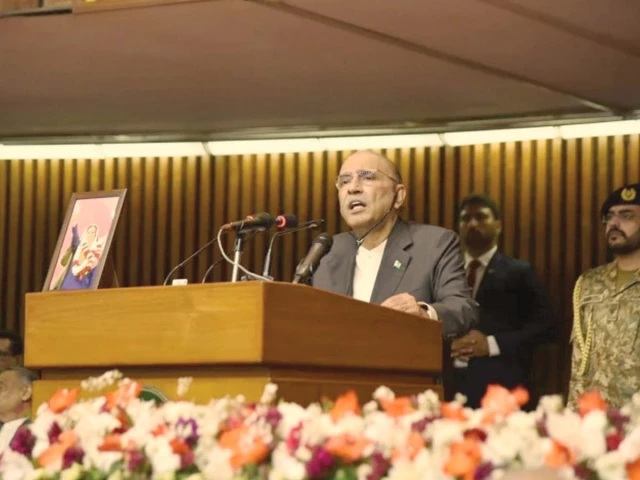
President Asif Ali Zardari on Monday used his ninth address to the joint sitting of parliament to deliver a sweeping message on war and peace, sovereignty and restraint, declaring that while Pakistan seeks dialogue, any aggressor "should prepare for another humiliating defeat".
The president gave a stark warning to those harbouring ill-will against the country and trying to destabilise it, saying that Pakistan would not permit its territory - or neighbouring soil - to be used to destabilise its peace.
The joint session, chaired by National Assembly Speaker Sardar Ayaz Sadiq, was attended by Prime Minister Shehbaz Sharif, members of both houses, including Senate Chairman Syed Yousuf Raza Gilani.
Opening his address, the president described it as a "unique honour" to speak for the ninth time as a twice-elected head of state, calling each speech "a reaffirmation of democratic continuity and responsibility".
He said, "The test of nations is not only in crises but also at critical turning points," adding that the strength of the republic lies in the Constitution, public resolve, parliamentary and governmental accountability, and the morale of the armed forces.
The president said that Pakistan remained deeply concerned at recent grave developments. "We urge the need to exercise maximum restraint, to uphold international law, and to respect the territorial integrity of all brotherly nations," he said, stressing that negotiated solutions were essential to save the region from a deepening crisis.
He strongly condemned the war being waged against Iran, while negotiations were under way, reaffirming Pakistan's support for its sovereignty and territorial integrity. "I join all Pakistanis in condoling the martyrdom of Iran's supreme leader Ayotollah Ali Khamenai," he said.
He also condemned subsequent attacks on the UAE, Bahrain, Jordan, Kuwait, Qatar and Saudi Arabia, observing, "The sooner stability returns to the region, the sooner the world can go back to the business of rebuilding lives and fractured trust."
Turning to India, the president declared that "nobody in South Asia would be free and safe until Kashmiris win their freedom from Indian occupation". Referring to Maarka-e-Haq, he said 2025 marked a turning point defined by a "resounding military victory" that repelled external aggression and shattered the myth of regional conventional superiority.
"By the Grace of Allah, this was not just a military victory; it was an expression of our national resolve in crisis," he said. "United as one proud nation, we bravely repulsed India's aggression and emerged victorious, both militarily and diplomatically. Our decisive and principled response was acknowledged by world capitals, beyond a shadow of any doubt."
Responding to statements by Indian leaders about preparing for another war, he said, "As a lifelong advocate for regional peace, I would not recommend it. At the same time, I would also say that any aggressor should prepare for another humiliating defeat. Make no mistake. We are ready for you." He urged India to "move away from war theatres to meaningful negotiating tables because that is the only path for the regional security."
President Zardari termed India's move to place the Indus Waters Treaty in abeyance as "plain and simple hydro-terrorism, a weaponisation of vital water flows, to exert political leverage". He said this blatant disregard for international and humanitarian law jeopardised Pakistan's agricultural economy and signalled a dangerous escalation.
"Water security has emerged as a strategic concern. India's attempts to manipulate river flows and engage in what amounts to water aggression, requires careful, long-term policy planning," he said, adding, "Rivers symbolise life and the international law does not permit the unilateral blockage of water." He warned that violation of one treaty could imperil others and vowed, "We will defend our water rights with unity, resolve, strength and legal clarity."
Addressing developments on the western border, the president said that despite multiple diplomatic engagements by Pakistan and friendly countries, the Afghan de facto regime continued to provide safe sanctuaries to terrorist groups including Al-Qaeda, BLA and TTP. "All promises they made in Doha, not to allow these terror groups to operate from Afghan soil, have been conveniently forgotten," he said.
"For us war is always the last option. No state accepts serial attacks on its soil," he remarked, adding that Pakistan had tried every possible form of diplomacy to prevent military responses to terrorist incursions. "We have let both India and Afghanistan see a fraction of our capabilities."
He emphasised, "Let me be clear: the soil of Pakistan is sacred. We will not allow any entity – domestic or foreign – to use neighbouring territory to destabilise our peace." Citing Article 51 of the UN Charter, he said Pakistan had the right to defend its sovereignty and that the entire nation stood united with its armed forces against cross-border terrorism.
The president also referred to a recent UN Security Council monitoring team report describing the presence of terrorist groups in Afghanistan as an extra-regional threat, warning that any country could fall victim to another catastrophic attack if the issue were ignored.
On foreign relations, Zardari said Pakistan's ties with China had ascended to new heights in all areas and that CPEC 2.0 would revolutionise infrastructure. He expressed gratitude for China's solidarity during Maarka-e-Haq and for advancing shared objectives of security and connectivity.
He appreciated efforts by countries that sought to de-escalate the Pakistan-India conflict, particularly those that brokered a ceasefire between two nuclear neighbours. He said Pakistan and the United States had opened new avenues for strategic cooperation, investment and economic partnership, with the coming year expected to be more productive.
Highlighting deepened ties with Gulf countries, Azerbaijan and Turkiye, he described the Pakistan-Saudi Strategic Mutual Defence Agreement as a new milestone. He reiterated Pakistan's unchanged stance on Palestine, supporting an independent and undivided state with borders as before 1967 and with Al-Quds Al Sharif as its capital.
Congratulating the people of Bangladesh on forming a new government, he said bilateral relations were poised to become steadier and stronger and reaffirmed Pakistan's commitment to peace, security and stability in the region and beyond.
Domestically, President Zardari underscored his constitutional mandate to safeguard the unity of the federation and parliament. He said provincial autonomy had strengthened participatory governance and that a strong federation required coordination, not centralisation. Constitutional forums such as the Council of Common Interests (CCI) must function effectively, he added.
Issues relating to natural resources, fiscal distribution, energy coordination and water management, he said, must be resolved through consultation, expressing hope for a just and equitable National Finance Commission (NFC) Award in the coming year.
On Balochistan, he said the government's strategy was a "hearts-and-minds campaign", ensuring dividends of mineral wealth and the blue economy reached local populations first. While dismantling insurgencies fuelled by foreign proxies, he said, the state was equally focused on addressing genuine social and economic grievances. "The people of Balochistan are and must remain full partners in Pakistan's progress," he stressed.
Reviewing the economy, the president commended the government for steering it away from a virtual collapse. "Through steady stewardship, we have seen stability return in key indicators. But this is a first step on a journey to sustained, people-centric growth," he said. "Our salaried classes, pensioners, labourers and small traders have endured a long night of hardship. The next phase must therefore focus on inclusive growth, jobs, and direct relief."
He urged structural reforms, transparency in taxation and public expenditure, and broadening of the tax base. "We cannot afford technological isolation," he said, noting that policy frameworks had been reset for emerging sectors and digital assets.
Identifying high energy costs as a major constraint, he called energy reform a prerequisite for industrial revival. "At a time when the world is moving towards clean energy, Pakistan cannot afford to lag," he said.
He called for expanding the Benazir Income Support Programme (BISP) to empower those at the bottom of the social pyramid. Concluding, Zardari urged unity at a time of trial. "Let us preserve the unity displayed in moments of trial. Let us institutionalise reform. Let us ensure that macro-economic gains translate into household relief. Let us safeguard our borders while creating opportunities within.
During the session, provincial governors and chief ministers, diplomats, and First Lady Aseefa Bhutto Zardari were present in the gallery. Extraordinary security arrangements were in place inside and outside Parliament House. The opposition staged a protest, chanting "Go Zardari Go".
(WITH NPUT FROM APP)




This material may not be published, broadcast, rewritten, redistributed or derived from. Unless otherwise stated, all content is copyrighted © 2026 The Express Tribune.



COMMENTS
Comments are moderated and generally will be posted if they are on-topic and not abusive.
For more information, please see our Comments FAQ