Ella Langley's rise meets online scrutiny
Updated 44 minutes ago

'Anfas-ul-Jamal Fun' showcases diverse range of artworks reflecting Islamic civilization, aesthetic excellence
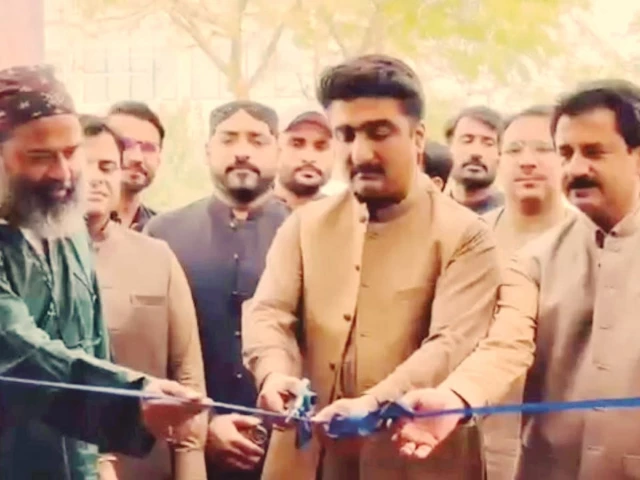
An Islamic art exhibition titled "Anfas-ul-Jamal Fun" has opened in Karachi, bringing together artists and art enthusiasts to celebrate the spiritual and aesthetic traditions of Islamic civilisation.
The exhibition, organised by the Culture Department of Sindh, was inaugurated at Sambara Art Gallery by Sindh's Minister for Culture, Tourism and Antiquities, Syed Zulfiqar Ali Shah.
Senior officials including Director General Culture Habibullah Memon and Director General Libraries Hidayatullah Rajar were also present at the opening ceremony.
The exhibition showcases a diverse range of artworks reflecting Islamic civilisation, spirituality and aesthetic heritage. Participating artists have presented calligraphy, paintings and mixed-media works that explore themes of faith, tradition and cultural identity.
Speaking at the event, Mr Shah described Islamic art as "an essential part of our civilisational identity."
"Young generations must be connected with Islamic arts. It is the need of the time," he said, adding that calligraphy and Islamic art represent a "beautiful blend of spirituality and visual elegance."
He said such exhibitions play a vital role in promoting social harmony and cultural awareness. "The Sindh government will continue to fully encourage young people and provide them with opportunities to present their talent to the world," he added.
Mr Shah also acknowledged the support of Bilawal Bhutto Zardari, saying he had consistently encouraged youth development initiatives.
The exhibition is expected to run for several days, offering visitors an opportunity to engage with the artistic expressions rooted in Islamic heritage while fostering dialogue between tradition and contemporary creativity.
The early developments of Islamic art were influenced by Roman art, Early Christian art (particularly Byzantine art), and Sassanian art, with later influences from Central Asian nomadic traditions. Chinese art had a significant influence on Islamic painting, pottery, and textiles. From its beginnings, Islamic art has been based on the written version of the Quran and other seminal religious works, which is reflected by the important role of calligraphy, representing the word as the medium of divine revelation.
Religious Islamic art has been typically characterized by the absence of figures and extensive use of calligraphic, geometric and abstract floral patterns. Nevertheless, representations of human and animal forms historically flourished in nearly all Islamic cultures, although, partly because of opposing religious sentiments, living beings in paintings were often stylized, giving rise to a variety of decorative figural designs.
Both religious and secular art objects often exhibit the same references, styles and forms. These include calligraphy, architecture, textiles and furnishings, such as carpets and woodwork. Secular arts and crafts include the production of textiles, such as clothing, carpets or tents, as well as household objects, made from metal, wood or other materials. Further, figurative miniature paintings have a rich tradition, especially in Persian, Mughal and Ottoman painting. These pictures were often meant to illustrate well-known historical or poetic stories. Some interpretations of Islam, however, include a ban of depiction of animate beings, also known as aniconism. Islamic aniconism stems in part from the prohibition of idolatry and in part from the belief that creation of living forms is God's prerogative.
Calligraphic design is omnipresent in Islamic art, where, as in Europe in the Middle Ages, religious exhortations, including Qur'anic verses, may be included in secular objects, especially coins, tiles and metalwork, and most painted miniatures include some script, as do many buildings. Use of Islamic calligraphy in architecture extended significantly outside of Islamic territories; one notable example is the use of Chinese calligraphy of Arabic verses from the Qur'an in the Great Mosque of Xi'an. Other inscriptions include verses of poetry, and inscriptions recording ownership or donation. Two of the main scripts involved are the symbolic kufic and naskh scripts, which can be found adorning and enhancing the visual appeal of the walls and domes of buildings, the sides of minbars, and metalwork. Islamic calligraphy in the form of painting or sculptures is sometimes referred to as Quranic art.






This material may not be published, broadcast, rewritten, redistributed or derived from. Unless otherwise stated, all content is copyrighted © 2026 The Express Tribune.
COMMENTS
Comments are moderated and generally will be posted if they are on-topic and not abusive.
For more information, please see our Comments FAQ