Fire in Delhi hotel kills at least 21, police say
Updated 1 hour ago

'Everyone will be on standby to fly to Pakistan if necessary,' says White House spokesperson
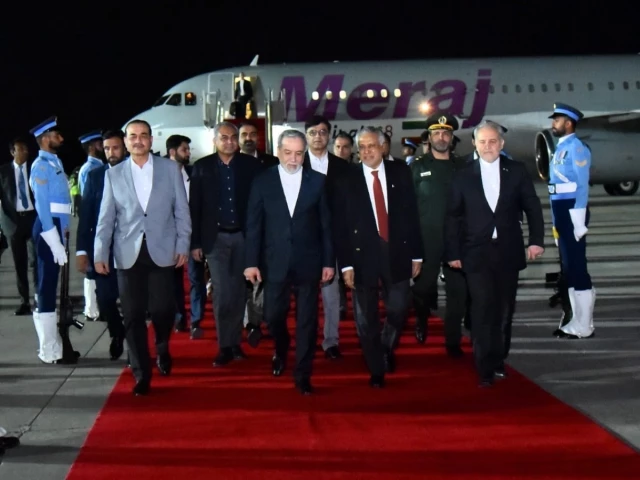
Iranian Foreign Minister Abbas Araghchi arrived in Islamabad on Friday night as the White House said that United States special envoy Steve Witkoff and adviser Jared Kushner would travel to Pakistan on Saturday for talks.
Foreign Office (FO) Spokesperson Tahir Andrabi said he was received by Deputy PM and FM Ishaq Dar and Chief of Defence Forces and Chief of the Army Staff Field Marshal Asim Munir, along with other senior officials upon arrival.
"During the visit, the Iranian foreign minister will hold meetings with Pakistan’s senior leadership to discuss the latest regional developments as well as ongoing efforts for regional peace and stability."
#BREAKING
— Pakistan TV (@PakTVGlobal) April 24, 2026
Iranian Foreign Minister Abbas Araghchi arrives in Pakistan and is warmly received by Chief of Defence Forces, Field Marshal Syed Asim Munir, Deputy Prime Minister and Foreign Minister, Ishaq Dar, and Interior Minister, Mohsin Naqvi. During his visit, the Iranian FM… pic.twitter.com/Yvf5J5JI73
The Iranian delegation headed by the Foreign Minister of Islamic Republic of Iran H.E. Abbas Araghchi has arrived in Islamabad today. ⁰ ⁰The Iranian Foreign Minister was received by Deputy Prime Minister/Foreign Minister Senator Mohammad Ishaq Dar, Chief of Army Staff and Chief…
— Tahir Andrabi (@TahirAndrabi) April 24, 2026
Araghchi said earlier on X that he was embarking on a "timely tour" of Islamabad, Muscat and Moscow.
"Purpose of my visits is to closely coordinate with our partners on bilateral matters and consult on regional developments. Our neighbours are our priority."
Embarking on timely tour of Islamabad, Muscat, and Moscow.
— Seyed Abbas Araghchi (@araghchi) April 24, 2026
Purpose of my visits is to closely coordinate with our partners on bilateral matters and consult on regional developments.
Our neighbors are our priority.
Two Pakistani government sources earlier told Reuters that Araghchi's visit could signal the resumption of peace talks with the US.
Araghchi "will tell us what instructions he has when he arrives. All this is speculative", one of the sources said. The two sources said Araghchi would hold bilateral talks during his brief visit and discuss his side of the proposal for talks with the US over the Iran war, which would then be conveyed to Washington.
Iranian state media outlet IRNA said the purpose of this trip was bilateral consultations, discussions and dialogue regarding the ongoing developments in the region, as well as the latest status of the imposed war by the United States and the Israeli regime against Iran."
وزیر امور خارجه ایران از شامگاه جمعه ۴ اردیبهشت، سفر دورهای را به اسلام آباد، مسقط و مسکو آغاز خواهد کرد.
— خبرگزاری ایرنا (@IRNA_1313) April 24, 2026
هدف از این سفر رایزنیهای دوجانبه، بحث و گفتوگو درباره تحولات جاری در منطقه و همچنین آخرین وضعیت جنگ تحمیلی ایالات متحده و رژیم اسرائیل علیه ایران است. https://t.co/52ss3QbGZj
However, Iranian analyst Mohammad Marandi, a professor at the University of Tehran, said FM Araghchi "will not hold any negotiations with the Trump regime in Islamabad and will merely convey Iran’s considerations and views regarding the end of the war to the Pakistani side".
He claimed he was "informed that no negotiations with any Americans are planned during this visit".
The Iranian foreign minister will not hold any negotiations with the Trump regime in Islamabad and will merely convey Iran’s considerations and views regarding the end of the war to the Pakistani side. This meeting is a response to General Asim Munir’s trip to Tehran, and I have…
— Seyed Mohammad Marandi (@s_m_marandi) April 24, 2026
Meanwhile, White House Press Secretary Karoline Leavitt said in an interview with Fox News: “I can confirm special envoy Steve Witkoff and Jared Kushner will be off to Pakistan again tomorrow morning to engage in direct talks, intermediated by the Pakistanis, who have been incredible mediators throughout this entire process, with representatives from the Iranian delegation."
She said Iran had requested the meeting after President Donald Trump urged Tehran to engage, adding: “We're hopeful that it will be a productive conversation and hopefully move the ball forward towards a deal.”
Leavitt said that Vice President JD Vance would stay in the US although he “remains deeply involved in this entire process”.
“He'll be standing by here in the United States, along with the president and the Secretary of State Marco Rubio and the entire national security team for updates. And of course, everyone will be on standby to fly to Pakistan if necessary, but first, Steve and Jared will be going over there to report back to the president, the vice president, and the rest of the team,” she added.
Leavitt said without elaborating that the US had seen some progress from the Iranian side in recent days and hopes more would be made in weekend talks. "We hope progress will be made and we hope that positive developments will come from this meeting," she told reporters.
BREAKING: Karoline Leavitt confirms Jared Kushner and Steve Witkoff will head back to Pakistan tomorrow for peace talks with Iran.@AmericaRpts @johnrobertsFox pic.twitter.com/npLePI513c
— Fox News (@FoxNews) April 24, 2026
Trump told Reuters that Iran planned to make an offer aimed at satisfying US demands.
"They're making an offer and we'll have to see," Trump said.
The last round of peace talks was expected on Tuesday but never took place, with Iran saying it was not yet ready to commit to attending and a US delegation led by Vance never left Washington.
Earlier, FM Dar discussed regional developments, the ceasefire and ongoing diplomatic efforts by Pakistan in the context of the US-Israeli war on Iran in a telephone call with Araghchi.
According to a statement by the FO, FM Dar underscored the importance of sustained dialogue and engagement to address outstanding issues to advance regional peace and stability at the earliest. FM Araghchi appreciated Pakistan’s consistent and constructive facilitation role in this regard.
DPM/FM Senator Mohammad Ishaq Dar @MIshaqDar50 received a call today from Foreign Minister of Iran H.E. Abbas Araghchi @Araghchi.
— Ministry of Foreign Affairs - Pakistan (@ForeignOfficePk) April 24, 2026
Both sides exchanged views on regional developments, the ceasefire, and ongoing diplomatic efforts being pursued by Islamabad in the context of… pic.twitter.com/eJ1fuVTVKE
Iran rejects Israel's 'baseless accusations' over Lebanon role
According to Press TV, Iran rejected Israel's "baseless accusations" about the Islamic Republic's role in Lebanon. It said Israel uses such accusations as a pretext to justify its persistent violations of Lebanon's sovereignty and territorial integrity.
The Iranian defence ministry said that Iran will continue producing military equipment and that it is prepared to meet the armed forces’ needs in all scenarios, including war and peacetime conditions, according to Press TV.
A senior Islamic Revolution Guards Corps (IRGC) commander said on Thursday night that Trump has suffered a strategic failure, adding that Washington's military apparatus can not defeat the Iranian nation, as per Press TV.
IRGC’s political deputy Brigadier General Yadollah Javani addressed thousands of people who took to the streets in Arak to voice support for the Islamic Republic against the US-Israeli aggression, which began on February 28.
According to Press TV, Javani noted that the United States, the Zionist regime, and their allies wrongly believed a direct, full-scale assault would overwhelm Tehran in less than 48 hours.
"Today, Trump wants to force the great Iranian nation to surrender, while God has blocked the path of the infidels' and falsehood's domination over the believers, and Trump does not understand it," Javani said, adding, “Trump will never defeat the Iranian nation.”
Iran has also said that they "reject" the Arab League's accusations that it is sowing insecurity in the region, emphasising that Iran's defensive measures against US military bases and some Persian Gulf littoral states fall within Tehran's inherent right to self-defence under the UN Charter, as per Press TV.
Iran rejects the Arab League's false accusations that it is sowing insecurity in the region, emphasizing that Iran's defensive measures against US military bases and some Persian Gulf littoral states fall within Tehran's inherent right to self‑defense under the UN Charter. pic.twitter.com/P5dYVWdeHi
— Press TV 🔻 (@PressTV) April 24, 2026
Meanwhile, Commander in Chief of the Iranian Army Major General Hatami stated on X that "through the strong unity of the nation, the armed forces, and the three branches of the government, we will make the criminal aggressor regret its actions."
همه ما ایرانی و مسلمان انقلابی هستیم و با اتحاد آهنین ملت، نیروهای مسلح و قوای سهگانه و تبعیت از رهبر معظم انقلاب اسلامی و فرمانده کل قوا، متجاوز جنایتکار را پشیمان خواهیم کرد...
— سرلشکر امیر حاتمی (@hatami_org) April 24, 2026
یک خدا، یک رهبر، یک ملت، یک راه و آن هم راه پیروزی ایران عزیزتر از جان.#پیروزی_از_مسیر_مقاومت
Trump says US will not use nuclear weapons in war on Iran
Trump said on Thursday that he would not use a nuclear weapon in the war against Iran. "Why would I use a nuclear weapon? We've totally, in a very conventional way, decimated them without it," Trump told reporters at the White House when asked whether he would use such a weapon.
REPORTER: Would you use a nuclear weapon against Iran?
— Department of State (@StateDept) April 23, 2026
PRESIDENT TRUMP: No. Why would a stupid question like that be asked?
Why would l use a nuclear weapon when we’ve totally decimated Iran without it? A nuclear weapon should never be allowed to be used by anybody. pic.twitter.com/7hAlHLrNT4
"No, I wouldn't use it. A nuclear weapon should never be allowed to be used by anybody," he said. "There's nothing worse than a nuclear weapon that takes out cities, destroys the Middle East, or creates a nuclear holocaust in Europe," he added.
PRESIDENT TRUMP: There’s nothing worse than a nuclear weapon that takes out cities, destroys the Middle East; or creates a nuclear holocaust in Europe. The missiles will reach us at some point unless we stop them now. pic.twitter.com/1nidafdi9T
— Department of State (@StateDept) April 23, 2026
Asked how long he was willing to wait for a long-term peace deal with Iran, Trump said, "Don't rush me." He said Iran might have loaded up their weaponry "a little bit" during the two-week ceasefire, but added that the US military could knock that out in about one day.
"Their navy is gone. Their air force is gone, their anti-aircraft is gone ...maybe they loaded up a little bit during the two-week hiatus, but we'll knock that out about one day, if they did," he said.
PRESIDENT TRUMP: In four weeks we have totally defeated Iran’s military.
— Department of State (@StateDept) April 23, 2026
I want to get a great deal where our nation and the world is safe from lunatics with nuclear weapons. pic.twitter.com/lmI1NAkbvA
"I want to make the best deal. I could make a deal right now ... but I don't want to do that. I want to have it everlasting," Trump added. "I want a great deal where our nation and the world is safe from lunatics with nuclear weapons."
Russia among ‘friendly’ countries granted Hormuz transit fee exemption by Iran
Al Jazeera reported that Iran granted “friendly” countries, including Russia, a fee exemption to transit the Strait of Hormuz, according to the Russian state news agency RIA Novosti.
“We have provided exceptions for some countries. I don’t know what will happen in the future,” Iranian Ambassador to Moscow, Kazem Jalali, told the news outlet. “At the moment, our Foreign Ministry is trying to use the exceptions provided for friendly countries, for example Russia,” Jalali said.
Tehran has floated plans to levy tariffs on shipping in the strait amid the US-Israel war on Iran.
Iran fast-boat swarms add to Hormuz threats for shipping
Iran's use of a swarm of small, fast boats to seize two container ships near the Strait of Hormuz undermines suggestions that US forces have disabled its naval capabilities.
Trump on Monday acknowledged that while Iran’s conventional navy had been largely destroyed, its "fast-attack ships" had not been considered much of a threat.
He said any such vessels coming near a US blockade set up outside the strait would be "immediately ELIMINATED" using the "same system of kill" deployed in the Caribbean and Pacific, where US air strikes have hit suspected drug boats and killed at least 110 people.
Those boats were not attacking large, unarmed commercial ships, however, nor nearly as heavily armed, with Iran's Revolutionary Guards sporting heavy machine guns, rocket launchers and, in some cases, anti-ship missiles.
Read: Edge of a deal or slide to conflict?
Speedboat attacks now form part of a "layered system of threats," alongside "shore-based missiles, drones, mines and electronic interference to create uncertainty and slow decision-making," Greek maritime security company Diaplous told Reuters.
Iran was estimated to have hundreds, if not thousands, of these boats before the war, often hidden in coastal tunnels, naval bases or among civilian vessels, according to maritime security specialists.
Some 100 or more may have been destroyed since the US-Israeli war on Iran began on February 28, said Corey Ranslem, chief executive of maritime security group Dryad Global.
Israel and Lebanon on Thursday agreed to extend their ceasefire by three weeks after a high-level meeting between representatives of both countries in the White House Oval Office, Trump announced on social media.
"I look forward in the near future to hosting the Prime Minister of Israel, Bibi Netanyahu, and the President of Lebanon, Joseph Aoun. It was a Great Honor to be a participant at this very Historic Meeting!" Trump said.
Change in tactics
Before this week, Iran had relied on missile and drone strikes to hit shipping traffic around the strait, a route which normally handles 20% of the world's daily oil and liquefied natural gas supply.
Those attacks had stopped with the April 8 ceasefire.
The seizure of the two container ships by Iran followed Washington's imposition of a blockade on Iran's trade by sea and the start of it intercepting Iran-linked oil tankers and other ships.
"The civilian shipping industry is not equipped to prevent Iranian armed forces from seizing vessels," said Daniel Mueller, a senior analyst at British maritime security company Ambrey.
Typically, about a dozen boats are used in a seizure operation, he added.
Iran's fast boats now serve as the "backbone" of Iran’s naval strategy, able to deploy rapidly as part of its "asymmetrical war against the enemy," a senior Iranian security official told Reuters.
"Because of their very high speeds, these boats can successfully carry out hit-and-run attacks without being detected," the official said, speaking on condition of anonymity.
Fast boat limitations
Including this week’s seizures, Iran has used small, fast boats at least seven times going back to 2019, Ambrey's Mueller said.
High winds and swells in the waters off Iran during summer make it hard to conduct such operations, said one Iranian shipping source familiar with the waters.
"When it is very bumpy, they (armed forces onboard) cannot shoot," the source said.
They are also ill-equipped to go head-to-head with a warship, and would likely suffer "very heavy casualties" in any direct assault on one, said Jeremy Binnie, a Middle East specialist at defence intelligence company Janes.
"Even if they tried to saturate the ship’s defences by attacking from multiple directions, they would be extremely vulnerable to the air support that would be called in," he said.
On paper, guided missile strikes would easily destroy these boats, but shoulder-fired missile launchers would pose a threat to low-flying US aircraft, Binnie said.
"It is going to be much harder to eliminate the small boat threat than it was to destroy Iran’s larger naval vessels, which were big targets that were relatively easy to find and track and, at most, only had a limited ability to defend themselves from air attack," he said.
The reality for the shipping sector is further disruption as well as elevated insurance costs.
After the so-called "tanker war" of the 1980s, Iran increasingly used asymmetric tactics as the Iranian navy was effectively destroyed, much as it has been in the current conflict, said Duncan Potts, a director with consultancy Universal Defence and Security Solutions and a former British Royal Navy vice admiral.
"When the US Navy and the president say, 'We've destroyed the navy, we've sunk a frigate off Sri Lanka' – you've done that before, but you've forgotten that your opposition here went asymmetric. And they've perfected it."










This material may not be published, broadcast, rewritten, redistributed or derived from. Unless otherwise stated, all content is copyrighted © 2026 The Express Tribune.






COMMENTS (3)
Comments are moderated and generally will be posted if they are on-topic and not abusive.
For more information, please see our Comments FAQ