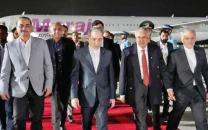
President Asif Zardari to embark on week-long visit to China for talks on trade, CPEC
Updated 3 hours ago

Larger bench rules July 21 order was issued by a bench not legally constituted under approved roster

The Islamabad High Court (IHC) on Monday withdrew contempt of court notices issued to Prime Minister Shehbaz Sharif and the federal cabinet in the Dr Aafia Siddiqui case, ruling that a July 21 order was passed by a bench that was not legally constituted under the approved judicial roster.
A four-member larger bench headed by Justice Arbab Muhammad Tahir issued a written judgment, holding that the IHC chief justice was the “master of the roster” and exclusively empowered to constitute benches.
The judges said that only a bench formed with the approval of the chief justice had the authority to hear cases. They added that any objection relating to the roster or constitution of a bench could be resolved through administrative procedures.
"A bench that does not appear on the roster approved by the chief justice, therefore, suffers from a fundamental legal defect," reads the short order.
Citing Article 202 of the Constitution and relevant high court rules, the judgment observed that no judge or bench could assign a case to itself, initiate proceedings, retain, transfer or assume jurisdiction independently.
The authority to consolidate similar petitions, transfer cases at any stage, and ensure judicial harmony rested solely with the chief justice. The chief justice was not bound to seek consent from a bench before transferring a case.
The larger bench ruled that the July 21 contempt order in the Aafia Siddiqui case had been issued by a bench that did not legally exist under the approved roster. Consequently, the contempt notices issued to the prime minister and the federal cabinet were withdrawn.
Justice Sardar Ijaz Ishaq Khan had issued the contempt notices on July 21, 2025. According to the judgment, the case was heard despite not being included in the cause list, and the judge’s name was not part of the judges’ duty roster at the time of the hearing.
The IHC had previously asked the prime minister and the cabinet to clarify why they had not supported legal efforts on Dr Aafia’s behalf in the United States.
Read: IHC issues contempt notices to Shehbaz, cabinet in Dr Aafia case
The federal government argued that the proposed amendments would exceed judicial authority and violate the finality of decided cases. It added that reopening a matter long concluded would contravene established legal principles.
Officials emphasised that the case was closely linked to foreign policy and international law. The amended petition had requested that the government be constitutionally obliged to take steps for Dr Aafia’s release and repatriation.
According to the government, in October 2024, the prime minister sent a letter to the US president in support of clemency for Dr Aafia. A high-level delegation was also sent to the US to explore prisoner transfer agreements. However, US authorities did not agree to any such arrangements, the federal government stated.
Who is Dr Aafia?
Dr Aafia, a Pakistani neuroscientist currently incarcerated in the US, was sentenced to 86 years in prison on charges of attempted murder — a sentence significantly exceeding the US legal maximum of 10 years for the crime.
She has served 16 years behind bars and has been separated from her children for more than two decades.
Aafia, born in 1972 in Karachi, Pakistan, was an accomplished neuroscientist who earned a PhD from Brandeis University in 2001.
Also Read: Aafia Siddiqui’s US lawyer to arrive in Pakistan
Her case began in 2003 after the capture of Khalid Sheikh Mohammed (KSM), Al-Qaeda’s 9/11 mastermind. Aafia, reportedly married to KSM’s nephew, disappeared with her children in Karachi, later earning the title “Lady Al-Qaeda” due to alleged links with Al-Qaeda.
Aafia was reportedly intercepted in Karachi in March 2003 while travelling with her three children and subsequently disappeared for five years. In 2008, it was revealed that she had been imprisoned in Afghanistan before being transferred to the US.
Reports said she was carrying sodium cyanide and documents outlining plans for attacks on US targets. During interrogation, she reportedly wrestled a US soldier’s rifle and attempted to shoot US personnel while shouting, “Death to America.” She was wounded in the struggle and later showed signs of severe mistreatment.
Two of her children, Ahmed and Maryam, were released in 2008 and 2010 respectively, the whereabouts of her son Sulaiman remain unknown.


















This material may not be published, broadcast, rewritten, redistributed or derived from. Unless otherwise stated, all content is copyrighted © 2026 The Express Tribune.



COMMENTS (1)
Comments are moderated and generally will be posted if they are on-topic and not abusive.
For more information, please see our Comments FAQ