Gunmen kill three picnickers in Khuzdar
Updated 1 hour ago

Buyback rate for solar net generation likely to be reduced to Rs11 per unit; contract period reduced from 7 to 5 years
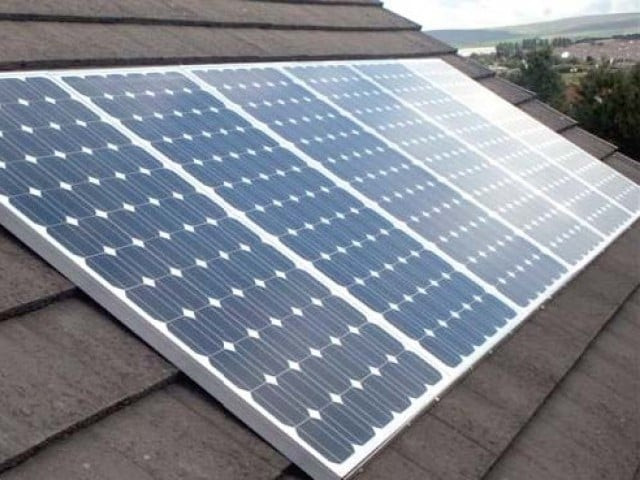
The government may face political backlash as solar net metering is almost dead in Pakistan after the National Electric Power Regulatory Authority (NEPRA) abolished exchange of electricity units in solar net metering on Monday in a blow to consumers desiring to shift to renewables.
At present, the buyback rate for solar net generation is Rs25.9 per unit which may be reduced to Rs11 per unit. The contract period has been reduced from seven to five years. The burden of IPPs capacity payments is being shifted to solar consumers now.
Discos will charge their rate for electricity which may be up to Rs50 per unit and will receive electricity from consumers at day at possible rate of Rs11 per unit.
The new buyback has not been notified but it was discussed at Rs11 per unit during discussions with stakeholders. The solar net consumers will have to pay net difference to Discos after exchange of unit regime comes to an end.
The policy will not apply to existing consumers. However, Discos have been authorised either to terminate or shift consumers to new policy after expiry of contract.
Pakistan’s power regulator has overhauled the country’s net metering regime, shifting rooftop solar and other small generators to a new “net billing” system under the NEPRA (Prosumer) Regulations, 2026, a move that fundamentally changes how electricity producers are paid and repeals the decade-old net metering framework.
Under the new rules, notified today by NEPRA, utilities will be required to purchase excess electricity from prosumers, households, businesses and industries generating up to 1 megawatt at the national average energy purchase price, while selling electricity back to them at the applicable consumer tariff, effectively ending one-to-one net metering.
The regulations apply to solar, wind and biogas systems and take effect immediately, replacing the NEPRA Alternative & Renewable Energy Distributed Generation and Net Metering Regulations, 2015. Existing prosumers will continue under their current agreements until expiry, but all future renewals will fall under the new billing structure.
NEPRA has capped the maximum size of a distributed generation facility at 1MW, and limited system capacity to the sanctioned load of the consumer, with a key technical restriction that no new connections will be allowed if generation on a transformer reaches 80% of its rated capacity. Systems of 250kW or above must undergo a mandatory load flow study.
Utilities are required to process applications within strict timelines, acknowledging requests within five working days, completing technical reviews within 15 days, and installing interconnection facilities within 15 days after payment. Prosumers must also obtain formal concurrence from NEPRA, which the regulator says will be issued within seven working days.
Financially, all interconnection costs, including meters and grid upgrades, will be borne by the prosumer, while NEPRA has introduced a non-refundable concurrence fee of Rs1,000 per kilowatt. Metering must support two-way measurement, either through a single bidirectional meter or dual meters.
The standard agreement term has been set at five years against seven years previously, renewable by mutual consent, while utilities retain the right to disconnect systems in case of faults, non-compliance, or for maintenance, with or without notice. Prosumers are barred from selling power to third parties using the utility’s network.
NEPRA has also granted itself broad powers to revise purchase rates during the life of agreements, issue binding directions, demand operational data, impose penalties, and relax or modify provisions where necessary.
The shift to net billing marks one of the most significant policy reversals in Pakistan’s renewable energy sector, redefining the economics of rooftop solar and signaling a tighter regulatory grip as the number of distributed generators continues to surge.















This material may not be published, broadcast, rewritten, redistributed or derived from. Unless otherwise stated, all content is copyrighted © 2026 The Express Tribune.






COMMENTS (3)
Comments are moderated and generally will be posted if they are on-topic and not abusive.
For more information, please see our Comments FAQ