UK police arrest seven over high-end shoplifting plot
Updated 49 minutes ago

Joins with EU, Japan on price floors for critical minerals; will develop coordinated mineral trade policy with Mexico
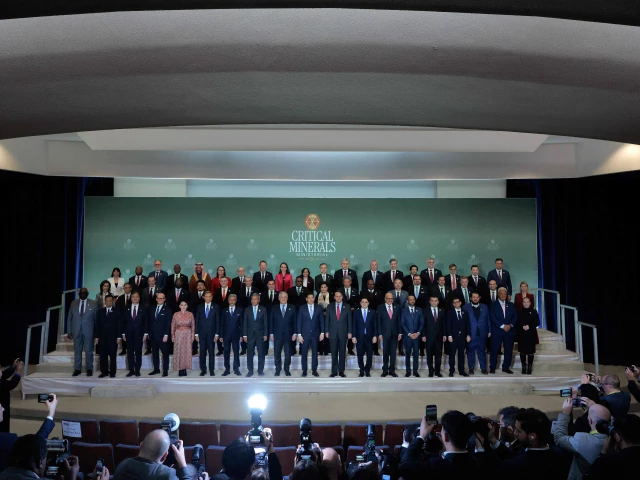
United States President Donald Trump's administration called on Wednesday for a preferential trade zone among allies on critical minerals crucial for advanced technology, in a rare turn to multilateralism in the face of China's dominance.
Representatives of 55 countries gathered at the State Department to launch what Vice President JD Vance called the Agreement on Trade in Critical Minerals, a far cry from the Trump administration's disdain for alliances and traditional diplomacy since returning to office a year ago.
China last year flexed its muscle in a trade war with Trump by tightening controls on critical minerals, including rare earths vital to products from smartphones to electric cars to fighter jets.
The supply of critical minerals is "heavily concentrated in the hands of one country", meaning it can become "a tool of leverage in geopolitics" or subject to disruptions such as pandemics, Secretary of State Marco Rubio said.
Vance said the US would help build a "trading bloc among allies and partners" that guarantees American access while "also expanding production across the entire zone".
Vance, who bills himself as a champion of the American working class, said the effort would create "good-paying jobs, skilled jobs, for the American labor force".
"But we seek to make sure our friends and our allies are part of this and that you all are covered as well," said Vance, a frequent critic of US involvement overseas.
The nascent trading bloc, which aims to cover two-thirds of the global economy, would regulate minimum prices for critical minerals, fearing that China could suddenly rattle markets by ramping up exports.
"Investment is nearly impossible, and it will stay that way, so long as prices are erratic and unpredictable," Vance said.
Coordination with top allies
Parallel to the larger effort, the US said it planned to close a deal with the European Union within 30 days on critical mineral supply chains and also announced a three-way partnership with the EU and Japan.
The three-way partnership will include coordination including price floors for critical minerals, the US Trade Representative's office said.
The US also announced an agreement with Mexico and has already reached deals on critical minerals with Japan, Australia, Saudi Arabia, South Korea and Thailand.
The two unveiled a 60-day plan to develop coordinated trade policies aimed at mitigating vulnerabilities in critical mineral supply chains, including possible price floors for certain mineral imports.
The plan, which includes no specific mention of China and its chokehold on processing of many such minerals, calls for the two nations to consult on including price floors in a binding plurilateral agreement on trade in critical minerals.
US Trade Representative Jamieson Greer said the US-Mexico plan underscored the countries' shared commitment to address global market distortions that have left North American supply chains vulnerable to disruptions.
"Correcting these vulnerabilities is imperative, as critical minerals are strategic assets integral to modern and innovative industrial economies, and diverse, resilient, and market-based supply chains are essential for our economic and national security," the plan said.
Interior Secretary Doug Burgum said another 11 countries would join today and that another 20 are interested in participating.
China mines about 60% of the world's rare earths and processes around 90%. In October, it offered the US a one-year reprieve on export curbs of the minerals in a deal with Trump.
Critical to global economy
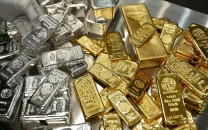
Critical minerals comprise dozens of materials such as cobalt, nickel, manganese, graphite and lithium — as well as "rare earths", a set of 17 metallic elements essential to many high-tech devices.
Japan, with its high-tech economy and turbulent history with China, is especially concerned. This week Japan said it found potential in the first deep-sea search for rare earths.
"As any supply chain disruption would bring a significant impact on the global economy, we should work together to address this challenge," senior Japanese official Iwao Horii told the meeting.
Horii said Japan was boosting its own efforts at home and that "the key is to diversify supply sources".
Trump has vowed to use US might to secure wealth only for itself, even flirting with invading Greenland, an autonomous territory of NATO ally Denmark, which did not attend Wednesday's meeting.
On Monday, Trump unveiled "Project Vault", a nearly $12 billion bid to stockpile critical minerals and effectively anything else needed by US industry.
Vance accused former president Joe Biden of failing to address critical minerals, although the Democratic administration launched in 2022 a Minerals Security Partnership focusing on collaborative funding.
The initiative covered two dozen countries, including key US allies, and eventually expanded to include more areas, including Greenland.








This material may not be published, broadcast, rewritten, redistributed or derived from. Unless otherwise stated, all content is copyrighted © 2026 The Express Tribune.





COMMENTS
Comments are moderated and generally will be posted if they are on-topic and not abusive.
For more information, please see our Comments FAQ