SC advances digital justice with nationwide online hearings
Updated 3 hours ago

Emphasises Pakistan’s support for Libya's peace, stability, institutional development
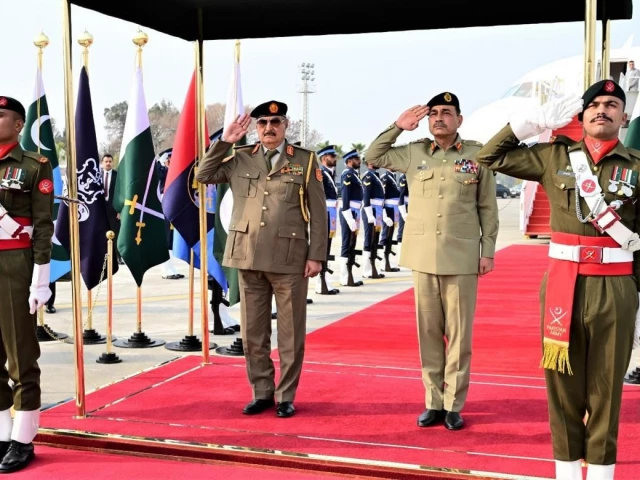
Chief of Defence Forces (CDF) and Chief of the Army Staff Field Marshal Asim Munir discussed regional security dynamics in a meeting with senior Libyan military officials on Monday, according to the military's media wing.
A press release from the Inter-Services Public Relations (ISPR) said CDF Munir met Libyan Arab Armed Forces Commander-in-Chief Field Marshal Khalifa Abu-al-Qasim Haftar and Deputy Commander-in-Chief Lieutenant General Saddam Khalifa Haftar at the General Headquarters today.
"Both sides exchanged views on matters of mutual interest, with particular focus on security dynamics in respective regions and professional cooperation. The discussion underscored the importance of continued engagement and collaboration between the Armed Forces of Pakistan and Libya," the statement said.
The ISPR said CDF Munir welcomed the two and reaffirmed the country's commitment to strengthening bilateral relations with Libya, emphasising Pakistan’s support for peace, stability, and institutional development in Libya.
"The meeting was held in a cordial and constructive atmosphere, reflecting the longstanding friendly relations between Pakistan and Libya," the ISPR said.
Field Marshal Khalifa Abu-al-Qasim Haftar, Commander-in-Chief of the Libyan Arab Armed Forces, along with Lieutenant General Saddam Khalifa Haftar, Deputy Commander-in-Chief of the Libyan Arab Armed Forces, called on Field Marshal Syed Asim Munir, NI (M), HJ, COAS & CDF, at… pic.twitter.com/aIPlV3ma6A
— PTV News (@PTVNewsOfficial) February 2, 2026
The Libyan deputy commander in chief later met Chief of the Air Staff Air Chief Marshal Zaheer Ahmed Baber Sidhu at the Air Headquarters, Islamabad.
"The meeting focused on matters of mutual interest, the regional security environment, and avenues for strengthening bilateral military cooperation. The air chief highlighted the strong religious and historical ties between Pakistan and Libya, Pakistan Air Force’s operational readiness, modernisation, multi-domain capability development, and emphasis on indigenisation, innovation, and human resource development. He reaffirmed PAF’s commitment to further enhance professional cooperation with the Libyan Air Force," the ISPR said.
It added that the Libyan delegation was briefed on PAF’s indigenisation initiatives under the National Aerospace Science & Technology Park.
The ISPR said the Libyan military official "highly appreciated" PAF’s professionalism and expressed keen interest in expanding cooperation through joint training, exercises, and professional exchanges.
"The visit underscores a renewed momentum in defence collaboration between the two brotherly nations," the ISPR concluded.
Pakistan and Libya enjoy strong diplomatic and military ties as they struck a multi-billion dollar conventional arms deal last month.
The deal, described as one of Pakistan’s largest-ever weapons sales, was finalised after a prior meeting between CDF Munir and the deputy commander in chief in Benghazi.
A copy of the deal seen by Reuters before its finalisation listed the purchase of 16 JF-17 Thunder fighter jets, jointly developed by Pakistan and China, and 12 Super Mushak trainer aircraft used for basic pilot training.
One Pakistani official confirmed the list was accurate, while another said all items mentioned were part of the deal, though exact numbers could not be independently verified. Officials cited by Reuters said the agreement covered equipment for land, sea and air forces and would be implemented over a period of around two-and-a-half years.
Libya has technically remained under a UN arms embargo since February 2011, imposed through United Nations Security Council Resolution (UNSCR) 1970 and later reinforced by subsequent resolutions, including UNSCR 1973. The embargo prohibits all states from supplying, selling or transferring arms and related materiel to Libya.
Despite this legal framework, arms flows into Libya have continued largely unabated over the past decade, fuelling proxy conflicts and deepening divisions between rival factions.
Sources had told The Express Tribune that Pakistani authorities did not expect the UN embargo to pose a practical obstacle to the reported defence cooperation with Libya, arguing that the embargo had long ceased to function as an effective enforcement mechanism.
According to the sources, the arms embargo existed more as a formal or “paper” restriction rather than a meaningful barrier on the ground. They pointed to persistent violations by multiple regional and international actors over the years, which had effectively hollowed out the embargo’s credibility.
The sources noted that Libya’s fragmented governance structure and deep political divisions within the UN Security Council had significantly undermined enforcement.










This material may not be published, broadcast, rewritten, redistributed or derived from. Unless otherwise stated, all content is copyrighted © 2026 The Express Tribune.






COMMENTS
Comments are moderated and generally will be posted if they are on-topic and not abusive.
For more information, please see our Comments FAQ