Hill Park row erupts as MQM-P accuses authorities of land grabbing; mayor denies claim
Updated 18 minutes ago

The officials, all involved in defence matters, declined to be identified due to sensitivity surrounding the agreement
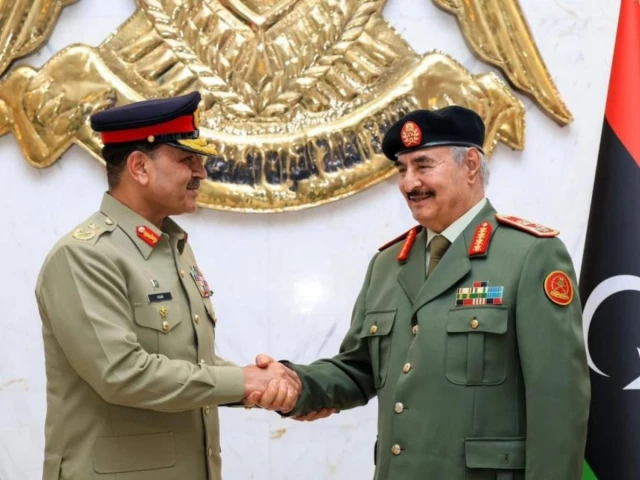
Pakistan has reached a major multi-billion dollar conventional arms export deal with Libya, four Pakistani officials told Reuters.
According to Reuters, the deal, described as one of Pakistan’s largest-ever weapons sales, was finalised after a meeting last week between Chief of Army Staff and Chief of Defence Forces Field Marshal Asim Munir and Lt Gen Saddam Khalifa Haftar, Deputy Commander-in-Chief of the Libyan Armed Forces in Benghazi.
The officials, all involved in defence matters, declined to be identified due to the sensitivity surrounding the agreement. Pakistan’s Foreign Office, defence ministry and military did not respond to requests for comment. A copy of the deal seen by Reuters before its finalisation listed the purchase of 16 JF-17 Thunder fighter jets, jointly developed by Pakistan and China, and 12 Super Mushak trainer aircraft used for basic pilot training.
One Pakistani official confirmed the list was accurate, while another said all items mentioned were part of the deal, though exact numbers could not be independently verified. Officials cited by Reuters said the agreement covers equipment for land, sea and air forces and would be implemented over a period of around two-and-a-half years.
The LNA’s official media channel also reported on Sunday that the faction had entered into a defence cooperation pact with Pakistan, including weapons sales, joint training and military manufacturing, without offering further details. Sources confirmed the agreement that would mark a major milestone for Pakistan’s defence exports and place it among a small group of countries capable of concluding multi-billion dollar conventional arm deals.
However, any such agreement with the LNA is expected to attract international scrutiny given Libya’s prolonged instability since the 2011 NATO-backed uprising that toppled Muammar Gaddafi and plunged the country into years of conflict between rival authorities in the east and west.
Libya has technically remained under a UN arms embargo since February 2011, imposed through United Nations Security Council Resolution (UNSCR) 1970 and later reinforced by subsequent resolutions, including UNSCR 1973. The embargo prohibits all states from supplying, selling or transferring arms and related materiel to Libya.
Despite this legal framework, arms flows into Libya have continued largely unabated over the past decade, fuelling proxy conflicts and deepening divisions between rival factions.
Sources told The Express Tribune that Pakistani authorities do not expect the UN embargo to pose a practical obstacle to the reported defence cooperation with Libya, arguing that the embargo has long ceased to function as an effective enforcement mechanism.
According to the sources, the arms embargo exists more as a formal or “paper” restriction rather than a meaningful barrier on the ground. They pointed to persistent violations by multiple regional and international actors over the years, which have effectively hollowed out the embargo’s credibility. The sources noted that Libya’s fragmented governance structure and deep political divisions within the UN Security Council have significantly undermined enforcement.
Monitoring mechanisms rely largely on voluntary compliance by member states and periodic reporting by the UN Panel of Experts, with limited capacity to interdict or penalise violators. Even the European Union’s naval mission, Operation Irini, launched in March 2020 to enforce the arms embargo, has had only marginal impact, the sources said, due to its limited mandate, selective inspections and lack of consensus among EU members on Libya.
Over the years, rival Libyan factions have received extensive military support from external powers. Turkey and Qatar have openly backed the Tripoli-based governments, including the former Government of National Accord (GNA) and its successor, the Government of National Unity (GNU), through the supply of drones, armoured vehicles, air defence systems, military advisors and allied fighters.
The Tripoli authorities have also enjoyed diplomatic recognition and varying degrees of political support from the United States, Britain and Italy. On the opposing side, the eastern-based House of Representatives and the LNA have been supported by the United Arab Emirates, Egypt and Russia, with reports of fighter aircraft, drones, artillery systems, armoured vehicles, intelligence sharing and private military contractors.
France has also faced repeated allegations of covert assistance to the LNA, though Paris has officially denied direct military involvement. Saudi Arabia, Jordan and Chad have likewise been cited in UN reports for providing varying forms of support to eastern Libyan forces.
Sources told The Express Tribune that these sustained and largely unchecked violations have created a permissive environment in which new defence arrangements are unlikely to trigger meaningful punitive action. They added that supplier states have routinely exploited loopholes in the embargo by routing weapons through third countries, classifying shipments as dual-use or civilian equipment, and relying on private military contractors and mercenaries to provide combat capabilities without formal state-to-state transfers.
Financial support, the sources said, has often been disguised as humanitarian or reconstruction assistance, while selective enforcement and weak intelligence sharing among UN members have further reduced the risk of accountability. Against this backdrop, sources believe that the reported defence deal reflects Islamabad’s growing confidence in its indigenous defence industry and its expanding military diplomacy, the sources added.
They argued that Pakistan has made steady progress in recent years in developing competitive defence products, ranging from fighter aircraft and trainer planes to armoured vehicles, naval platforms and precision-guided munitions. Recent military exercises and defence exhibitions, including the Mark-e-Haq series, have showcased these capabilities to foreign delegations.
The sources described the Libya agreement, if fully implemented, as historic in both scale and financial impact, potentially opening new markets for Pakistani defence exports in Africa and the Middle East.
They also credited the outcome to what they termed an export-driven strategic outlook and an emphasis on defence diplomacy, while acknowledging that the deal would continue to be closely watched by international observers amid Libya’s unresolved conflict and fragile political process.






This material may not be published, broadcast, rewritten, redistributed or derived from. Unless otherwise stated, all content is copyrighted © 2026 The Express Tribune.






COMMENTS (6)
Comments are moderated and generally will be posted if they are on-topic and not abusive.
For more information, please see our Comments FAQ