The ever-evolving Middle East conflict
Updated 8 hours ago

History repeats in the Middle East as US "gangsterism" pushes Iran toward an explosive conflict
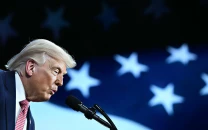
President Trump is posing a dilemma for historians focusing on the Middle Eastern war theatre. Will history repeat itself? I haven't heard a single European leader speaking against the possible American military action against Iran. This means both US and EU allies can be in a possible war against Iran. Quite like how Allied powers joined hands to defeat the Ottomans in WWI, both US and the EU join hands now to undo what is left of Iran.
I say what is left of Iran, because it is the West that joined hands to execute a maximum pressure campaign against Iran and created circumstances to destabilise it both politically and economically. One big question that the West hesitates to ask and answer is whether the street protests that erupted in December 2025 in Iran were indigenous, homegrown and organic, or whether they were foreign-driven, imposed and a result of Western interference and Western agents that provoked the Iranians to resort to protests against the regime.
In WWI, the Allies used 'Ottoman Empire' and 'Turkey' interchangeably and displayed a marked preference for the latter designation as the war went on, to help fortify the notion that the non-Turkish population of the Ottoman Empire was somehow 'captive people' in need of liberation. Similar to how the Allies are now portraying the Iranians whose freedoms are shackled under the present Iranian regime in a sovereign country and who must be liberated.
History tells us how the Ottoman Empire was made to accept peace terms and history may repeat itself in what may become of others in the Middle Eastern theatre of war. In WWI, Germany and Austria-Hungary went down together with the Ottoman Empire. While Iran is presently in the crosshairs of an Allied military campaign in the Middle East, who, like Germany and Austria-Hungary, will be the other fall guys in the current war? Let there be little doubt that there will be others, if not immediately but in the years to follow. The Whiteman's burden of civilising the Middle East is heavy and that burden will remain on the Whiteman's shoulders until all threats to its own civilisation are eliminated.
Jeffery D Sachs is a professor at Columbia University, US, and as an SDG advocate for the UN Secretary General on the Sustainable Development Goals, has described the American use of threats against Iran as 'gangsterism.' Post-Cold War, all that the US has done is engage in wars and regime change operations that stood out as the main tools of its militarised and hegemonic foreign policy. For the mighty Americans, developing an international consensus before undertaking such operations has little or no meaning. Is gangsterism now the new US principle or doctrine of conducting foreign affairs? Can prioritising strategic interests over international norms be considered a form of gangsterism? Is the use of coercion more than persuasion also a form of gangsterism? The world is no longer suspicious or concerned; it is alarmed and almost convinced that the new American doctrine of gangsterism under President Trump's leadership is pushing the world towards another global conflict.
Iran is at high alert and there is an hourly exchange of warnings between the two countries. President Trump is reminding Iran that "time is running out" for a nuclear deal. But there are some very pertinent questions that one must ask to understand the nature of the current American gangsterism. Didn't Iran agree to sign a nuclear deal with the West in 2015? Was it Iran or President Trump who backed off from the deal? What evidence has the US shared with the world to prove that Iran's nuclear programme is not for peaceful purposes? Can any self-respecting nation agree to negotiations with a gun pointing to its head? Why do Europeans speak up only when the US is ready to attack Europe (Denmark, Greenland)? Are the threats of invasion and kidnapping of the President the new principles of America's doctrine of gangsterism under President Trump? Are the rules-based order and respect for international laws only designed for the weak?
The war that the Americans have postured themselves to fight is not in the American backyard; if this war is fought, it will be fought in the most conflictual and explosive region in the world. The ripple effect of this war may draw in other great powers who are already looking grudgingly at the Americans, who have come to play ball in the geographic space thousands of miles away from America and in their sphere of influence. The outbreak of any war is judged by both the intentions and the capabilities deployed by the enemy. Iran is witnessing how both the EU and Israel are on the edge of their seats and rallying US to go for the kill. However, more than the American military might that is on display, it is the fear of Iranian retaliation that may still instil some sense in the military and the political leadership of the US.
The Americans and the Israelis were not able to overthrow the Iranian regime, despite a well-orchestrated plan. Today, if Iran is attacked, the Iranian regime will still be in power, and it proved in the 12-day war that it can penetrate the Israeli air defence shield. For Iran, this war will clearly be an existential threat, and its response may not remain limited to attacking just the military machines in the Indian Ocean and the State of Israel. Iran has already warned that its response will be dense and wide. The political goal of this likely American war is the toppling of the Iranian regime, and no regime has ever been toppled just by the use of air power. Iran has already deployed drone carriers on its coast, and the Iranian news agency reports that a new batch of thousand drones has been added to its arsenal. The Middle East, as we can see, is once again at the brink of an unnecessary war.
Pakistan is expected to align with US regional priorities. China doesn't want confrontation and Pakistan is in a tricky position where it doesn't want to choose blocs but wants to survive between them. Pakistan is Iran's neighbour, but it risks sanctions if it appears to be pro-Iran. Thus, Pakistan will have to walk a tight rope — avoid being seen as an ally of Iran against the US and also avoid being seen as a tool of the US-Gulf pressure against Iran. One can see a quiet Pakistani diplomacy, behind the scenes assuring Iran of its cooperation and publicly balancing with the US and Gulf countries, thus avoiding any military entanglement. But this is not practicing neutrality — this is resorting to strategic ambiguity to survive in an environment of uncertainty.







This material may not be published, broadcast, rewritten, redistributed or derived from. Unless otherwise stated, all content is copyrighted © 2026 The Express Tribune.

COMMENTS (1)
Comments are moderated and generally will be posted if they are on-topic and not abusive.
For more information, please see our Comments FAQ