FM Dar lauds Pakistan’s peace efforts, says country’s ‘best days lie ahead’ as economy moving towards stability
Updated 4 hours ago

FO says stance on Palestine unchanged as joining Board of Peace unrelated to Abraham Accords
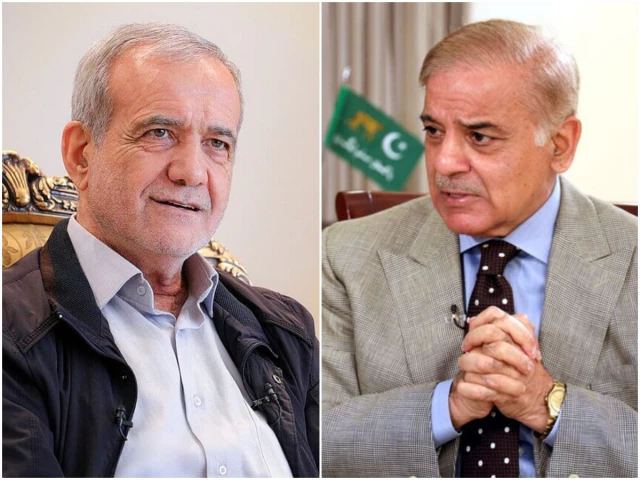
As threats of a potential United States attack on Iran loom large, Pakistan on Thursday stepped in to defuse the crisis as Prime Minister Shehbaz Sharif spoke to the Iranian president while Islamabad was also in touch with Washington.
Within hours of a telephonic conversation between Deputy PM and Foreign Minister Ishaq Dar and his Iranian counterpart, Abbas Araghchi, PM Shehbaz also held a telephonic conversation with Iranian President Masoud Pezeshkian.
وزیراعظم محمد شہباز شریف کا اسلامی جمہوریہ ایران کے صدر ڈاکٹر مسعود پیزشکیان سے ٹیلی فونک رابطہ
— Government of Pakistan (@GovtofPakistan) January 29, 2026
وزیراعظم نے خطے میں امن، سلامتی اور ترقی کے فروغ کے لیے پائیدار مذاکرات اور سفارتی تبادلۂ خیال کی اہمیت پر زور دیا۔
مشترکہ تاریخ، ثقافت اور عقیدے سے جڑے پاکستان اور ایران کے درمیان… pic.twitter.com/ti1HGxzNRJ
The flurry of diplomatic engagements came against the backdrop of renewed escalation in tensions between Iran and the US, which has sent multiple warships to the region. President Donald Trump warned Tehran to strike a nuclear deal or face the consequences.
Pakistan is alarmed by these developments and is believed to have been making diplomatic efforts to cool off the brewing crisis.
A read out from the PM Office said the two leaders exchanged views on the evolving regional situation. PM Shehbaz underscored the importance of sustained dialogue and diplomatic engagement for promoting peace, security and development in the region.
Reflecting the close and fraternal ties between Pakistan and Iran, rooted in shared history, culture, and faith, both leaders reaffirmed their commitment to maintain regular high-level engagements and consultations through bilateral institutional mechanisms, to further strengthen cooperation across the full spectrum of bilateral relations.
Spoke with my brother President Dr. Masoud Pezeshkian of Iran today.
— Shehbaz Sharif (@CMShehbaz) January 29, 2026
We exchanged views on the evolving regional situation and agreed that sustained dialogue and diplomatic engagement are vital for peace, security, and development in our region.
We also reaffirmed our…
Read More: Pakistan alarmed by renewed Iran-US tensions
Earlier, FM Dar spoke with Araghchi amid rising tensions in the Middle East, following renewed threats by Trump to take military action against Iran.
According to a statement issued by the Ministry of Foreign Affairs, Dar expressed concern over the evolving regional situation and stressed that dialogue and diplomacy remain the only viable way forward. Both leaders agreed to remain in close contact as the situation develops.
Separately at a weekly news briefing, Foreign Office Spokesperson Tahir Andrabi reiterated Pakistan’s long-standing position that dialogue and diplomacy remained the only viable path to resolving regional disputes, warning that the Middle East could not afford another war that would derail economic development and regional stability.
He said Pakistan had consistently opposed the use of force, interference in internal affairs and the imposition of unilateral sanctions, particularly against “brotherly country” Iran.
“As war clouds hover, Pakistan has always advocated peace and diplomacy to settle all outstanding issues,” he said, adding that FM Dar held two telephone conversations this week with his Iranian counterpart to discuss the evolving situation.
Weekly Press Briefing by the Spokesperson @TahirAndrabi
— Ministry of Foreign Affairs - Pakistan (@ForeignOfficePk) January 29, 2026
On Board of Peace (BoP) - related questions. pic.twitter.com/zHDxrLyM3B
He said Pakistan’s engagement was not limited to Tehran, noting that Islamabad also used international forums, including the World Economic Forum (WEF), to convey its position. “Our delegation at WEF, particularly the deputy prime minister, was also engaged with the US side. Our advocacy for peace and diplomacy continues,” Andrabi said.
Warning of the broader fallout of conflict, the spokesperson said turmoil in the region would directly undermine prospects for economic growth and prosperity. “This region cannot afford war. We hope that peace and diplomacy will prevail,” he added.
EU-India trade deal
Responding to questions on the EU-India free trade agreement, Andrabi said Pakistan was fully aware of the developments and had been closely following the matter through bilateral and multilateral channels.
He underlined that Pakistan enjoyed long-standing, friendly and mutually beneficial relations with the European Union, particularly under the Generalised Scheme of Preferences Plus scheme, which he described as a “win-win template” for both sides.
“Imports of textiles and apparel from Pakistan to the EU cater to the consumer market, providing an uninterrupted supply of affordable goods,” he said, adding that bilateral trade volume between Pakistan and the EU currently stood at close to €12 billion.
The spokesperson said Islamabad remained committed to further strengthening relations with the EU in all areas of mutual interest, including trade. He noted that the issue was discussed during the Pakistan-EU Strategic Dialogue held late last year, led by FM Dar and his EU counterpart.
The matter, he said, also came up in subsequent engagements with EU institutions and member states, including the latest bilateral political consultations with Belgium held earlier this week. “We are following this matter bilaterally with EU member states and collectively with EU headquarters in Brussels,” Andrabi said.
Board of Peace
Addressing concerns over Pakistan’s decision to join the Board of Peace (BOP), the spokesperson said Islamabad had joined the initiative “in good faith” with clearly defined objectives.
“Our objectives are threefold: to consolidate and sustain a ceasefire in Gaza, to support reconstruction, and to advance a just and lasting peace based on the Palestinian right to self-determination,” he said.
He rejected the notion that Pakistan had joined the initiative in isolation, pointing out that seven other Muslim countries including Saudi Arabia, Türkiye, Egypt, Jordan, the UAE, Indonesia and Qatar were also part of the BOP.
Also Read: Trump launches ‘Board of Peace’
“As such, Pakistan joining the BOP should be seen in the continuum of a collective initiative by these eight Arab and Islamic countries to promote peace in Gaza,” Andrabi said, adding that the effort dated back to August and September last year.
Describing the humanitarian situation in Gaza as catastrophic, the spokesperson said the people of Gaza had endured unprecedented suffering, death and destruction over the past two years, while international mechanisms had failed to halt the Israeli offensive.
“The UN Security Council remained deadlocked, the International Court of Justice issued advisory opinions, and the General Assembly adopted resolutions — all failed to stop the onslaught,” he said.
“In this backdrop, the BOP is a glimmer of hope for Palestine.”
Andrabi categorically dismissed claims linking the BOP to the Abraham Accords.
“Pakistan’s position remains unchanged. We will not become a party to the Abraham Accords,” he said.
He clarified that the BOP did not replace the United Nations and was established under a specific mandate authorised by UN Security Council Resolution 2803. “It is intended to complement, not undermine, the UN system,” he added.
Andrabi also said Pakistan had not decided to join the International Stabilisation Force (ISF) and that membership of the BOP did not imply any commitment to contribute troops.
On the decision-making process, Andrabi said the foreign ministry and all relevant stakeholders had held joint consultations and that the decision was taken collectively, in line with the Rules of Business of the federal government.
Pakistan, he said, hoped the framework established by the BOP would lead to concrete steps towards a permanent ceasefire, expanded humanitarian assistance, reconstruction of Gaza, and a credible, time-bound political process.
“This should culminate in an independent, sovereign and contiguous Palestinian state based on pre-1967 borders, with Al-Quds Al-Sharif as its capital,” he said.
He added that Pakistan looked forward to playing a constructive role within the BOP to help end the suffering of the Palestinian people.
Responding to a question on representation and membership, Andrabi said participation would depend on the level of meetings, whether summit-level or ministerial. He added that the membership was for three years, with no permanent or non-permanent categories linked to financial contributions.
US travel advisory
On reports regarding an updated travel advisory from the US about Pakistan, the spokesperson said the statement had been seen and it was understood that it was not a downscaling but an update, with certain earlier concerns removed.
“The two sides are engaged on this through diplomatic channels,” he said, adding that Pakistan remained “open, safe and secure for international travel”.



This material may not be published, broadcast, rewritten, redistributed or derived from. Unless otherwise stated, all content is copyrighted © 2026 The Express Tribune.








COMMENTS
Comments are moderated and generally will be posted if they are on-topic and not abusive.
For more information, please see our Comments FAQ