Brand reliability fetches demanded price
Updated May 26, 2026

Signs $603m loan deals; govt to pick advisers as it mulls dollar, Islamic bonds
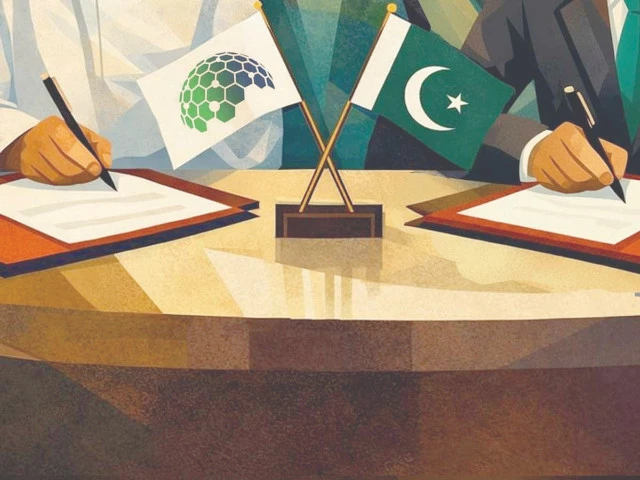
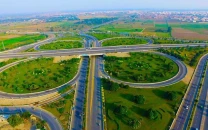
Pakistan and the Islamic Development Bank (IsDB) on Tuesday signed three loan agreements worth about $603 million to finance the M-6 Sukkur-Hyderabad Motorway, Poverty Graduation of Extremely Poor and Flood-Affected Households (PGEP) project and Out-of-School Children project for Azad Jammu and Kashmir.
The agreements were formalised following high-level talks between Minister for Economic Affairs Ahad Khan Cheema and an IsDB delegation, led by Vice President Dr Rami Ahmad. The project agreements were officially signed by IsDB VP Dr Rami Ahmad and Economic Affairs Division Secretary Muhammad Humair Karim. Federal Minister for Economic Affairs Ahad Cheema and Federal Minister for Poverty Alleviation and Social Safety Syed Imran Ahmad Shah were also present.
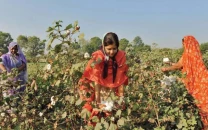
Under the agreements, the IsDB will provide $475 million for the M-6 Sukkur-Hyderabad Motorway, a key link to the proposed Peshawar-Karachi Motorway. Pakistan also signed an agreement to launch the Poverty Graduation of Extremely Poor and Flood-Affected Households project, a landmark initiative aimed at transitioning the ultra-poor households from dependency on cash assistance to sustainable livelihoods, resilience and economic self-reliance. PGEP has a total outlay of $134.2 million, of which the IsDB will contribute $118.4 million.
The project will be implemented in 25 districts (20 districts selected based on the Multidimensional Poverty Index – MPI 2024 and five most flood-affected districts in 2022 and 2025). The project aims to reach 160,866 households and create 100,000 employment opportunities through integrated asset transfers, interest-free loans, skills development, rainwater harvesting, climate-smart agriculture and business service providers' interventions.
PGEP reflects the government's commitment to shifting from consumption-based safety nets to graduation-focused, resilience-driven development, aligned with national priorities and the Sustainable Development Goals.
Furthermore, for the Out-of-School Children project, the IsDB will provide $10 million, which will help bring about 60,000 out-of-school children back into classrooms, besides supporting the training of 4,000 teachers. The IsDB VP stressed that the bank was keen on further expanding cooperation with Pakistan in areas of mutual interest.
Davos engagements
Meanwhile, Federal Minister for Finance Muhammad Aurangzeb said that the government would float a proposal in the coming weeks to select financial advisers. The government is reviewing whether to issue dollar, euro or Islamic bonds. At the same time, Pakistan is also preparing to soon introduce its first Panda bond.
According to the Ministry of Finance, Pakistan is preparing to re-enter the global bond market after a gap of four years. This move indicates that stability has returned to the country's economy, whereas a few years ago Pakistan had come closer to default. On the occasion of the World Economic Forum (WEF) in Davos, Switzerland, the Pakistani delegation, led by Prime Minister Shehbaz Sharif, is conveying to global investors that Pakistan's economy has improved and is ready for investment in the minerals, agriculture and technology sectors.
The finance minister said that Pakistan had achieved significant successes in economic stabilisation. According to him, all major economic indicators, including inflation, interest rates, the fiscal deficit, and the current account, are moving in the positive direction. Pakistan had largely exited the global bond market after 2022; however, strict fiscal reforms were implemented under IMF programmes. Inflation, which at one point had surged to 40%, has now dropped to single digits. The government has once again achieved a primary fiscal surplus and global rating agencies have improved Pakistan's credit rating.
According to Aurangzeb, foreign exchange reserves are expected to reach the equivalent of three months of imports by June, which is considered an international benchmark. He said there was no immediate pressure on the rupee because the balance of payments has improved, remittances have increased and services exports are rising. The rupee has remained stable for nearly one and a half year.
The finance minister said that along with economic stabilisation, long-delayed reforms were also being carried out, including the privatisation of state-owned enterprises and the expansion of tax net. The national airline was sold last month and the government is now considering selling its stake in New York's Roosevelt Hotel, outsourcing the management of major airports and privatising nearly two dozen other state-owned entities.
He made it clear that the government's priority was export-led growth to avoid recurring balance-of-payments crises caused by dependence on imports. The finance minister said that Pakistan must stay the course of reforms as it was the only path to sustainable growth.
Meeting with UAE minister
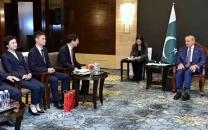
Finance Minister Aurangzeb on Tuesday met United Arab Emirates Minister of State for Financial Affairs Mohamed Al Hussaini on the sidelines of the World Economic Forum Annual Meeting in Davos. The meeting provided an opportunity for both sides to review ongoing economic engagement and discuss ways to further strengthen the close and multifaceted relationship between Pakistan and the UAE, said a press release issued by the Ministry of Finance. Aurangzeb expressed appreciation for the UAE's continued support and noted that bilateral relations were further strengthening, particularly in light of the recent visit of the UAE president to Pakistan.
WITH ADDITIONAL INPUT FROM APP





This material may not be published, broadcast, rewritten, redistributed or derived from. Unless otherwise stated, all content is copyrighted © 2026 The Express Tribune.


COMMENTS
Comments are moderated and generally will be posted if they are on-topic and not abusive.
For more information, please see our Comments FAQ