FBR inspector critically wounded in Clifton shooting; case registered against ex-cop's son
Updated 2 hours ago

Shehbaz to discuss fiscal stimulus with IMF MD in Davos
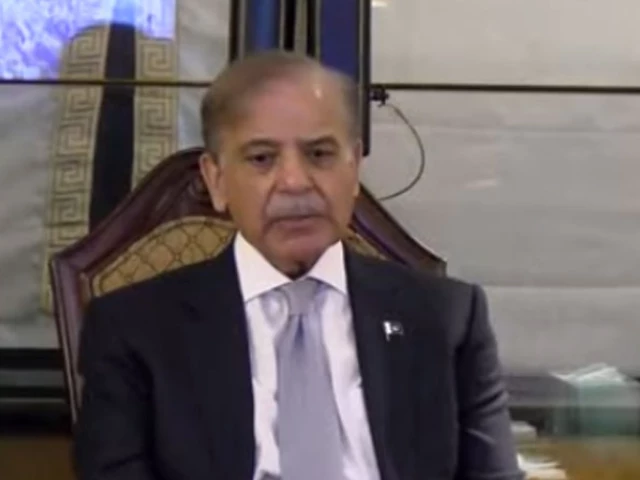
Prime Minister Shehbaz Sharif has a scheduled meeting with the International Monetary Fund (IMF) managing director next week at a Swiss hilly resort, where he would seek her support for a colossal relief package to save the remaining industries and individuals from further economic collapse.
Next week's meeting may remind us of another gathering held about three years ago between the heads of the Pakistani government and the IMF. In the middle of 2023, Shehbaz Sharif had committed in Paris with Kristalina Georgieva that he would do the right things to put the economy back on track and avoid default.
Sharif did save the economy from default, but this caused the highest unemployment and highest poverty in decadesan outcome that he now desires to reverse in Switzerland.
The sources in the PM's Office confirmed that the meeting between the premier and the IMF managing director was scheduled for the coming week. The Ministry of Finance said it would not comment on the meeting the IMF also did not respond to the requests for a version.
The new plan has been developed in consultation with the Special Investment Facilitation Council, the business community and the input from the Ministry of Finance and Revenue. The tasks include abolishing all those tax distortions that were created in the system since 2013, including substantially reducing income tax rates for firms and individuals, the sources added.
Last month, a prime minister's private-sector-led panel had recommended reducing taxes by Rs975 billion to provide some relief to the formal sector. The sources said that after adding other components, the package cost may jump to Rs1.5 trillion to close to Rs2 trillion, depending upon the final blueprint to be shared with the IMF.
Finance Minister Muhammad Aurangzeb and Secretary Imdad Ullah Bosal are also flying to Davos for the meeting, the sources added.
Unusually, the finance secretary goes to attend the WEF meetings, which annually take place at the hilly resort in freezing temperatures.
Usually, technicalities are not decided at the heads' meeting, and these details are then left to the regional and country offices of the IMF.
It is not clear how much immediate support the prime minister can get in a single meeting,g and the expectations are that the IMF might deliberate over the details of the plan and its viability during the next month's third review talks under the $7 billion bailout package, commented one of the persons having knowledge of the development.
During the past month, Pakistan's top policy makers have already spoken about the internal resentment within the business community about the unfair energy prices and the unduly heavy taxes that are driving the local and foreign investors out of Pakistan.
This week, Deputy Prime Minister Ishaq Dar dropped a first hint when he publicly said that the IMF's programmes were generally anti-growth and the government was going to engage with the lender for introducing a pro-growth package.
At the same venue, Finance Minister Muhammad Aurangzeb did say that some companies were leaving due to higher energy prices and taxes, but he again reiterated treading a "sustainable path" ahead.
A few weeks ago, the national coordinator of the SIFC said that industrialists were the easy prey of the tax machinery. Lt General Sarfraz Ahmed underscored the need to abolish the super tax, dividend tax, and reduce corporate income tax to 25%.
On Friday, S M Tanveer, a leading textile miller and representative of the Federation of Pakistan Chambers of Commerce and Industry (FPCCI), stated that the 150 industries built by three generations have closed down and many more are on the vergeof shutting down, urging the government to cut taxes and energy prices to revive industry.
What could be in the plan?
The sources said that according to the deliberations, all the distortions like super tax, deemed-income tax on provincial subject of real estate, capital value tax on foreign assets may be asked to be abolished. These distortions have increased the effective income tax rate to 60%.
According to a story reported by The Express Tribune last month, the government may seek a reduction in corporate income tax from 29% to 25%, the maximum individual rate from 45% to 30%, salaried class tax to 25%, abolishing 10% super tax, ending 15% inter-corporate dividend tax and cutting sales tax from 18% to 15%.
The sources said that the estimated annual revenue impact of the move could be well above the Rs1.5 trillion, with the maximum impact of over Rs600 billion on account of reducing the standard sales tax rate.
The situation was the worst in the case ofthe salaried class. According to the FBR, the "withholding tax collection from salaries registered the highest increase of Rs214.2 billion (55% growth) in the last fiscal year, primarily due to a decrease in the number of income tax slabs and an increase in the corresponding tax rates in each slab".
Younus Dagha, former finance secretary, said this week that under the IMF programme, salaried class taxation has been increased by 230%.
The plan is based on the assumption that the stalled local and foreign investment would kick in, which would activate the economy for covering revenue shortfall. It suggests that in the first year, there may be negative revenue growth without compromising the tax-to-GDP ratio, which would be covered in the next year.
This week, World Bank country head Miss Bolormaa told the finance minister that the investment was falling behind the targets agreed in the $20 billion Country Partnership Framework.
The government may also promise to cut the SOEs' losses by more than half in three years to reduce expenses as part of the plan, the sources said.
The sources said that the Ministry of Finance also wanted to get relief this time after it faced criticism that it gave too much in return for just $7 billion, spread over three years.
However, there have also been challenges to the IMF programme from the federal government. It did not implement the National Fiscal Pact in true letter and spirit. Just last week,k it conditionally approved a Rs465 billion-worth provincial motorway project. This week, within one day, it approved a health programme that falls in the provincial domain.
The provincial governments have also delayed the implementation of the Agriculture Income Tax on the pretext of offsetting the impact of floods. However, the National Accounts Committee reported positive growth in agriculture for the first quarter, surprisingly rice production was shown to be more than the pre-flood estimates.
The GST harmonisationbetweeng the Centre and the provinces is another case of failure.








This material may not be published, broadcast, rewritten, redistributed or derived from. Unless otherwise stated, all content is copyrighted © 2026 The Express Tribune.






COMMENTS (4)
Comments are moderated and generally will be posted if they are on-topic and not abusive.
For more information, please see our Comments FAQ