Brand reliability fetches demanded price
Updated 4 hours ago

FPCCI demands industrial emergency as costs, restrictive tax regime choke export competitiveness
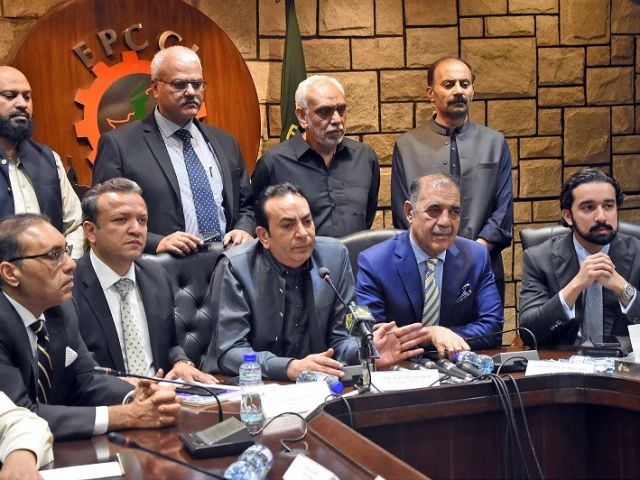
Federation of Pakistan Chambers of Commerce and Industry (FPCCI) President Atif Ikram Sheikh has called on the federal government to immediately declare an "industrial emergency," warning that Pakistan's manufacturing sector is facing a systemic and potentially irreversible collapse due to uncompetitive energy tariffs, high interest rates and a restrictive tax regime.
Speaking to The Express Tribune, Sheikh said Pakistani industries are operating at a severe disadvantage compared to regional competitors, primarily due to soaring energy costs. "In Pakistan, industries are paying around 13 cents per unit of electricity, while in neighbouring countries, energy costs range between seven and eight cents. Our energy is almost double what our competitors are paying," he said, adding that this disparity has eroded the competitiveness of local manufacturers in global markets.
Sheikh noted that despite having surplus energy capacity, the high cost of power continues to cripple both existing and new industries, including textiles, vegetable oil and other manufacturing sectors. He reiterated that the FPCCI had rejected incremental relief packages, pointing out that no industrial consumer had received electricity at the promised Rs22 per unit, while actual bills continue to reflect tariffs of Rs34 to Rs35 per unit.
He also criticised the country's tight monetary policy, stating that persistently high interest rates, hovering between 15% and 16% for much of the past year, have discouraged private investment. "When investors can earn 15% to 22% risk-free returns by parking money in banks, why would they invest in businesses?" he asked.
Although inflation has eased significantly, with December's Consumer Price Index (CPI) falling below 4%, Sheikh argued that interest rates should now be closer to 7% to stimulate economic activity.
The impact of these policies has been evident in Pakistan's export performance. Sheikh said exports have shown limited growth, confined largely to select sectors such as textiles and surgical instruments, while overall momentum remains weak.
"We have been stuck at an export target of $30 billion for the last two decades. Now we are talking about $100 billion, but that will require serious policy corrections," he said.
The FPCCI president further highlighted that Pakistani exporters are burdened with electricity tariffs of about 12.5 cents per unit, compared to 6 to 9 cents in competing economies such as India, Bangladesh and Vietnam. This gap, he warned, has accelerated de-industrialisation, forcing hundreds of units to shut down and prompting capital flight to more business-friendly countries.
Echoing these concerns, United Business Group (UBG) Patron-in-Chief SM Tanveer said the textile sector, the backbone of Pakistan's exports, is facing an existential crisis, with more than 100 mills already closed. He criticised the government's reliance on high interest rates to control inflation, arguing that the resulting liquidity crunch has choked private-sector credit and stalled industrial expansion.
The FPCCI has demanded a reduction in industrial income tax from 39% to 20%, a cut in gas tariffs from Rs3,900 to Rs2,400 per mmBtu, and a gradual reduction in the policy rate to 6%. The body has also urged the Special Investment Facilitation Council (SIFC) to intervene, warning that failure to act swiftly could lead to rising unemployment, shrinking exports and a deeper economic downturn.







This material may not be published, broadcast, rewritten, redistributed or derived from. Unless otherwise stated, all content is copyrighted © 2026 The Express Tribune.












COMMENTS
Comments are moderated and generally will be posted if they are on-topic and not abusive.
For more information, please see our Comments FAQ