'The Night Agent' returns bigger with new faces
Updated 9 hours ago

Advanced wearable technology includes a Chinese-made Lenovo pendant that captures sound and images hands-free
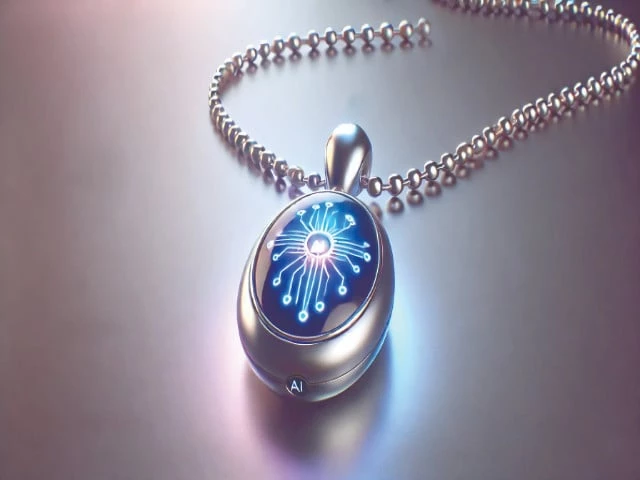
Pendants and brooches packed with artificial intelligence abounded at the Consumer Electronics show, using cameras and microphones to watch and listen through the day like a vigilant personal assistant.
The return of the wearable tech comes about a year after the discontinuation of a Humane AI Pin panned by reviewers after it was launched amid high expectations in early 2024.
It also comes as OpenAI chief Sam Altman and renowned industrial designer Jony Ive collaborate on a device for interacting with AI, expected to be ready by next year.
Not everyone is a fan of always-watching neckwear as a fashion accessory.
"Go make some real friends" became common graffiti on New York City subway ads for Friend brand AI pendants late last year to protest "surveillance capitalism."
Nonetheless, at the CES show in Las Vegas, gadget makers have pitched AI pendants as note-takers or ways to remember beautiful or important moments of each day.
Technical advances including improved chips have helped overcome early problems with poor battery life, buggy software, and stumbling conversations that tainted early pendant models.
China-based laptop titan Lenovo unveiled a prototype pendant from its Motorola subsidiary that allows voice control of its AI assistant Qira.
The device worn around the neck will capture sound and images hands-free.
Amazon made a deal to buy wearable AI startup Bee last year, and Meta acquired AI device company Limitless.
Bee devices are worn on the wrist, belt or lapel, and primarily function as an assistant by taking notes, offering reminders and keeping calendars.
Meanwhile, Meta has made a priority of developing AI "superintelligence" and is successfully packing AI into Ray-Ban glasses.
Companies are taking an array of approaches to wearable AI.
Startup Vocci, which focuses on AI-assisted notetaking, has opted for a ring, while Plaud has a pin as well as a rectangular device barely thicker than a credit card for keeping track of what is being said.
Chinese startup iBuddi came to Las Vegas to present a prototype of a companion medallion aimed at combating screen fatigue.
"Our core philosophy is to build a body-worn AI companion that replaces some phone interactions, rather than adding another screen that absorbs attention," iBuddi founder Yin Haitian told AFP.
The entrepreneur, who aims for a commercial launch in July, was adamant that iBuddi "is not driven by surveillance" but instead "reacts to the moments that matter instead of continuously recording everything."
A Looki L1 AI wearable, on the other hand, continuously captures a wearer's point of view, promising to advise when to avoid another cup of coffee, to comment on places or objects around you, and to summarize each day in a comic strip.
"Consumer expectations regarding privacy haven't gone away entirely, but they are shifting," said Avi Greengart, an analyst at tech research and advisory group, Techsponential.
"We're already being surveilled by billions of smartphones, city camera networks and smart devices that we willingly placed in our homes."
The analyst does not expect wearable AI to replace smartphones any time soon but sees them becoming common additions to personal tech ensembles along with smart watches, rings and glasses.
For those uncomfortable with idea of omnipresent surveillance, a startup at CES offered "Wearphone" — a mask with built-in earbuds and microphones designed to help keep conversations private.
In 2011, Altman became a partner at startup accelerator Y Combinator (YC), initially working on a part-time basis.In February 2014, he became president of YC. He aimed to expand YC to fund 1,000 new companies per year and sought to broaden the types of companies funded, particularly focusing on "hard technology" startups. In October 2015, Altman was involved in expanding YC's scope. He contributed $10 million to the initial fund of Y Combinator Research, and announced YC Continuity, a fund to invest in maturing YC companies. In September 2016, Altman's role at YC expanded to president of YC Group, which included Y Combinator and other units.
Ive has received accolades and honours for his designs and patents. In the United Kingdom, he has been appointed a Royal Designer for Industry (RDI), an Honorary Fellow of the Royal Academy of Engineering (HonFREng), and a Knight Commander of the Order of the British Empire (KBE). In 2018, he was awarded the Hawking Fellowship of the Cambridge Union Society. In a 2004 BBC poll of cultural writers, Ive was ranked the most influential person in British culture. His designs have been described as integral to the successes of Apple, one of the world's largest information technology companies by revenue and market capitalisation.














This material may not be published, broadcast, rewritten, redistributed or derived from. Unless otherwise stated, all content is copyrighted © 2026 The Express Tribune.







COMMENTS
Comments are moderated and generally will be posted if they are on-topic and not abusive.
For more information, please see our Comments FAQ