HAVI and Third Fret bring raw emotion in 'Dil Sukoon'
Updated 4 hours ago

Handmade in Dijkot, tablas carry centuries of musical tradition, with each stroke reflecting skill and enduring legacy
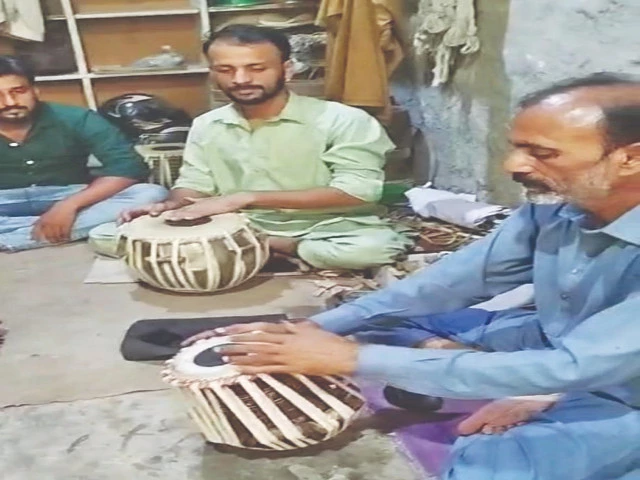
The beat of a dhol or the rhythm of a tabla travels from the ears to the heart and slowly takes over the body, making the listeners nod their heads.
Soon, feet move and fingers tap. When the tabla plays, people gather without being called. Whether it is a ghazal, thumri, folk song, tappay or maahi, the tabla gives music its rhythm and meaning.
Yet before this rhythm reaches a musician's hands, the tabla itself passes through a long and patient journey shaped not by machines but by skilled hands, trained ears and years of experience.
While Peshawar has long been known for making musical instruments, Punjab has its own lesser-known centre of this craft: Dijkot. Known for agricultural tools and iron implements, the town is also home to craftsmen who quietly keep the tradition of tabla and dholki making alive.
In a small workshop in Dijkot's market sits Israr Hussain, a craftsman who has spent 35 years shaping sound with his hands. His tablas and dholkis are played across Multan and Bahawalpur regions, and some reach as far as Lahore.
Making a tabla is slow, careful work. Israr explains that preparing a single dholki can take six hours, while a balanced tabla pair demands even greater attention. The process begins with the puri, the drumhead made from carefully selected goat skin (capra hircus).
The skin is washed, cleaned and stretched gradually, a stage craftsmen call khenchna. Leather straps are tied around the edges to give strength and balance. At the centre of the drumhead lies the soul of the tabla the syahi.
Internationally, in India and other regions, this is also known as the "black spot" or "gab"/"gaab" — a highly specific black paste made by mixing iron filings and other organic materials. Craftsmen often use soft metal waste from a forge or furnace to prepare this syahi.
Applied layer by layer, it is this syahi that gives the tabla its distinct tone. "It's not just a black circle," Israr told APP. "It is the heart of the sound; sur, lay and the language of sound."
A tabla is not a single drum but a pair, known as a jodi. The larger drum is called the Bayan (nar in local parlance); it produces deep bass tones. The smaller drum is the Dayan (madi), usually made of wood, and it produces clearer, sharper sounds.
In India and Pakistan, tabla players and teachers also refer to the drum surfaces as: Syahi/Gab/Gaab — the black circular spot at the centre. Puri/Pudi – the animal skin surface, Chati – the outer white area – produces higher tones.
When a tabla player strikes the centre of the syahi, the tone produced is called "Na" or "Tin", while strokes on the outer white area create sounds known as "Ta" or "Tun". These bols are like syllables in music – the language of rhythm.
Together, sur (tone) and lay (rhythm) give the instrument life. Israr explained that deep understanding of sur and lay is essential for a craftsman. Without knowing sound, he said, "you cannot make a good table".
Craftsmanship
Most tablas are traditionally made from wood, especially: Sheesham (Indian rosewood) Kikar (Acacia) and Mango wood. However, some enthusiasts and connoisseurs also request tablas made from copper or other metals, particularly for the bayan.
Metal-bodied tablas produce a slightly different resonance, often favoured by advanced players. Once the skin is fitted, the drums are tuned carefully using wooden pegs and gentle hammer adjustments. A finely tuned tabla can cost between Rs2,500 and Rs3,500, though it is often sold later at higher prices.
For Israr, this work is not just a profession it is a heritage. He told APP that the craft he practises is the soul of the subcontinent's music, passed down from his forefathers. He learned the art from his maternal uncle, and his grandfather, Mushtaq Hussain Goga, practised the same craft in pre-Partition India.
Today, Israr's son, Hussain, works alongside him and is actively learning the craft to carry it forward. Many shops in the market make parts and supplies related to tablas, Israr said, but the final instrument is "made right here, by the hands trained over decades".
"Demand for handmade tablas has waned," says Israr, noting that wedding seasons and festivals once brought heavy orders. "Now people's purchasing power has fallen," he adds. Yet in Dijkot, craftsmen persist, quietly shaping rhythm as digital sounds dominate modern music.
Silent until struck, the tabla commands attention with centuries of discipline and tradition in every beat. Amid leather and iron dust, in hands guided by instinct and families intent on preserving tradition, the tabla endures-speaking softly, steadily, with timeless grace.
As long as hands strike the drumhead and ears seek rhythm, the tabla endures, not just as an instrument, but as a voice of culture, memory, and heart.












This material may not be published, broadcast, rewritten, redistributed or derived from. Unless otherwise stated, all content is copyrighted © 2026 The Express Tribune.


COMMENTS
Comments are moderated and generally will be posted if they are on-topic and not abusive.
For more information, please see our Comments FAQ