SC redefines digital justice benchmarks
Updated 19 minutes ago

Campaign targets paper mulberry trees to address long-term health, environment concerns
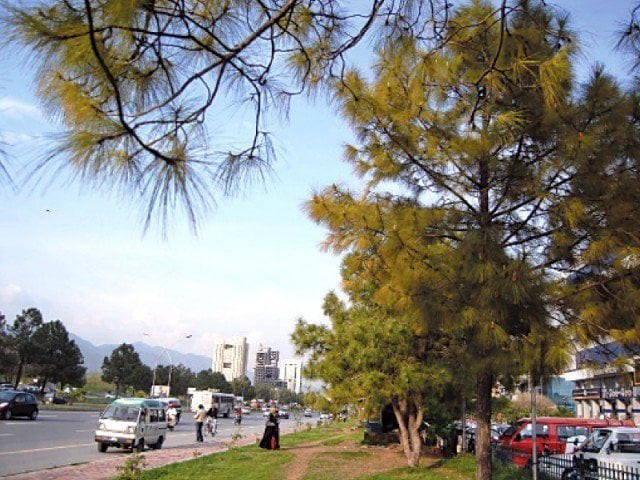
The Government of Pakistan had launched a comprehensive campaign in the last quarter of 2024 to address the long-standing issue of seasonal pollen allergy in the Islamabad Capital Territory.
The primary objective of the campaign is the systematic management of allergenic paper mulberry trees.
The initiative was launched on the direct instructions of the Prime Minister Shehbaz Sharif, who placed the pollen issue on the priority agenda. A clear roadmap for the campaign was prepared during a high-level meeting held on November 27, 2024, chaired by Minister of State for National Health Dr Mukhtar Ahmad Malik.
Under these directives, the Capital Development Authority (CDA) was tasked with implementing a detailed plan for the elimination of allergenic trees and submitting regular progress reports to safeguard Islamabad's residents from this serious public health challenge.
In close coordination with the CDA, the Ministry of National Health adopted a scientific three-phase methodology, including tree cutting, complete uprooting of roots and refilling of land to prevent regrowth.
As a result, 29,115 allergenic paper mulberry trees were removed across the federal capital.
It is noteworthy that this protocol was applied exclusively to paper mulberry trees. No native or non-allergenic trees were harmed during the campaign, and restoration efforts are limited strictly to planting new trees in place of uprooted paper mulberry units.
The cutting operation was carried out in major sectors and green areas of the capital. A total of 12,800 trees were removed from F-9 Park, 8,700 from Shakarparian, and 2,965 from urban sectors, including G-10, G-11, F-10, F-11, D-12, and along Srinagar Highway. Additional removals included 1,405 trees from G-8, 839 from G-9, 490 from F-8, 1,142 from H-8, and 534 from H-9, effectively covering both residential areas and key recreational zones.
Following the completion of the cutting phase, the campaign has transitioned into a sustainable green restoration strategy.
The government has directed that three new eco-friendly and native trees be planted for every uprooted allergenic tree. Under this policy, 40,000 native and environment-friendly mature trees have already been planted at cleared sites, including various fruit-bearing and conifer species, to establish a healthy ecosystem.
Public-private partnership has also been incorporated into the campaign. Mira Power Limited provided 3,000 native saplings, while Beaconhouse School System planted an additional 5,000 trees in the F-9 area.
Furthermore, on January 6, 2026, a tender was issued with OGDCL's support for 18,000 more large native trees to further strengthen plantation efforts.
In Shakarparian alone, 81 acres of land across three sites have been levelled, and pit-digging for the next plantation season is underway. The entire project is scheduled for completion by the end of April 2026.
According to data from Islamabad's Allergy Centre, public health has shown marked improvement following this intervention.
The number of patients requiring vaccination for pollen allergy has steadily declined.
Records show that 16,250 patients received pollen and paper mulberry allergy vaccines in 2023, which dropped to 14,747 in 2024 and further to 12,449 by the end of 2025 — a reduction of 23 per cent over two years. The impact was most evident in the final months of 2025, with only 512 vaccinations in November and 519 in December, compared to 1,164 and 1,141 cases respectively during the same months in 2023.














This material may not be published, broadcast, rewritten, redistributed or derived from. Unless otherwise stated, all content is copyrighted © 2026 The Express Tribune.






COMMENTS (2)
Comments are moderated and generally will be posted if they are on-topic and not abusive.
For more information, please see our Comments FAQ