Govt slashes jet fuel price by Rs48 per litre
Updated 55 minutes ago

Lt Gen Sharif vows to win war against terrorism through force
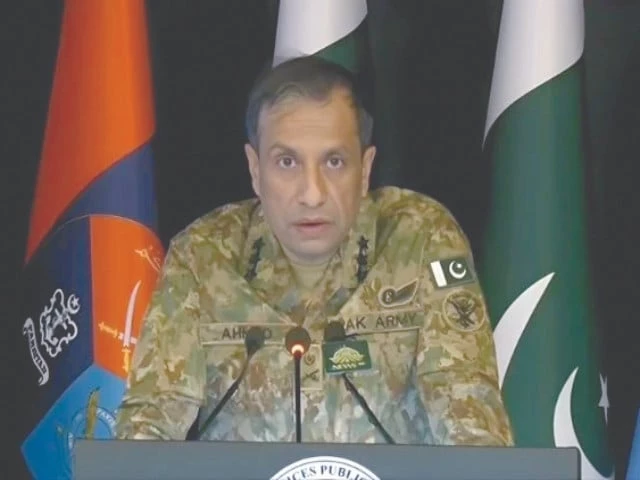
Director General Inter-Services Public Relations (ISPR) Lieutenant General Ahmed Sharif Chaudhry said on Tuesday that terrorists had found a "conducive environment" in Khyber-Pakhtunkhwa, which he linked to the province recording the highest number of attacks over the past year.
Addressing a wide-ranging media briefing at the General Headquarters in Rawalpindi, the chief military spokesperson said the state's stance on eliminating terrorism was unequivocal and asserted that the menace would be crushed decisively through the use of force and without compromise.
He rejected narratives portraying Pakistan as a "powerless state", blamed foreign-sponsored terrorist networks operating from Afghan soil, and outlined what he described as unprecedented intelligence-based operations as the state moves to dismantle terrorist threats once and for all.
Questioning why K-P continued to witness the highest number of attacks, he said terrorists had found a "conducive environment" in the province, adding: "A politically conducive environment is being provided for terrorism in Khyber Pakhtunkhwa."
"We will win the war against terrorism through force. We must win this war against terrorism at all costs," Lt Gen Sharif said, stressing that there was no daylight between the political leadership and the armed forces on the issue. "This is the war of the entire nation."
Reviewing terrorism in 2025
The ISPR chief said that the sole purpose of the press conference was to present a comprehensive review of terrorist activity during 2025, describing the year as historic and result-oriented in Pakistan's counterterrorism campaign.
In the last year, he said, an extraordinary number of the IBOs were conducted across the country, reflecting both the scale of the threat and the state's resolve to confront it. "In 2025, a complete harmony was achieved between the state of Pakistan and its people on the issue of terrorism."
The military spokesperson emphasised that terrorists had no connection, whatsoever, with Pakistan or Balochistan. He said that terrorism must be confronted as a collective national challenge rather than viewed through political or provincial lenses.
"The war against terrorism is the war of the entire nation," he continued, urging focus on the steps being taken to counter the menace rather than political narratives.
Providing statistics, Lt Gen Sharif said that in 2025, law enforcement agencies conducted 75,175 IBOs nationwide - an average of 206 operations every day. Of these, he added, 14,658 operations were carried out in Khyber-Pakhtunkhwa (K-P), 58,778 in Balochistan, and 1,739 in other parts of the country.
Despite these operations, Pakistan witnessed 5,397 terrorist incidents during the year. K-P accounted for the highest number, with 3,811 incidents, followed by Balochistan with 1,557 incidents. Only 29 incidents were reported from the rest of the country. A total of 2,597 terrorists were killed during the year, Lt Gen Sharif said.
Afghanistan as terror hub
Lt Gen Sharif said that terrorism in Pakistan resurged after 2021, the year when there was a change of power in Afghanistan following the Doha Agreement. He recalled that under the Doha Agreement, Afghan authorities had made three key commitments: Afghan soil would not be used for terrorism; terrorism would be ended, and women's education would be ensured.
"The hubs of Fitna al-Khawarij and Fitna-e-Hindustan are in Afghanistan," he said, alleging that all major terrorist organisations targeting Pakistan were based there and were being nurtured. He said Pakistan's counterterrorism efforts over the past two decades were widely acknowledged by the international community. "This war against terrorism is the war of the entire nation."
NAP and religious clarity
The DG ISPR said there was consensus among all political parties on the National Action Plan (NAP) and that its implementation was critical to defeating terrorism. Referring to Khawarij, he said Islamic injunctions were clear regarding those who wage war against the state and society.
"It is absolutely clear that we have to win this war against terrorism," he said, stressing that no individual's politics and no personality were greater than Pakistan.
The chief military spokesperson strongly criticised the narrative of a "powerless state," calling it absurd and misleading. He referred to a former prime minister, who had publicly claimed to be powerless, yet had declared the then army chief as the "father of the nation". "We believe the nation has only one father - Quaid-i-Azam Muhammad Ali Jinnah," he said.
He questioned where was the then DG Inter-Services Intelligence (ISI) today, saying that the state institutions had been used for personal political interests at the time, with governance revolving around a single individual.
He clarified that the military had no issue with any political party and treated all political forces and provinces equally. "Today's government is empowered, and previous governments were also empowered," he said.
Lt Gen Sharif alleged that terrorism in Pakistan was sponsored by India and facilitated by Afghan Taliban elements. He said the Afghan Taliban had no role in the withdrawal of the US and allied forces but had instead prepared and supported the Tehreek-e-Taliban Pakistan (TTP) within their organisational structure to sustain a "war economy".
He said the US had left behind $7.2 billion worth of advanced weapons in Afghanistan, which had fallen into the hands of militant groups. "These elements are clearly identified as Khawarij," he said, adding that despite this, calls were frequently made to negotiate with them whenever action was taken.
The DG ISPR said that clashes had taken place on the Pak-Afghan border during 'Marka-e-Haq' and again in October. "India was exposed and taught a lesson in Marka-e-Haq," he said, adding that following this, India further fuelled terrorism inside Pakistan.
Referring to what he termed "Operation Sindoor," he accused India of targeting women and children, saying the episode had left a lasting stain on India's image. "No one has given India the right to target Pakistani civilians or infrastructure," he said.
He added that terrorists had been targeted along the Pak-Afghan border and that Afghan Taliban forces had attacked Pakistani posts, prompting a firm response. Over the past three months, borders were closed, he said, adding that "there are clear signs for those who understand."
In October 2025, he said, dozens of Afghan posts were destroyed within hours during operations against terrorists. Lt Gen Sharif said Pakistan possessed complete evidence regarding the identities of terrorists and those sheltering them. Looking at 10 major terrorist incidents, he said all those involved were Afghan nationals.
He cited the Jaffar Express attack, in which 21 civilians were martyred, the attack on a civilian bus in Noshki, and an attempted attack on APS Wana, which he said sought to replicate the APS Peshawar tragedy. "The Jaffar Express incident will never be forgotten," he said.
He also referred to attacks on Frontier Corps headquarters in Quetta and Peshawar, which resulted in civilian casualties. "This is the nation's war - every child's war," he said, rejecting the notion that it was only the army's fight.
Rejecting claims that terrorists freely cross the border, the DG ISPR said infiltrators were being neutralised. "In April, 71 terrorists were killed," he said, adding that militants crossed in organised formations and were eliminated wherever detected.
He dismissed allegations that the Pakistan Army used drones to target civilians, saying terrorists were instead using armed quadcopters, even launching attacks from mosques, with India as their principal patron. He said terrorists deliberately used women and children as human shields.
The army, he conituned, targeted only terrorists and their facilitators, and quadcopters were used solely in unpopulated areas or for surveillance. "There is no collateral damage," the chief military spokesperson stated emphatically.
Lt Gen Sharif said the Peshawar corps commander frequently visited affected areas and that there was no divide between the army and the people. Flood relief, infrastructure repair, and road clearance operations were ongoing, he said.
"The clarity the Pakistani nation has received this year was never there before," he stressed. He said the clarity regarding Fitna al-Khawarij and Fitna-e-Hindustan had existed in 2023 and remained firm in 2025. "No one can shake us from this narrative," he said.
Religious scholars and elders, Lt Gen Sharif said, were also aligned under the message of "Paigham-e-Pakistan". He criticised political narratives opposing counterterrorism operations, questioning what alternative was being proposed. "If military operations are not to be conducted, then what is to be done?" he asked. "Sit at the feet of Khawarij?"
He said illegal weapons, narcotics, and smuggling had direct links with terrorism and noted the steps taken to curb illegal fuel trade that previously funded militant activity. Concluding the briefing, the DG ISPR said Pakistan was constitutionally and legally-bound to protect its territory and citizens.
"For us, a terrorist has no colour or shade," he said. "We have no sympathy for any terrorist. We are on the right path, and the truth will prevail. We are proud to fight the war against terrorism."





This material may not be published, broadcast, rewritten, redistributed or derived from. Unless otherwise stated, all content is copyrighted © 2026 The Express Tribune.

COMMENTS
Comments are moderated and generally will be posted if they are on-topic and not abusive.
For more information, please see our Comments FAQ