UK envoy commends, supports Pakistan's role in bringing US-Iran on negotiating table
Updated 2 hours ago

Citizens accuse authorities of using traffic enforcement as a revenue-generation tool
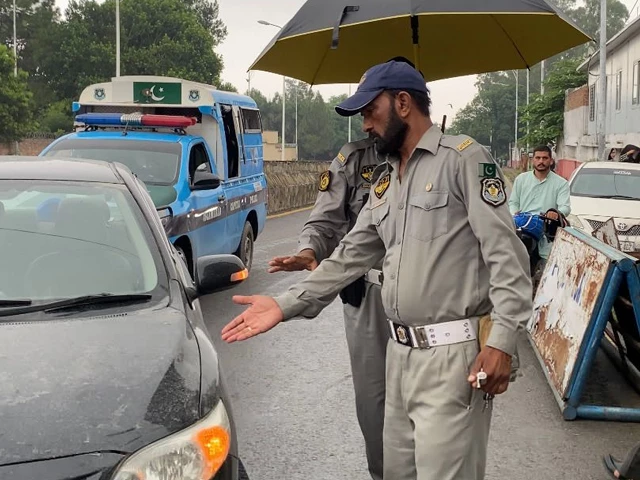
Exorbitant fines imposed across the country in the name of enforcing traffic laws have made daily life unbearable for the public. Motorcycle riders, Qingqi rickshaw drivers, bike riders, taxi and wagon drivers have openly revolted against what they describe as an oppressive system.
Instead of reform, the existing traffic regime has, they say, turned into a cruel and punitive mechanism.
Under the pretext of traffic challans, minimum fines of Rs2,000 for motorcycles and up to Rs10,000 for vehicles are being imposed, which citizens term nothing less than a form of extortionate taxation. With conventional sources of revenue drying up, the government appears to be increasing its income through traffic penalties.
As a result, altercations between traffic wardens and citizens have become routine. The objective, people allege, no longer seems to be ensuring compliance with the law, but rather the forcible collection of fines.
Motorcyclists Sharif Qureshi and Hanif Ahmed, along with Qingqi rickshaw drivers Faizan and Naveed, stated that the country's dire economic conditions, record-high inflation, business stagnation, unemployment, steep increases in utility bills and an overwhelming tax burden have already broken the back of the common man. In such circumstances, traffic fines running into thousands and tens of thousands of rupees have become an unbearable burden for ordinary citizens.
They added that in any civilised country, laws are framed in accordance with the financial capacity of the public. Here, however, the scale of fines is such that they are tolerable only for the affluent, while becoming a punishment for the poor. Motorcycle riders, in particular, have emerged as the worst victims of this system.
Citizens further complained that at many locations there are no clear signboards indicating one-way roads, no-parking zones or other traffic restrictions, yet people are still issued challans. In several areas, traffic police personnel stand at unauthorised points, stopping citizens where neither a clear violation is evident nor is the law properly explained.
There are also reports that traffic police in certain areas are given specific challan targets, creating pressure to impose fines at all costs. As a consequence, even innocent citizens are not spared, and hefty penalties are imposed for minor mistakes.
The confiscation of driving licences and identity cards is causing severe mental distress to citizens. Most distressingly, several incidents have already come to light in which people, driven by financial hardship, humiliation and helplessness, have taken the extreme step of suicide.
Members of the public question where a poor man should turn when he cannot afford to pay a fine, his licence is confiscated and his livelihood is put at risk. Is the state intent on pushing its citizens to such levels of despair and defiance?
According to citizens, such harsh and inhumane fines are increasing crime rather than reducing it. Public resentment is growing, and people are being forced towards wrongful paths, leading to a rise in theft, robbery and other social evilsdevelopments that are in no way in the interest of the country or society.
Public and social circles have strongly urged the government to conduct a comprehensive review of traffic laws and fines, abolish the challan target culture, ensure the installation of clear and visible signboards, and align penalties with the financial capacity of the public.
They stressed that the role of the state is to make citizens law-abiding, not to mentally, economically and socially crush them to the point of rebellion, crime and suicide.
















This material may not be published, broadcast, rewritten, redistributed or derived from. Unless otherwise stated, all content is copyrighted © 2026 The Express Tribune.





COMMENTS
Comments are moderated and generally will be posted if they are on-topic and not abusive.
For more information, please see our Comments FAQ