Panel to assess Baloch university needs
Updated 45 minutes ago

Only 50 private air monitors exist in Karachi, though over 500 are needed
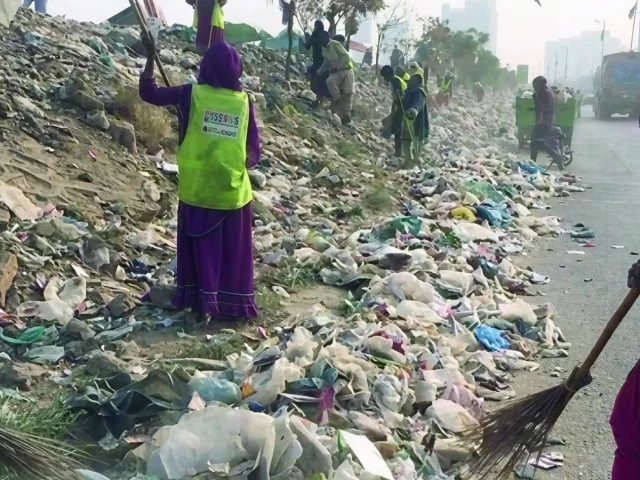
While Lahore is notorious for its incessant smog season, Karachi too has been facing a severe air pollution crisis, worsened by an acute lack of proper monitoring systems, outdated equipment, and weak enforcement, leaving millions exposed to hazardous air daily.
A major contributor to this crisis is the rapid increase in petrol- and diesel-powered vehicles. In Sindh, over 9.3 million vehicles are registered, of which more than 8 million operate in Karachi alone. These include both modern vehicles and light and heavy vehicles that are several decades old. Reportedly, vehicles account for around 70 per cent of Karachi's air pollution. Even vehicles that do not visibly emit smoke still release harmful gases, making traffic emissions the single largest pollution source in the city.
Although Karachi has about 50 privately installed air quality monitors covering limited areas, experts suggest the city should ideally have more than 500 monitors to accurately assess pollution across neighborhoods. Yet the Sindh Environmental Protection Agency (SEPA) faces serious challenges due to a lack of functional equipment. A Japanese-donated air quality monitoring station has been out of order for eight years, and SEPA currently has only 12 working analyzers and one mobile monitoring van. As a result, the agency often relies on air quality data from private companies.
Director of the Climate Action Center, Yasir Husain, explained that Karachi's Air Quality Index (AQI) became especially dangerous during winter. "Historical data shows that PM2.5 levels have reached as high as 350 in past winters, classified as "hazardous." In the current season, the PM2.5 reached 300 on December 20th, which falls under the "very unhealthy" category.
Reduced wind movement in winter prevents pollutants from dispersing, unlike summer, when strong sea breezes keep pollution levels relatively lower and closer to normal," said Husain.
The AQI colour-coding system is used globally to raise awareness and guide precautionary measures. Green indicates good air quality, while yellow, orange, red, purple, and maroon reflect increasing health risks, with maroon representing hazardous conditions. Husain stressed the importance of installing colour-coded AQI displays on major roads so that all citizens, regardless of literacy, could easily understand pollution levels and take precautions such as limiting outdoor activity and wearing masks.
Data also showed that pollution spiked during peak traffic hours, particularly from 8 to 9am and 1 to 2pm, coinciding with school opening and closing times. During these hours, a large number of school vans and private vehicles are on the roads, significantly increasing emissions. The most polluted areas include Gulshan Chowrangi and M.A. Jinnah Road due to heavy traffic congestion. According to IQAir, high air pollution levels make Karachi appear among the top ten most polluted cities worldwide.
The Traffic Police have taken limited enforcement actions. In 2025, they issued 484 challans and canceled 728 fitness certificates of smoke-emitting vehicles. However, inspections were mostly done visually due to a lack of proper equipment. Traffic police officials stated that SEPA was supposed to assist in these operations but often failed to actively participate despite issuing campaign notifications.
SEPA officials acknowledged that petrol- and diesel-powered vehicles contributed to 70 per cent of Karachi's air pollution, stressing the need for long-term solutions. In the meanwhile, experts recommended electric vehicles, mass transit expansion, and revival of the Karachi Circular Railway. While smog has reduced visibility, flights and highways remain mostly unaffected, however, pollution risks persist without structural reforms.















This material may not be published, broadcast, rewritten, redistributed or derived from. Unless otherwise stated, all content is copyrighted © 2026 The Express Tribune.






COMMENTS
Comments are moderated and generally will be posted if they are on-topic and not abusive.
For more information, please see our Comments FAQ