TODAY’S PAPER | January 22, 2026 | EPAPER

CCP fines Mezan Beverages Rs150m for copying PepsiCo’s Sting

Accused of mimicking Sting’s overall design, colour combination, bottle shape, branding

Ehtesham Mufti January 02, 2026 1 min read
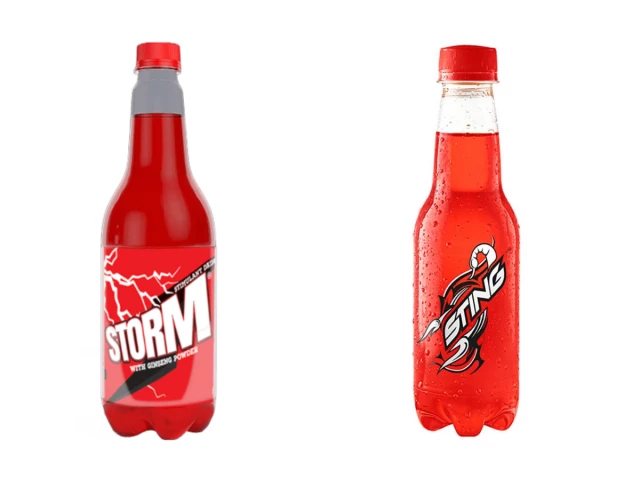
Mizan Beverages 'Storm', PepsiCo's 'Sting' Photo: Official websites

A fine of Rs150 million has been imposed on Mezan Beverages (Pvt) Ltd on Friday for copying the packaging and trade dress of PepsiCo's energy drink "Sting" by the Competition Commission of Pakistan (CCP).

According to the Commission, Mezan’s energy drink ‘Storm’ mimicked Sting’s overall design, colour combination, bottle shape, and branding, creating a clear likelihood of consumer confusion. The Commission categorised this as parasitic copying, violating Section 10 of the Pakistan Competition Act 2010.

Section 10 of the Pakistan Competition Act 2010 prohibits undertakings from engaging in "deceptive marketing practices."

The Act defines deceptive practices to include: the distribution of "false or misleading information that is capable of harming the business interests of others"; the distribution of false or misleading information to consumers; "false or misleading comparison of goods in the process of advertising"; or the "fraudulent use of another's trademark, firm name, or product labelling or packaging."

The case had been pending since 2018. PepsiCo Inc. had lodged a complaint claiming that Mezan Beverages designed ‘Storm’ to closely resemble Sting and illegitimately benefit from PepsiCo’s brand reputation. Instead of addressing the merits, Mezan challenged the Commission’s authority in court, obtaining interim injunctions that repeatedly delayed the inquiry for several years.

Last year, the Lahore High Court rejected Mezan Beverages’ petition, upholding the CCP’s authority to conduct the inquiry. The court noted that Mezan used legal injunctions to stall the Commission’s proceedings and directed CCP to complete its inquiry and issue a decision.

The Competition Commission’s detailed ruling noted that Storm’s red color scheme, bold slanted white lettering, and bottle shape closely resembled Sting. These branding elements could mislead ordinary consumers. The Commission emphasised that having a registered trademark for ‘Storm’ does not exempt a company from competition law if it misleads consumers.

CCP Chairman Dr. Kabir Sidhu stated that copying brands and using misleading packaging or marketing will not be tolerated, regardless of company size, and strict action will be taken.

COMMENTS (7)

Mohammad | 2 weeks ago | Reply The fact is that royalties aren t paid for making the product locally they re paid for the intangible value behind it research safety standards brand trust and global reputation. Skipping royalties may conserve foreign exchange in the short term but it also tells investors that IP can be copied without consequence. That discourages technology transfer limits high-value investment and keeps local firms stuck as imitators rather than creators. Over time that costs more foreign exchange than it saves and delays the development of brands that could one day earn royalties from abroad.
Naseema Jabeen | 2 weeks ago | Reply But if a product can be made locally and sold at a lower price why should valuable foreign exchange be spent on paying royalties to multinational brands at all
Zulfiqar Khan | 2 weeks ago Please note that counterfeiting and piracy impose substantial and measurable losses on Pakistan s economy. Some estimates suggest this number to be over 20 Billion Dollars annually. These losses are not limited to foreign rights-holders they directly affect domestic industry public revenue employment and consumer welfare. First the state suffers significant fiscal losses. Counterfeit and pirated goods largely circulate through the informal economy escaping sales tax income tax and customs duties. Conservative estimates place annual revenue losses in the hundreds of billions of rupees weakening the government s ability to fund public services and industrial development. Second legitimate local manufacturers are harmed. Companies that invest in quality control regulatory compliance branding and intellectual property are undercut by counterfeiters who bear none of these costs. This distorts competition discourages innovation and penalizes precisely the kind of lawful domestic enterprise that economic policy seeks to promote. Third there are serious consumer and public-health losses. Counterfeit pharmaceuticals food items agro-chemicals and automotive parts pose direct risks to life and safety. The economic cost of health complications crop failures and accidents caused by fake products far exceeds any short-term price advantage to consumers. Fourth widespread infringement damages Pakistan s investment climate. Weak enforcement of intellectual property rights increases perceived risk for both foreign and domestic investors limits technology transfer and restricts access to global value chains. Over time this constrains exports and reduces opportunities for skill development and job creation. Finally counterfeiting entrenches a culture of deception rather than innovation. When copying is rewarded and originality is not protected firms rationally invest less in research brand-building and quality improvement. The long-term loss is an economy trapped in low value-addition rather than one that competes on excellence. In sum the cost of counterfeiting is systemic. It drains public revenue endangers consumers undermines legitimate local businesses and weakens Pakistan s prospects for sustainable economic growth. The issue is not protection of foreign brands per se but protection of the rule of law and the conditions necessary for genuine domestic success.
Jamal Yousuf | 2 weeks ago Local companies are free to manufacture comparable products and we can avoid paying royalties altogether. What they cannot do is misappropriate the goodwill of established foreign or even local brands by using deceptively similar names trade dress or packaging. Competing on product is legitimate competing by creating consumer confusion is not. History shows that alignment with multinational brands is not the only path to success. Local brands such as Tapal and Shan Masala built independent intellectual property invested in quality and trust and succeeded without borrowing another brand s reputation. Their success demonstrates that domestic industry can thrive on originality rather than imitation. The issue therefore is not whether local production is possible it clearly is but whether it is done through genuine competition or by free-riding on the reputation that others lawfully built.
VIEW MORE COMMENTS
Replying to X

Comments are moderated and generally will be posted if they are on-topic and not abusive.

For more information, please see our Comments FAQ