KSE-100 sheds over 500 points at midday amid geopolitical jitters
Updated 45 minutes ago

Rigid rules, risk perceptions lock households, SMEs out of distributed financing
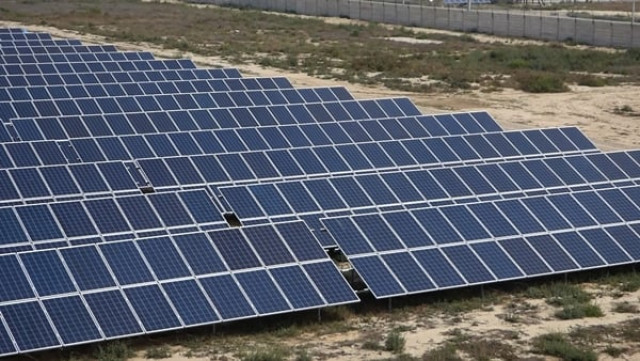
Pakistan's distributed solar market holds an estimated Rs800 billion ($2.8 billion) in untapped lending potential across just three major cities, yet millions of households and small businesses remain excluded due to structural financing constraints, according to a study launched on Monday by Renewables First.
Despite rapid growth in solar adoption across the country, the study finds that the benefits have accrued disproportionately to affluent households and large enterprises that are able to self-finance installations. In contrast, Pakistan's banking sector, which holds about $131 billion in deposits, channels only $50 billion into lending, with nearly 63% of banking assets invested in government securities rather than productive sectors of the economy.
The study was conducted in knowledge partnership with the Pakistan Banks' Association (PBA), the National Institute of Banking & Finance (NIBAF) and the Karachi School of Business & Leadership (KSBL), and was unveiled at a ceremony held at a local hotel in Karachi.
"The problem isn't actual risk, it's perceived risk," said Naveen Ahmed, climate finance expert and co-author of the study. He said that banks were missing viable business opportunities because internal systems and risk frameworks had not kept pace with market realities.
The report highlights a sharp paradox in Pakistan's energy and finance landscape. While electricity tariffs have risen by more than 200% since 2012, the cost of solar panels has declined by 73% since 2017, resulting in payback periods of less than two years in many cases. Despite this, households spending up to 20% of their income on electricity and small and medium enterprises (SMEs) burdened by high energy costs remain excluded from solar financing due to rigid collateral requirements that prioritise asset ownership over cash-flow viability.
Among the key findings, the study notes that banks operate at an advances-to-deposits ratio of below 40%, while often demanding double collateralisation for solar loans. It also finds that distributed solar portfolios show default rates of below 2%, compared to over 10% for traditional SME lending.
"This represents a missing middle segment, enterprises and households that are too large for microfinance but too small or informal for commercial banks," said Shezad Abdullah, a banker and co-author of the study.
Panelists at the launch stressed that unlocking this opportunity requires improved market segmentation and tailored product design rather than blanket risk aversion. Ammar Habib Khan, chief executive officer of the National Credit Guarantee Company Limited (NCGCL), said that before scaling up financing, it was essential to identify eligible consumer and enterprise segments, understand their risk profiles and design instruments accordingly.
Similarly, PBA Managing Director Nejib Rehman said banks were not fundamentally opposed to solar lending. However, he noted that concerns around repayment consistency, property ownership, particularly in apartment buildings, limited historical data and regulatory uncertainty continued to influence lending decisions.
The study proposes several market-ready financing models to bridge the gap, including anchor-based financing, vendor-linked financing, on-lending models through development finance institutions and microfinance providers, and securitisation of solar loan portfolios to unlock liquidity.
"Pakistan lacks credit bureaus covering informal borrowers, standardised documentation for small-ticket loans and efficient dispute resolution mechanisms," said Ummamah Shah, senior associate for energy finance at Renewables First.
Looking ahead, panelists also pointed to battery energy storage systems as the next phase of innovation, building on the momentum of distributed solar.
With Pakistan having imported over 50 gigawatts of solar panels in the past five years, equivalent to the country's entire grid capacity, the infrastructure exists. What remains missing is the financial intermediation to ensure equitable access.
"The question is not whether the financial system can afford to support this transition, but whether the country can afford continued inaction," the report concludes. "With billions in deposits seeking productive deployment and millions of households seeking affordable energy solutions, the ingredients for transformation exist."
The event concluded with the launch of the Pakistan Energy Finance Network, a practitioner-led platform aimed at bridging energy policy ambitions with financial market realities.















This material may not be published, broadcast, rewritten, redistributed or derived from. Unless otherwise stated, all content is copyrighted © 2026 The Express Tribune.






COMMENTS
Comments are moderated and generally will be posted if they are on-topic and not abusive.
For more information, please see our Comments FAQ