Forces kill terrorists' ringleader in Bannu
Updated 1 hour ago

Division bench compromising CJ Dogar, Justice Azam rules Justice Jahangiri’s appointment illegal
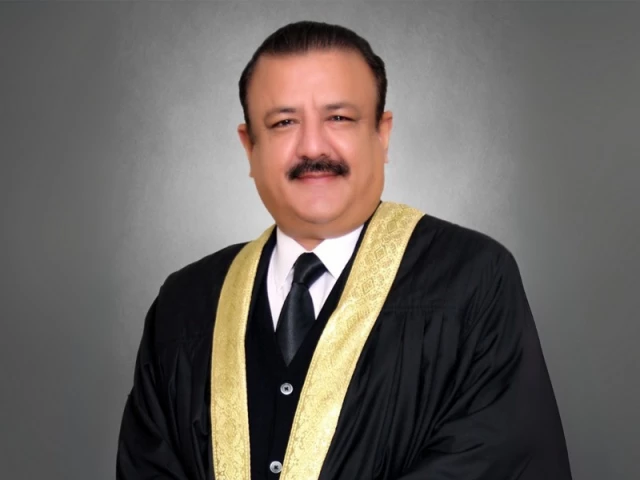
The Islamabad High Court (IHC) on Thursday officially de-notified Justice Tariq Mehmood Jahangiri over issues concerning his law degree.
A division bench, led by Chief Justice Sardar Muhammad Sarfraz Dogar and Justice Muhammad Azam Khan, ruled that Justice Jahangiri did not hold a valid degree at the time of his appointment and declared his appointment “illegal.”
The bench ordered him to immediately vacate his office and directed the law ministry to formally remove him from the judiciary. “He held an invalid law degree at the time of his appointment and confirmation as judge,” the court noted.
The IHC also disposed of all miscellaneous petitions related to the matter. Justice Jahangiri had left the court about half an hour before the verdict was announced.
The controversy over Justice Tariq Mehmood Jahangiri’s law degree began last year when a letter, allegedly from the University of Karachi’s controller of examinations, started circulating on social media. In July, a complaint regarding his purportedly fake degree was submitted to the Supreme Judicial Council (SJC), the top forum for judicial accountability, which investigates misconduct allegations against judges.
Advocate Mian Dawood, who filed the petition challenging Justice Tariq Jahangiri’s appointment, said the decisions already issued by the judge “will not be affected,” adding that any benefits or privileges he has received will also remain intact. He stressed that it is the government’s responsibility to initiate proceedings against Justice Jahangiri, noting, “Any further action depends on the government; if it does not file a case, it would be regrettable.”
The order sheet of the Islamabad High Court notes that “despite ample opportunities” the respondent “failed to submit a reply or produce valid educational credentials”, compelling the court to proceed with the matter on the basis of the available record. It holds that Justice Tariq Mehmood Jahangiri “did not possess a valid LL.B. degree at the time of his appointment/confirmation”, which is a “mandatory constitutional requirement under Article 175-A of the Constitution.”
Consequently, the court declared that his elevation as a judge of the Islamabad High Court was “without lawful authority,” directed that he be “de-notified forthwith,” and ordered the Ministry of Law and Justice Division to “take necessary steps accordingly.” All pending applications and connected objection cases were disposed of, with “detailed reasons to follow.”
Read: Judge Jahangiri accuses IHC CJ Dogar of misconduct
Highlighting institutional accountability, Dawood said those responsible at the University of Karachi at the time must face action, as fake mark sheets for LLB Part One and Two had been prepared. He further added that numerous Supreme Court rulings had been presented in court and emphasized, “Allegations against a judge must also be proven,” calling for action against anyone or any institution that provided protection to Justice Jahangiri.
Even yesterday, in his petition, Justice Jahangiri contended that the IHC order was passed “without affording him an opportunity of hearing, while individuals who were not parties to the case were heard on the question of maintainability.” He argued that this violated his fundamental right to due process guaranteed under Article 10A of the Constitution.
The petition states that the writ before the Islamabad High Court challenges his appointment as a judge on the basis of an alleged “invalid LLB degree,” a matter which, according to Justice Jahangiri, involves “disputed questions of fact that cannot be adjudicated by a high court without recording evidence.” He maintained that such issues fall within the jurisdiction of a trial court and that “the high court lacks authority to record evidence in quo warranto proceedings.”
The petition further notes that the IHC, while declaring the writ maintainable, relied on a report submitted by the University of Karachi “without examining its validity or allowing Justice Jahangiri to contest it.” It added that proceedings and decisions of the University of Karachi regarding his degree, including actions taken by its Unfair Means Committee, Syndicate, and subsequent declarations, “are already under challenge before the Sindh High Court, where those proceedings have been suspended.”
Justice Jahangiri also highlighted that the alleged events concerning his degree relate to examinations conducted decades ago and that the allegations raised against him are “purely factual in nature, requiring a full trial.” He denied the allegations and stated that “his credentials have remained on record throughout his legal career, including during his enrolment as an advocate and subsequent judicial appointments.”
Through the petition, filed by Advocate Uzair Bhandari, Justice Jahangiri sought leave to appeal, conversion of the petition into an appeal, setting aside of the IHC’s December 9 order, and dismissal of the writ petition for being non-maintainable.
Read More: Justice Jahangiri challenges IHC order in law degree case before FCC
Earlier this year, lawyer Mian Dawood also filed a petition in the Islamabad High Court (IHC) challenging Jahangiri’s appointment.
The case has seen a prolonged legal trajectory. On September 16, the same IHC division bench first heard the petition and issued an interim order restraining Justice Jahangiri from performing judicial duties until the maintainability of the petition could be determined. The order, issued without prior notice to the judge, sparked debate within the legal community over whether a high court could suspend a sitting judge.
The Supreme Court intervened, setting aside the restraining order. A five-member constitutional bench, led by Justice Aminuddin Khan, ruled that a high court cannot bar a judge from performing judicial functions while hearing a quo warranto petition. The ruling clarified that it addressed only the legality of the interim order, not the merits of the allegations, and directed the IHC to decide all preliminary objections and proceed according to law.
Justice Jahangiri was also among six IHC judges who wrote to the SJC last year, alleging interference in judicial affairs by spy agencies. The letter ignited a broader debate on judicial independence and led to calls for a formal inquiry.














This material may not be published, broadcast, rewritten, redistributed or derived from. Unless otherwise stated, all content is copyrighted © 2026 The Express Tribune.






COMMENTS (3)
Comments are moderated and generally will be posted if they are on-topic and not abusive.
For more information, please see our Comments FAQ