'Late-night meals driving obesity surge'
Updated 1 hour ago

Court cites sensitivity of allegations over judge’s LLB degree
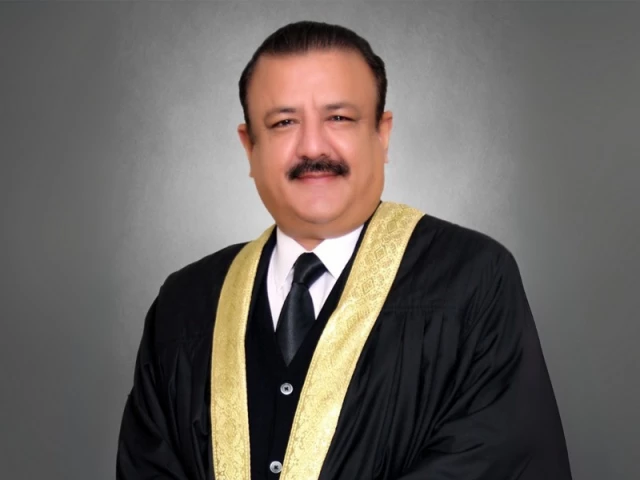
In the order sheet for its Monday proceedings on a quo warranto petition accusing Islamabad High Court (IHC) judge Tariq Mehmood Jahangiri of holding an invalid LLB degree, the IHC has noted that it formed a division bench to hear the plea "in view of the sensitivity of the matter".
Justice Jahangiri on Monday appeared in person before the IHC division bench comprising Chief Justice Sardar Muhammad Sarfraz Dogar and Justice Muhammad Azam Khan, hearing a petition filed by Mian Dawood Advocate.
The respondent judge had objected to the formation of a division bench to hear the plea, contending that this decision had deprived him of the chance of filing an intra-court appeal should the bench issue an order against him.
Justice Jahangiri had also objected to the inclusion of Justice Dogar in the bench, noting that he, Jahangiri, was among the IHC judges who had filed petitions against Dogar's transfer to the IHC from the Lahore High Court (LHC). Therefore, Dogar being part of a bench hearing a plea against Jahangiri was a "conflict of interest".
Explaining reasons for rejecting Justice Jahangiri's objections, the bench in its order sheet noted that it was deemed "conducive, proper and in the fitness of things" to constitute a division bench to hear the case instead of a single bench "in view of the sensitive nature of allegations against a sitting judge of this court."
"Even otherwise, the constitution of benches to hear cases is the sole prerogative of the chief justice. Furthermore, it is notable that it is not the first instance of this kind wherein a division bench has been constituted to hear a certain petition," it said.
Talking with reference to Justice Jahangiri's objection to the inclusion of Justice Dogar in the bench, it said the IHC judges' intra-court appeal against a Supreme Court order endorsing Dogar's transfer to the IHC had already been dismissed by the Federal Constitutional Court (FCC).
"Furthermore, it has been held by the Supreme Court of Pakistan in 'Asif Ali Zardari vs The State' that a judge of a superior court is a keeper of his own conscience, and it is for him to decide whether to hear or not to hear a matter before him".
It said in the "PM Benazir Bhutto vs The President of Pakistan" case, the issue of transfer of the case before a judge on the basis of bias was explained.
"It was observed that there is a marked distinction in the approach on the question of bias between the case of a judge of a subordinate court and the case about a judge of a superior court since in the former case, the superior courts do grant transfer applications on the ground of a judge having a personal, pecuniary or proprietary interest in the subject matter.
"[However,] in the latter case, the Supreme Court does not grant a transfer application on the above ground for want of power.
The court also turned down the Islamabad District Bar Association's request to become a party in the case. It said the bar association was neither a "necessary nor a proper" party to the case.

















This material may not be published, broadcast, rewritten, redistributed or derived from. Unless otherwise stated, all content is copyrighted © 2026 The Express Tribune.






COMMENTS
Comments are moderated and generally will be posted if they are on-topic and not abusive.
For more information, please see our Comments FAQ