Massive outages as deficit hits 6,500MW
Updated 5 hours ago

'Since 2022, more than 214 Afghan terrorists, including suicide bombers, have been neutralised in Pakistan'
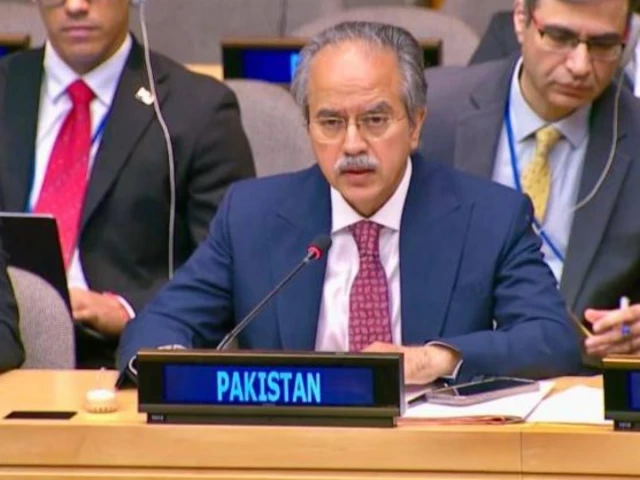
Permanent representative to the United Nations Ambassador Asim Iftikhar Ahmad told the UN Security Council on Wednesday that terrorism from Afghan soil poses the “gravest threat” to Pakistan’s security, as the Taliban support terrorist groups and allow them safe passage to operate across the border with impunity and free will.
“Afghanistan is once again a safe sanctuary for terrorist groups and proxies, with devastating consequences and mounting security challenges for its immediate neighbours, particularly Pakistan, and the region and beyond,” Ambassador Asim Iftikhar Ahmad, permanent representative of Pakistan to the UN, said during a debate on the situation in that country.
“Terrorist entities including ISIL-K, Al-Qaeda, TTP, ETIM, BLA and Majeed Brigade enjoy safe havens in Afghanistan’s territory, with dozens of terrorist camps enabling cross-border infiltration and violent attacks including suicide bombings,” he said, adding there was evidence of collaboration among these terrorist groups through joint training, illicit weapons trade, refuge to terrorists, and coordinated attacks against Pakistan using the Afghan soil.
“And not surprisingly, one detractor in the region, opportunist, and spoiler, as ever has moved fast to intensify its sponsorship of terrorist activity through material, technical and financial support, to terrorist groups and proxies active against Pakistan from Afghan soil,” the Pakistani envoy said in an obvious reference to India, whose relations with Taliban have significantly improved leading to reopening of the Indian embassy in Kabul.
Indeed, India’s speech in the Council was in sharp contrast to its past denunciation of Taliban policies. India, Ambassador Parvathaneni Harish said, “deeply values its civilizational relationship and centuries-old bonds of friendship with Afghanistan, and this history continues to guide our actions in forging deeper ties” with Afghans.
In his remarks, Ambassador Asim Ahmad, the Pakistani envoy, said that Pakistan had engaged with the Taliban authorities regularly over the past four years, but regrettably instead of seeing them take concrete, effective and decisive actions against terrorist groups, “we saw a steep surge in terrorist attacks against Pakistan; planned, financed and orchestrated using Afghan soil under their watch.”
Read: Pakistan considers options as US halts Afghan relocation
“Just this year alone, we have lost close to 1,200 lives to terrorism emanating from Afghanistan. Since 2022, more than 214 Afghan terrorists, including suicide bombers, have been neutralised in Pakistan during CT (counter terrorism) operations”.
He linked border clashes directly to terrorism and security, and urged UNAMA (UN Assistance Mission in Afghanistan) to provide an objective assessment of border security.
Pakistan has supported the dialogue process in Doha and Istanbul, the Pakistani envoy said. But if the Taliban does not take concrete and verifiable action against terrorist groups, Pakistan will take all necessary defensive measures.
Having hosted Afghan refugees for over four decades, Pakistan also believes that Afghans should return to their country in a dignified and orderly manner, he added.
Ambassador Asim Ahmad also said that the Taliban’s continued restrictions on women and girls were “inconsistent with Islamic traditions and norms of Muslim society, as also highlighted by OIC countries on several occasions”.
Pakistan, he said, fully shares the concerns of the international community on the issue of human rights, particularly women's and girls' rights in Afghanistan.
“No country desires peace and stability in Afghanistan more than Pakistan,” the Pakistani envoy added, urging the Taliban to promote a conducive environment for sincere dialogue, address Pakistan’s legitimate security concerns, and come out of a “state of denial” that serves no one.
Read more: Afghanistan: the question of Pakistan's complaints
On her part, the United States’ delegate said, “Quite simply, the Taliban are not good-faith interlocutors, and they do not care about the well-being of the Afghan people.” They (Taliban) manipulate international support, ignore Afghans’ basic needs and demonstrate little willingness to meet their international commitments.
If the Taliban prevents the United Nations Assistance Mission in Afghanistan(UNAMA) from carrying out its tasks, then the Council should consider realigning its mandate to this reality, she said.
Briefing the 15-member Council, Deputy Special Representative of the Secretary-General for Afghanistan Georgette Gagnon, and the UN Emergency Relief Coordinator Tom Fletcher, said nearly half the population will need protection and humanitarian assistance in 2026.
"Women and girls remain 'systematically excluded' from almost all aspects of public life," Ms Gagnon said, as the ban on secondary and higher education for girls has now entered its fourth year, depriving the country of future doctors, teachers and leaders.
“Media freedom is increasingly restricted. Journalists face intimidation, detention and censorship, reducing the space for public debate and public participation,” she added.
Afghans – both women and men – also face daily intrusions under the de facto authorities’ law on the “propagation of virtue and prevention of vice,” she added, describing a pattern of systematic interference in private life.
At the same time, humanitarian needs are surging. Fletcher, the UN humanitarian aid chief, said that nearly 22 million people will need assistance next year, with Afghanistan now ranking among the world’s largest humanitarian crises.
Also read: No inkling of Pak-Afghan Taliban talks in Saudi Arabia, says FO
“For the first time in four years, the number of people facing hunger has gone up,” he warned. Some 17.4 million Afghans are now food insecure, while massive funding cuts have left the response “stretched to breaking point.”
More than 300 nutrition delivery points have closed, leaving 1.1 million children without lifesaving nutrition, while 1.7 million face the risk of death without treatment. The health system is also buckling: 422 health facilities were closed in 2025, cutting three million people off from lifesaving care.
Adding to the strain, Afghanistan has seen record refugee returns, with over 2.6 million Afghans returning in 2025 alone, bringing the two-year total to more than four million. Most arrive with few possessions and are absorbed into already impoverished communities.
“Women and children made up 60% of all returns this year,” Fletcher noted, returning to a country where women are barred from education, work and in some cases, healthcare.













This material may not be published, broadcast, rewritten, redistributed or derived from. Unless otherwise stated, all content is copyrighted © 2026 The Express Tribune.







COMMENTS (1)
Comments are moderated and generally will be posted if they are on-topic and not abusive.
For more information, please see our Comments FAQ