Oil rises, stocks waver as new US strikes dampen peace deal hopes
Updated 11 hours ago

BIS flags risk as yellow metal and stocks rally in tandem for first time in 50 years indicating market fragility
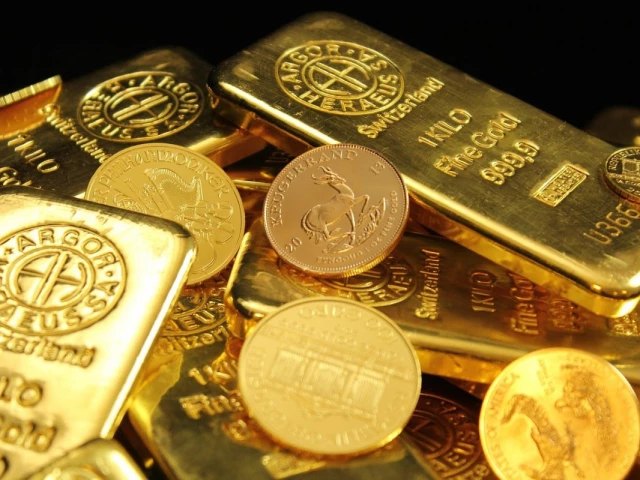
Gold prices in Pakistan increased on Monday, mirroring gains in the international market as investors awaited the US Federal Reserve's policy meeting. Expectations of an interest rate cut kept the dollar subdued, helping drive bullion demand. Domestically, gold per tola rose by Rs1,600 to Rs443,762, while the 10-gram rate reached Rs380,454, up Rs1,372, according to the All Pakistan Sarafa Gems and Jewellers Association (APGJSA). The uptick follows a recent dip, when gold fell to Rs442,162 on Saturday. Internationally, spot gold gained 0.4% to $4,214.41 per ounce, while US gold futures for February delivery held steady at $4,243.50 amid cautious market sentiment.
Meanwhile, a simultaneous surge in gold and global equity markets, a correlation rarely observed in more than fifty years, has raised alarm among global monetary monitors, particularly the Bank for International Settlements (BIS). Often referred to as the central bank of central banks, the BIS has cautioned that this unexpected co-movement signals increasing fragility in financial markets and may reflect an emerging asset bubble. According to Reuters, the institution warns that markets are being driven not by traditional fundamentals, but by excess liquidity, investor speculation and geopolitical uncertainties, resulting in conditions that could reverse sharply if stimulus or sentiment weakens.
Gold's extraordinary performance lies at the heart of these concerns. Prices have risen nearly 60% since early 2025, marking what could be the biggest annual gain since 1979. Typically, gold rallies when equities weaken, acting as a safe haven when markets wobble. Yet the present landscape shows both asset classes rising together, powered simultaneously by enthusiasm for artificial intelligence stocks and by aggressive accumulation of bullion by central banks. This pairing is historically unusual, and analysts believe it reflects anxiety regarding the future of the dollar as well as a high appetite for risk.
Adnan Agar, Director at Interactive Commodities, said the situation reveals deeper global realignments. Gold demand, he noted, is being supported heavily by sovereign institutions, suggesting that without continuous central bank buying, prices could fall by as much as $1,000 to $1,500 per ounce. Meanwhile, retail buyers, priced out of gold, are shifting interest towards silver, which has outperformed gold on a percentage basis. Copper and platinum are also rallying, creating a rare four-metal rise driven by strategic stockpiling. Agar described this trend as a "metal war," similar to the past scramble for rare earth elements, with China, India and Turkey accelerating purchases to reduce reliance on the US dollar.
At the same time, the US equity boom is being propelled overwhelmingly by a handful of technology leaders, including Apple, Microsoft, Google and semiconductor giant Nvidia, now valued at nearly $4.4 trillion. With sovereign wealth funds from China, Japan, Saudi Arabia and Norway also deeply invested, global powers have a direct stake in sustaining US market strength. The Nasdaq's dramatic climb from 8,000 in 2020 to around 26,400 today illustrates the dominance of this concentrated rally, even after surviving a tariff-driven correction earlier this year and rebounding swiftly. The analyst warned that the world is now witnessing a twin-engine rally built on de-dollarisation and AI optimism. But if either driver falters, central bank buying or tech-market momentum, the synchronised ascent could just as quickly turn into a synchronised collapse.
Furthermore, the Pakistani rupee inched up against the US dollar on Monday, closing at 280.41, up by Re0.01 in the inter-bank market.
Over the previous week, the currency also posted a marginal gain of Rs0.10 (0.04%), settling at 280.42 from 280.52, according to the State Bank of Pakistan (SBP).






This material may not be published, broadcast, rewritten, redistributed or derived from. Unless otherwise stated, all content is copyrighted © 2026 The Express Tribune.













COMMENTS
Comments are moderated and generally will be posted if they are on-topic and not abusive.
For more information, please see our Comments FAQ