Mahira Khan, Hina Rabbani Khar and more to attend Harvard conference
Updated 1 hour ago

Global broadcasters gather in Yangjiang as China urges deeper cultural ties and tech-driven cooperation
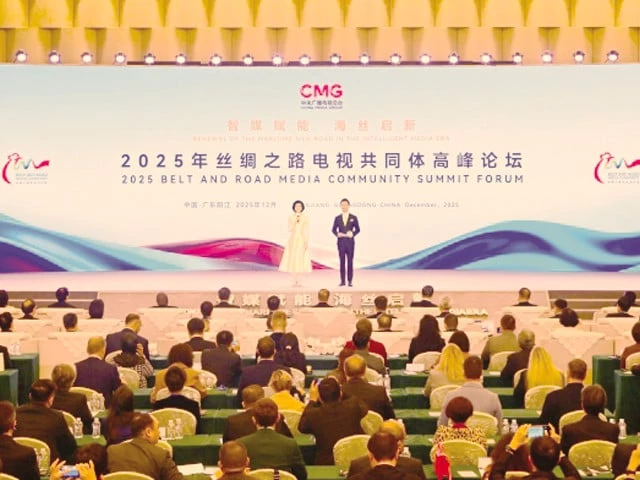
The port city of Yangjiang plays host to a gathering that underscores China's ambition to refashion global media ties, as nearly 300 delegates from 20 countries arrived for the 2025 Silk Road TV Community Summit.
Under the theme 'Smart Media Empowers, Maritime Silk Road Embarks Anew', the summit is framed as evidence that the Belt and Road Initiative (BRI) has matured from hard infrastructure into deeper human connections, with Guangdong positioning itself at the centre of that evolution.
Shen Haixiong, president of China Media Group, called for reviving the Silk Road ethos of "peaceful cooperation, openness, inclusiveness, mutual learning and mutual benefit" at a time of global unease. He highlighted "Four Global Initiatives" to promote a shared future narrative.
Provincial publicity chief Hu Jinjun said the summit mirrors China's latest phase of modernisation, inviting international partners to tap Guangdong's industrial weight, expand cultural exchanges and build "win-win" media partnerships capable of reinforcing narratives.
Speakers from the Asia-Pacific Broadcasting Union, Arab States Broadcasting Union and African Union of Broadcasting, addressing the summit via video links, praised the forum as a reliable platform for recalibrating media alliances and steering global broadcasters through rapid technological and geopolitical shifts.
Kenya's Media Council Chairman Joseph Maina Mururi warned that digital technologies are rewriting the rules of information flow, arguing that the BRI can help connect Africa's expanding markets with China's technical strengths to form a more inclusive media ecosystem capable of narrowing cultural divides.
China International Television Corporation Chairman Jiang Haiqing unveiled the community's annual report and the "Yangjiang Initiative," a blueprint urging stronger technology-enabled media cooperation, support for green development and renewed storytelling around the Maritime Silk Road's expanding footprint.
Panel sessions probed industrial uses of AI-generated content, international collaboration and cultural exchange, while new projects were rolled out, including joint communication drives, a co-produced micro-documentary, multilingual FAST TV translations and the expansion of CGTN Spanish broadcasts in Latin America.
Formed in 2016, the Silk Road TV Community now unites 149 member institutions from 64 countries, growing into the world's first all-media alliance themed on the Silk Road and a prominent platform for cross-border film and television exchanges anchored in China's evolving global outreach.








1725429132-0/Untitled-design-(12)1725429132-0-208x130.webp "widespread rain thunderstorms expected across country from april 1 pmd")





This material may not be published, broadcast, rewritten, redistributed or derived from. Unless otherwise stated, all content is copyrighted © 2026 The Express Tribune.






COMMENTS
Comments are moderated and generally will be posted if they are on-topic and not abusive.
For more information, please see our Comments FAQ