Govt slashes jet fuel price by Rs48 per litre
Updated 1 hour ago

Shahdara, Kahna Nau, FMD Research Centre corridor cross 300 threshold, entering ‘very unhealthy’ to ‘hazardous’ range
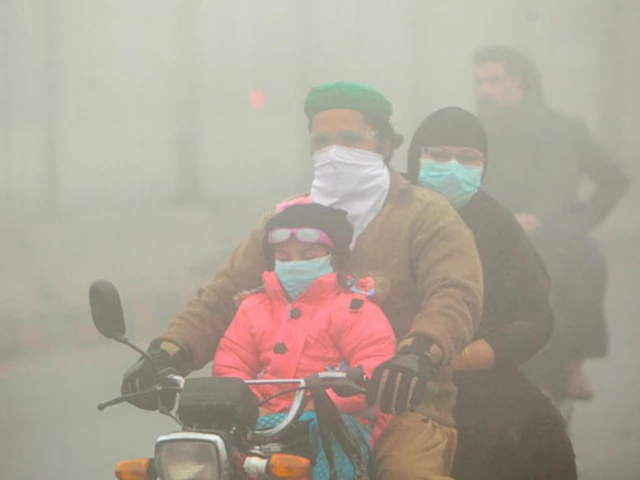
Air quality across Punjab deteriorated sharply on Saturday, with Lahore once again ranking as the world’s most polluted city after stagnant winter conditions trapped heavy particulate matter over the province.
Fresh data from the Environment Protection Agency (EPA) placed Lahore’s average Air Quality Index at 288, while several monitoring stations — including Shahdara, Kahna Nau and the FMD Research Centre corridor — crossed the 300 threshold, entering the 'very unhealthy' to 'hazardous' range.
The Punjab-wide AQI averaged 211, indicating province-wide stress. Districts such as Narowal, Khanewal, Hafizabad, and Kasur also recorded critically high values, prompting authorities to extend a province-level alert for a third consecutive day.
Officials attributed the surge to a mix of local emissions and transboundary pollution driven by shifting northwesterly winds. A shallow westerly wave now moving across the upper parts of the country, combined with prevailing continental air, has slowed dispersion of pollutants — a pattern the Pakistan Meteorological Department (PMD) warns is likely to persist through the weekend.
Under directives from Chief Minister Maryam Nawaz Sharif, environmental and administrative departments remain on round-the-clock duty. Field teams have intensified inspections of industrial zones, brick kilns and transport corridors. Drone surveillance is being used to detect crop-burning hotspots, while scientific mapping tools are tracking the inflow of pollution from border regions and major industrial belts.
Senior officials said the government’s rapid-response system is operating at full capacity, with enforcement squads, water bowsers and air-quality monitoring teams deployed across Lahore. Public advisories urge residents — especially children, the elderly and people with asthma or chronic respiratory illness — to reduce outdoor exposure, wear protective masks and seek timely medical care in case of breathing difficulties.
Weather outlook signals little relief
The latest PMD forecast, issued on Saturday evening, suggests little improvement in visibility or air dispersion over Punjab’s plains.
On Sunday, cold and dry weather will dominate most regions, with particularly frigid conditions in northern areas during morning and night hours. Partly cloudy skies are anticipated in Gilgit-Baltistan, Kashmir, northern Balochistan and upper Khyber-Pakhtunkhwa. The PMD again warns of persistent smog and fog across the plains of Punjab and K-P during night and early-morning hours, limiting visibility for motorists and further constraining air quality.
The coldest temperatures on Saturday were led by Leh at –9°C, followed by Skardu and Gupis at –5°C. Kalat, Dir, Bagrote and Gilgit each recorded lows of –3°C, underscoring the onset of peak winter across the upper half of the country.
Health experts warn that the current AQI levels — particularly in areas exceeding 300 — can trigger respiratory distress, eye irritation and reduced lung function. People have been advised to use air purifiers where possible, keep windows closed during high-pollution hours and avoid early-morning outdoor activity, when smog concentrations are typically at their peak.
With Lahore again topping global pollution charts — surpassing Delhi, Kolkata, Dhaka and Bishkek — provincial authorities say sustained public cooperation will be critical as Pakistan moves deeper into the smog-prone winter stretch.














This material may not be published, broadcast, rewritten, redistributed or derived from. Unless otherwise stated, all content is copyrighted © 2026 The Express Tribune.






COMMENTS (1)
Comments are moderated and generally will be posted if they are on-topic and not abusive.
For more information, please see our Comments FAQ