Over 1,000 Hollywood figures oppose Paramount-WB merger
Updated 10 hours ago

'Actor in Law', 'Umro Ayyar', and 'Taxali Gate' screen at FIFF in Shiraz
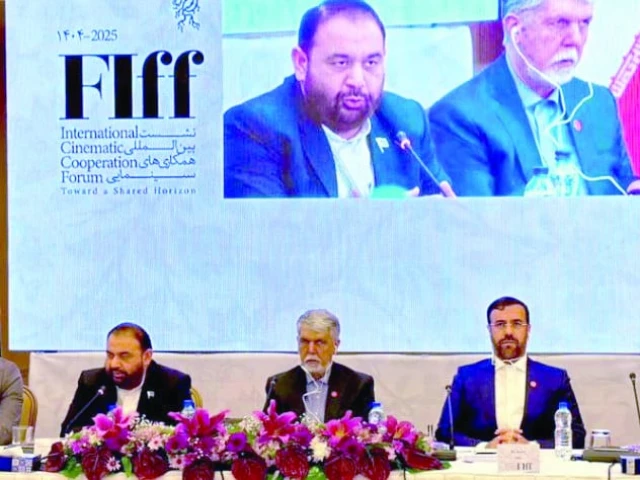
Pakistan's participation in the 43rd Fajr International Film Festival (FIFF), held in the historic city of Shiraz, Iran, marked a significant milestone in South Asian cultural engagement and cinematic diplomacy, Iranian media reported.
Leading the national delegation, Culture Minister Aurangzeb Khichi was invited as a special guest, accompanied by prominent Pakistani filmmakers. His presence underscored Pakistan's commitment to promoting cultural cooperation, artistic exchange, and regional tourism through cinema.
Speaking at an even as part of the festival, Khichi highlighted the historical, social, and religious ties shared by Pakistan and Iran, emphasising cinema as a powerful medium for enhancing cultural identity and fostering people-to-people connections.
He stressed that the exchange of films between Pakistani and Iranian cinemas would deepen mutual understanding and provide opportunities for joint projects. He reaffirmed Pakistan's determination to revitalise its film sector and hoped for further collaboration with Iran.
For the first time, three Pakistani films were screened at the festival, signalling growing recognition for the country's film industry. The films — 'Actor in Law', 'Umro Ayyar: A New Beginning', and 'Taxali Gate' — span diverse genres, storytelling traditions, and cinematic styles, reflecting the evolving creativity of Pakistani cinema.
The FIFF, now in its 43rd edition, is renowned for its rich heritage and international prestige. Set against Shiraz's backdrop of poetry, architecture, and history, the festival has become a prominent platform for filmmakers to present socially relevant, artistically bold, and culturally grounded works.
Participation in such a prestigious event elevates Pakistan's presence in regional cinema networks, providing a forum for critical engagement, cultural diplomacy, and potential collaboration across borders.
Pakistan's delegation actively engaged in festival events, including visits to the Pakistan Pavilion and meetings with Iranian cultural authorities. Minister Khichi met with the chairman of the Cinematic Foundation of Iran, inviting him to Pakistan to explore joint film projects.
During the festival, discussions focused on promoting co-productions, exchange of expertise, and utilisation of filming locations across both countries. Delegates explored student training programmes, collaborative workshops, and joint screenings, highlighting cinema's capacity to foster dialogue, understanding, and peace.
Iranian authorities, including Minister of Culture Seyed Abbas Salehi, Raed Faridzadeh of the Iranian Cinema Organisation, and Fars Province Governor Hossein Ali Amiri, emphasised cinema's unifying potential, linking cultural heritage with modern storytelling.
The festival itself hosted a comprehensive programme with over 60 films across multiple sections, including International Competition, Eastern Vista, Future Frame, and the Broken Olive Branch, alongside non-competitive showcases such as Retrospective & Restorations and Festival of Festivals.
Notable winners included Hungary's 'Lesson Learned', awarded the Crystal Simorgh for Best Film, and Martin Pavol Repka, honoured for Best Director for 'March to May'. Russian film 'Where the White Cranes Dance' won Best Film in the Eastern Vista category.
Tunisia's 'Round 13' and Iran-Australia-Canada co-production 'Two Faces of Autumn' jointly received Best Film recognition in the Future Frame segment. The Broken Olive Branch category, which spotlighted politically and socially resonant works, awarded 'All That's Left of You' as Best Film, reflecting the festival's commitment to highlighting global perspectives.
For Pakistan, the event provided not only international visibility but also practical opportunities for co-productions, joint workshops, and exchange programmes for filmmakers, thereby strengthening the nation's creative economy.
The festival also offered a chance for Pakistani filmmakers to engage in workshops, film viewings, and dialogue with international counterparts. These interactions foster professional development, knowledge sharing, and exposure to emerging technologies and cinematic trends, further supporting the growth of Pakistan's film industry.
Film screenings at the festival serve as a form of cultural memory, capturing societal experiences, humour, struggles, and aspirations. For Iranian audiences, Pakistani films provided insights into contemporary life, while Pakistani participation symbolised growing recognition and national pride.
These measures promise to strengthen cultural diplomacy, enhance tourism, and deepen creative collaboration between both nations. The 43rd FIFFconcluded on December 2 with an awards ceremony at the Honar Shahr Aftab Cineplex in Shiraz.
By combining art, diplomacy, and tourism, Pakistan's presence at the festival has opened new avenues for international collaboration, audience engagement, and economic opportunity. It represents a milestone for Pakistani cinema, demonstrating how creative industries can serve as instruments of soft power, cultural exchange, and regional solidarity.











This material may not be published, broadcast, rewritten, redistributed or derived from. Unless otherwise stated, all content is copyrighted © 2026 The Express Tribune.





COMMENTS
Comments are moderated and generally will be posted if they are on-topic and not abusive.
For more information, please see our Comments FAQ