Artisans in Britain, Germany and France craft the Royal Opera House's new curtains
Updated 2 hours ago

Doha's first film festival leans into bold political cinema
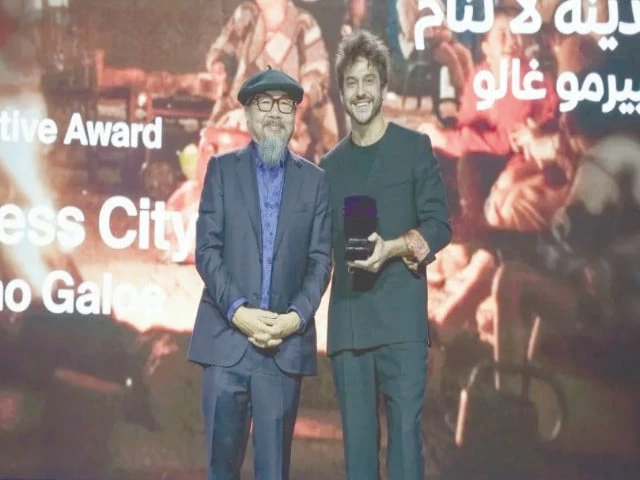
The inaugural Doha Film Festival closed with a clear sense of purpose as Guillermo Galoe's 'Sleepless City' claimed Best Film, capping a week that festival director Fatma Hassan Alremaihi framed as a push to champion daring cinematic voices.
Galoe's film, a hybrid drama rooted in Europe's largest informal settlement, quickly became the symbol of an edition leaning unmistakably toward politically engaged storytelling.
The narrative prize jury, led by acclaimed filmmaker Rithy Panh and comprising Raja Amari, Brigitte Lacombe, Dhafer L'Abidine and Alessandra Speciale, selected 'Sleepless City' unanimously.
They praised its sensitive fusion of fiction and documentary and called it a powerful reflection of contemporary youth struggles shaped by the clash between tradition and modernity.
Shot over several years in Madrid's La Cañada Real, the film focuses on 15-year-old Toni as looming demolitions threaten the fragile home he shares with his scrap-dealer family.
Rather than heightening tension, Galoe lets ordinary gestures build into a portrait of a rarely represented community. Its success offered the festival an early emblem of its global range, stretching from Spain and Brazil to Palestine, Libya and Sudan.
'The Reserve' earned a Special Mention for its tense portrayal of a forest ranger confronting environmental collapse in rural Mexico, a narrative underscoring the festival's appetite for films blending personal stakes with broader crises.
The Best Performance Award was shared by Majd Eid and Nader Abd Alhay for their roles in 'Once Upon a Time in Gaza', which earlier won best director in Cannes' Un Certain Regard.
Best Artistic Achievement went to Kamal Al Jafari for 'With Hasan in Gaza' and Chie Hayakawa for 'Renoir', two works applauded for their layered use of archival material and delicate visual construction, each reshaping memory into new cinematic textures.
In the international short film competition, jury head Eddie Bertozzi led a panel that singled out Leonardo Martinelli's 'Samba Infinito' for its confident belief in cinema's capacity to heal private and social wounds.
The short-film jury also honoured Aria Sánchez and Marina Meira, awarding Best Director for 'Primary Education', a sharp examination of conformity and power among schoolchildren. Its compact structure impressed jurors with its clarity and bite.
Milica Janevski won Best Performance for her role in 'Upon Sunrise', portraying a Serbian mother pushed to psychological and material limits as she attempts to keep her family afloat amid mounting pressures that test her resolve.
Two Special Mentions rounded out the short-film honours, recognising 'L'Mina' and young actor Ammar Ahmed for his role in 'Zizou', with both works noted for inventive storytelling that stretched beyond conventional short-film boundaries.
The festival's youth jury delivered one of the event's most striking statements by awarding the Ajyal Feature Award to 'The Voice of Hind Rajab', a reconstruction of the final phone call of a 6-year-old girl trapped under fire in Gaza.
The Ajyal Short Award went to 'Sulaimani', Vinnie Ann Bose's Paris-set animated work following two young women from Kerala whose chance meeting becomes an exploration of memory and diaspora shaped through the language and rituals of food.
Doha's commitment to cultivating local filmmaking emerged clearly in the 'Made in Qatar' awards, where Justin Kramer's 'Fahad the Furious' won Best Film. The short blends family drama with comedic misunderstandings.
Rashid Al Sheeb received the Abdulaziz Jassim Award for Performance for his role in 'Fahad the Furious', with the jury praising the quiet emotional rhythms he brought to a story grounded in generational tension inside a traditional household.
Eiman Mirghani was named Best Director for 'Villa 187', a story of memory and displacement after a family forced to leave the Doha home that shaped their identity across decades, a narrative that echoed wider regional experiences of rapid change.
'Project Aisha' received a Special Mention for its tense depiction of a mother whose unconventional attempts to care for her injured daughter strain family loyalties and test the limits of desperation within an ordinary domestic environment.
Suzannah Mirghani's 'Cotton Queen' won the Audience Award, extending the world she introduced in her acclaimed short 'Al-Sit'. The feature follows teenage Nafisa in a Sudanese village caught between tradition and modernisation, mirroring the film's own wartime production challenges.
Shot with Sudanese refugees in Egypt recreating the village, 'Cotton Queen' resonated deeply with viewers, who responded to its intertwining of resilience, cultural memory and personal transformation during a period of national upheaval.
Across its 97 films from 62 countries, the festival positioned itself as a platform invested equally in inventive cinema, political urgency and emerging local talent, offering a programme that felt energetic rather than tentative for a first edition.
Industry activity around the festival pointed to Qatar's ambitions to become a hub for international production, but the programming itself did the heavier lifting, projecting a confident curatorial identity rather than a purely infrastructural pitch.
By the week's end, Doha had introduced itself as a place aiming to attract filmmakers from around the world while building a durable creative ecosystem at home, a dual focus reflected in a set of winners unified by conviction, craft and thematic clarity.
For a debut edition, the festival showed unusual coherence, suggesting that its future may depend less on spectacle and more on its ability to remain a crossroads for stories that challenge, extend and complicate the global cinematic conversation.














This material may not be published, broadcast, rewritten, redistributed or derived from. Unless otherwise stated, all content is copyrighted © 2026 The Express Tribune.




COMMENTS
Comments are moderated and generally will be posted if they are on-topic and not abusive.
For more information, please see our Comments FAQ