- 11 Feb 2011
Egypt unrest: Mubarak confounds all - 11 Feb 2011
Mubarak says to delegate powers to VP Suleiman
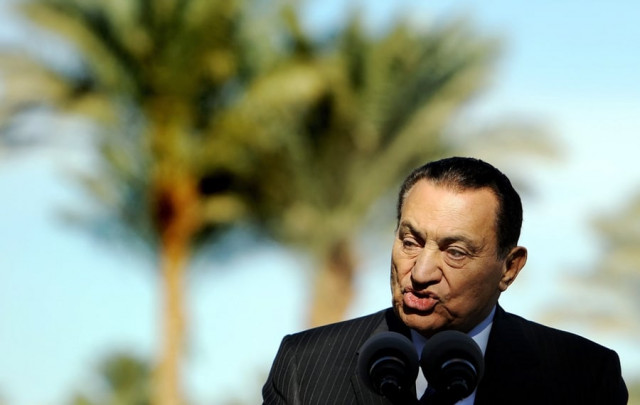
Hosni Mubarak stepped down after 18 days of protests across Egypt. PHOTO: AFP
CAIRO: Hosni Mubarak stepped down as Egypt’s president on Friday, handing over to the army and ending three decades of autocratic rule, bowing to escalating pressure from the military and protesters demanding that he go.
Vice President Omar Suleiman said a military council would run the affairs of the Arab world’s most populous nation. A free and fair presidential election has been promised for September.
A speaker made the announcement in Cairo’s Tahrir Square where hundreds of thousands broke down in tears, celebrated and hugged each other chanting: “The people have brought down the regime.” Others shouted: “Allahu Akbar (God is great).
The 82-year-old Mubarak’s downfall after 18 days of unprecedented mass protests was a momentous victory for people power and was sure to rock autocrats throughout the Arab world and beyond.
Egypt’s powerful military gave guarantees earlier on Friday that promised democratic reforms would be carried out but angry protesters intensified an uprising against Mubarak, marching on the presidential palace and the state television tower.
It was an effort by the army to defuse the revolt but, in disregarding protesters’ key demand for Mubarak’s ouster now, it failed to calm the turmoil that has disrupted the economy and rattled the entire Middle East.
The military’s intervention was not enough.
The tumult over Mubarak’s refusal to resign had tested the loyalties of the armed forces, which had to choose whether to protect their supreme commander or ditch him.
The sharpening confrontation had raised fear of uncontrolled violence in the most populous Arab nation, a key US ally in an oil-rich region where the chance of chaos spreading to other long stable but repressive states troubles the West.
Washington has called for a prompt democratic transition to restore stability in Egypt, a rare Arab state no longer hostile to Israel, guardian of the Suez Canal linking Europe and Asia and a major force against militant Islam in the region.
The army statement noted that Mubarak had handed powers to govern the country of 80 million people to his deputy the previous day — perhaps signalling that this should satisfy demonstrators, reformists and opposition figures.
“This is not our demand,” one protester said, after relaying the contents of the army statement to the crowd in Cairo’s central Tahrir Square. “We have one demand, that Mubarak step down.” He has said he will stay until September elections.
The Muslim Brotherhood, an opposition group, urged protesters to keep up mass nationwide street protests, describing Mubarak’s concessions as a trick to stay in power.
Reforms too little too late
Hundreds of thousands of protesters rallied across Egypt, including in the industrial city of Suez, earlier the scene of some of the fiercest violence in the crisis, and the second city of Alexandria, as well as in Tanta and other Nile Delta centres.
The army also said it “confirms the lifting of the state of emergency as soon as the current circumstances end”, a pledge that would remove a law imposed after Mubarak became president following Anwar Sadat’s assassination in 1981 and that protesters say has long been used to stifle dissent.
It further promised to guarantee free and fair elections and other concessions made by Mubarak to protesters that would have been unthinkable before January 25, when the revolt began.
But none of this was enough for many hundreds of thousands of mistrustful protesters who rallied in cities across the Arab world’s most populous and influential country on Friday, fed up with high unemployment, a corrupt elite and police repression.
Since the fall of Tunisia’s long-time leader Zine al-Abidine Ben Ali, which triggered protests around the region, Egyptians have been demonstrating in huge numbers against rising prices, poverty, unemployment and their authoritarian regime.
Emergency laws
World powers had increasingly pressured Mubarak to organise an orderly transition of power since the protests erupted on January 28 setting off an earthquake that has shaken Egypt sending shock waves around the Middle East.
Mubarak, 82, was thrust into office when his predecessor, Anwar Sadat, was gunned down at a military parade in 1981.
The burly former air force commander has proved a far more durable leader than anyone imagined at the time, governing under emergency laws protesters say were used to crush dissent.
The president has long promoted peace abroad and more recently backed economic reforms at home led by his cabinet under Prime Minister Ahmed Nazif. But he always kept a tight lid on political opposition.
Mubarak resisted any significant political change even under pressure from the United States, which has poured billions of dollars of military and other aid into Egypt since it became the first Arab state to make peace with Israel, signing a treaty in 1979.
More in World
White revolution: Deliverance.
This is the way of rulers and dictators.
Long live the peopleRecommend
nothing can stop an idea whose time has come.Recommend
After Al-Mighty Allah, the biggest power on earth if of the people of any nation.
Egyptians have shown that they have the power to change and more changes are likely to be taken in Middle East Countries.
Hosni Mubarak has become relic of the past.Recommend
I do not bliev dis . . . . . . he wud like to B in power till his death . . . . Recommend
Cheers !!Recommend
Whose next!Recommend
Stubborn fox can not become a tiger. You can kill the persons but not an idea.Recommend
May Egypt once again stand as a beacon for the oppressed of the world! Power to the people!Recommend
Let’s march to the NA,Constitution Avenue. Islamabad is next.Recommend
what AbouAzizi did in Tunisia had made a name for himself in history..RIP…. a domino effect has started lets see who is next to go out in the middle east……bravo to the Egyptian people for their bravery and heroism against all odds……..Recommend
when will this finally happen in Pakistan, can any one tell me? We r very much in need of this!Recommend
I believe if the true change has to come to Egypt then Mubarak resigning isn’t enough.The Egyptian people must stay on the streets till they change the system like in Iran when it took a year of protests.Handing power over to council of armed forces and the CIA’s man Omer Sulaiman won’t bring any geniune transition to rule, that will be just a change of a face not that of the system.Recommend
Next turn is ours. Come forward Pakistanis.Recommend
Wonderful news. Next the Three “A’s” yes Abdullah’s of the Middle East and one “Z” of ours. A to Z. Recommend
Wow what a remarkable victory for the people of Egypt – The best part is that there wasn’t any bloodshed.
People of Pakistan will derive a lot of inspiration and courage from this Victory of a Common Man.Recommend
@Abira Khalid: I agree with youRecommend
Before we start dreaming of a similar revolt in Pakistan, we must prioritize the incentives of such a revolution. Toppling governments and leaders will be viewed as a violation of democratic principles in Pakistan since we are, theoretically, a representative democracy.Recommend
Wake up Pakistan .. remember, there is nothing more powerful than non-violence. Recommend
In the wake of Victory Friday in Tunisia, and Freedom Friday in Egypt, Qaddafi and Gilani jointly announced to abolish all Fridays, effective immediately …Recommend
alhumdulillahRecommend
Pakistan went through same phase, when Ayub Khan was tthrown out of power in 1969. He was driven out of power, by the power of the people. However, later on power was userp by civilian and military dictators, which resulted in the dismemberment of Pakistan. Let us hope the hard won freedom of Egyptians is not stolen by another military dictator controlled by foreign interest. It is going to be rough road ahead to the path of democracy.
It is a wake up call for other brutal regimes in the muslim world to look at their ways of treating their own people.
In Pakistan it is important now, more than ever for the government to take serious measures, to remove corruption, and to remove disparity between the have and have nots. The first step in that direction should be to return the stolen wealth. As long as these ugly and corrupt characters do not leave the scene of politics, any measure taken will not be sincere.Recommend
@Abira Could you, please, point out what change or changes occurred in Iran? In place of a the US backed dictator, a bunch of religious thugs hijacked Iranian people’s long struggle against Shah Iran. I do not understand why most of us believe that Iran has undergone a revolutionary change under religious regime. Please spare some time to collect figures about poverty, suppression, and extreme exploitation being carried out by these so-called revolutionaries. All the power and resources are now under strict control of religious elites, while people are still deprived as they were during Shah’s time.Recommend
Cheering at this moment is premature. The man who was the face of the system has been forced out. But what of the system?
The system that nurtured despots like Mubarak is the real threat to freedom for the Egyptians.
This system will not be easily overturned, because it is in the interests of external powers as well as some segments of the Egyptian establishment to maintain it, come what may.
Mubarak has been sacrificed by the ‘system’ in the greater good of maintaining the system in power.
The road to freedom has only just begun, and it is my hope that it endures and does not run out of steam merely with the removal of Mubarak.Recommend
The ‘change’ I talked about was the transition of power to the will of the people,in Egyptians words change of the ‘regime’ and if that has to come, like Omar says hope this revolution continues till the change of the system, which takes time posiibly years. Iranian revolution DID bring the change over a year of struggle; where the will of the people prevailed over a system governed by external powers. How that has changed living of a common man in Iran is a different debate altogether.Recommend
@Abira
“The Egyptian people must stay on the streets till they change the system like in Iran…”
Do you really know what has happened to Iran after that “revolution”? Iran was doing much better on military and economic front while the Shah was incharge. The people were looking for freedom of expression and took to the streets, to gain what? Iran is now isolated in the world, with it’s economy in worse condition, in addition to lack of freedom of expression that still prevails in that country. These so called “revolutions” are funded and only exploit people’s concerns. Lets see now what Egypt gains in the years to come.Recommend
For those who are rejoicing over removal of one of the “our kind of guy”, must read the article below. Egyptians, please, welcome another “our kind of guy”.
http://english.aljazeera.net/indepth/opinion/2011/02/201127114827382865.htmlRecommend
@amjad:
This is so true. However, I would like to add similar situation against Mr.Z.A.Bhutto during PNA movement. PNA movement is another classical example of so-called people’s revolution, engineered and directed by external forces with the help of their “kind of guys”. Pakistani military remained neutral against protesters, as most of the protesters were planted by military establishment, did by Egyptian military during these protests. Finally, military removed, Mr.Bhutto, from the scene for good. The ultimate end of the people’s revolution was appearance of another “our kind of guy” Gen.Zia, who faithfully served the masters and fought proxy war against the USSR. Recommend
@ meerza
I beg you to read the complete sentence so that you may comprehend what I have been trying to say in my posts and prevent from quoting out of context. ‘ The Egyptian people must STAY on the streets till they change the system like in Iran WHEN IT TOOK A YEAR OF PROTESTS ‘ I have claerly been talking of the time it takes for a system to change, it doesnot happen overnight with a change of a face.Recommend