US-Iran conflict and global disorder
Updated 12 hours ago

No regional consensus exists for war with Iran
The US-Iran talks in Geneva culminated with no specific agreement reached between the two countries. Had it been just about the US and Iran, we might have witnessed an agreement of some sort between the two countries, but the real issue here is Israel and its uncompromising, aggressive posture against Iran. No American president can afford to ignore demands that come from Israel.
For now, Iranians have agreed to draw a written proposal to address the US concerns, and the US Secretary of State has also announced that he will be visiting Israel on 28 Feb 2026 to brief Prime Minister Benjamin Netanyahu on the US-Iran talks held in Geneva.
Apparently, the US is taking time to exhaust the diplomatic path before it resorts to any military action, but going by the recent US history with Iran, anything can happen. In June 2025, following five earlier rounds of indirect talks, a sixth round of the US-Iran nuclear negotiations was scheduled in Muscat, Oman, but the US sidestepped diplomacy and executed a surprise attack on the Iranian nuclear sites.
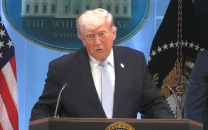
As of now the US president has spoken about a timeline of 10 to 15 days for the Iranians to reach a deal with the US, but given the recent history of Americans pulling up surprises one can assume that diplomatic activity aside, the American hubris — overconfidence in its power and vanity — and its prestige driven politics' may once again push the US to undertake a military action against Iran.
What, however, remains an unanswered question is why the US is in such a great hurry to resolve an issue that has been lingering on for decades? One should not forget that Prime Minister Netanyahu has been claiming since the early 90s that Iran is days away from achieving a nuclear capability.
Yet over three decades have passed, and there is no bomb in the basement as far as Iran is concerned. Officially, Iran is a signatory to the NPT, and that gives it the right to carry out uranium enrichment to pursue civil nuclear energy. Over the years, it has also shown willingness to forego weapon-grade enrichment and cooperate with the IAEA inspections, as was being done under JCPOA. So, why resort to military action and give deadlines and not pursue sustained diplomacy?
Maybe the US still considers that it has both the right and the ability to shape political outcomes around the continents all over the globe. But when hubris and vanity overinfluence policymaking, the policymakers of the aggressing nations usually end up neglecting and underestimating the resilience with which the aggressed nations may retaliate and deliver a counterpunch.
Two fundamental questions must be asked and rightly answered before deciding which instrument of power is best to use to defuse the Iranian issue. Diplomacy and not military action is the right way forward to resolve the Iranian issue. The Iranian enrichment capability, missile programme, asymmetric response capability through proxies and the ruling regime itself are the key issues of the joint American-Israeli concern.
But can these issues be resolved by undertaking a military action against Iran? The second question is more pertinent: Who wants a war? Given the consequences, no country in the Middle East except Israel wants a war with Iran, and that means that there is no regional consensus in undertaking the risk of fighting this war.
Neither Russia nor China wants this war. On termination of the US-Iran talks in Geneva, the Russian foreign minister expressed hopes for a diplomatic resolution of the issue and cautioned that last year's US strike on Iranian nuclear facilities could have triggered a nuclear incident, and the US should refrain from undertaking military strikes that may once again risk doing the same.
China imports 1.4 million barrels of oil per day from Iran, and one can imagine the consequences of such a war on Chinese manufacturing and industry. If there is a US-Israel dimension to this conflict, then one must not forget that there is a Russia-China and Iranian dimension to this conflict as well. As much as Israel nests with the US, the Iranians are also nesting with the Russians and the Chinese.
Even as I write, there are reports that the Russians and the Chinese have deployed naval vessels for joint naval exercises with Iran in the Strait of Hormuz. The US naval posturing, by deploying its carrier strike groups against Iran at this stage, is more to project power and signal its intent, but most importantly, an extreme coercive tactic to extract, under military pressure, a favourable deal and an Iranian submission on American terms.
Overconfidence in its own power has led the US to its fate in Korea, Vietnam, Afghanistan and Iraq, and one can only hope that the US will refrain from copying its hubris and militarised foreign policy and refrain from its overreach, especially when dealing with Iran.
No debate on the Iran nuclear deal can be complete unless we compare how President Obama and President Trump employed two different approaches to achieve the same end. Obama's strategic choice was to prevent nuclear escalation through negotiation rather than coercion.
Through the JCPOA, he put into practice regular IAEA inspections and verifications and topped it with a coalition diplomacy rather than unilateral threats of military action. He set aside hubris or vanity as preferred tools of American statecraft and chose a more dignified yet effective tool — diplomacy, backed by multilateral enforcement. There was no sinister goal of regime change, and the entire exercise was about nuclear risk reduction.
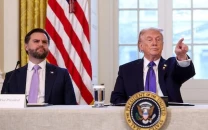
President Trump and his administration, instead of being motivated by hubris and vanity, may apply Obama's approach of pragmatic realism. A give-and-take approach under which the US can lift sanctions against Iran and provide it the opportunity and room to commit to a change in state behaviour to resolve broader geopolitical issues. Such an approach will have regional and global support. This approach would be seen as nondiscriminatory, more likely to lead to regional and global security.












This material may not be published, broadcast, rewritten, redistributed or derived from. Unless otherwise stated, all content is copyrighted © 2026 The Express Tribune.



COMMENTS
Comments are moderated and generally will be posted if they are on-topic and not abusive.
For more information, please see our Comments FAQ