Economic priorities
Planning for monsoon floods
The people speak
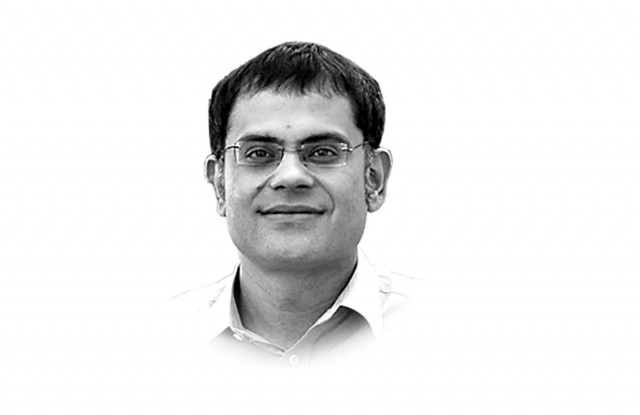
The writer is consulting editor, The Friday Times
Several self-styled analysts on ‘civil society’ have articulated contrarian views about the kind of choices they face, particularly with respect to forging alliances with political parties and avoiding the vigilantism that is the preserve of the extremists. The lawyers’ movement is being repeatedly cited as reference point without much introspection. Save a few exceptions, one is yet to hear a forceful condemnation of Islamabad lawyers’ love for Qadri.
We are faced with a deeper challenge today: Surviving as a plural society against a sectarian tide getting out of control. This is why engaging with the ‘political society’ is all the more important. We know that moderate parties such as the PPP are reticent to mobilise the cadres against extremism. Hence, the need to pressurise them into taking action to re-establish state writ. Condemning the PPP, the MQM, and the ANP may be the easiest recourse for many analysts but the truth is that we cannot work in isolation. No agenda for change, unless mullahs and the unelected saviours articulate it, is possible without the support of political society and grassroots cadres of political workers.
Pakistan’s political society is admittedly polarised on the issue of extremism. The state and its proxies have indoctrinated millions in the recent decades. Yet, Pakistanis have instinctively rejected their brand of societal framework, governed in part by the dictates of modernity and economics. A large number of students in Pakistan’s major universities are women who are increasingly visible in the workforce. There is a wider constituency in Pakistan, which is integrating into a global information economy and disagrees with the opportunist mullahs. This trend is likely to be irreversible.
The pejorative use of the term ‘liberal’ is also problematic for it is something not rooted in our historical trajectories of socio-economic development. It has captured the phony discourse by its misuse. Thus we have witnessed the emergence of a disparaging term, ‘liberal fascist’. Instead of fighting on this false binary of liberal-vs-conservative, we may have to get back to the essential question of seeking tolerance in a society scarred by violence, marginalisation and sectarianism.
Within the civil society debates, monitoring hate speech has been termed as mirror vigilantism. Again, this is a spurious argument for the extremists are killing people and there is no space for incitement to violence under the laws of our land including the Islamic laws that have been blended into our legal system.
Therefore a new agenda has to emerge in this existential battle for Pakistan. There is no alternative for the miniscule cadre of ‘civil society’ activists to engage with political parties, labour groups, moderate ulema and other professional associations to rally around the agenda for moderation. Without the involvement of political workers, the vigils and rallies of concerned citizens will remain footnotes in the tragic history of Pakistan. In any case a civil society is meaningless if not engaged with the larger citizenry.
Published in The Express Tribune, February 1st, 2011.
More in Opinion
Will America respect Pakistan’s law?
I agree to some extend with the Author but practically with all the multilingual gadgets around us its hard to bring people who have lost hopes in the literate society, that could only drag them on the roads for there own needs.. Yes we can show them the Way but until we lead them practically they wont come out..And then they have the Idiot Box to share there feelings so why to waste time on the roads..Time have changed and so did we..Recommend
fantastic RZA RUMI the great…….Pakistan is no doubt on the verge of becoming a gate ways for extremism……. Recommend
‘Civil’ or ‘political’ society needs a good ethical code of conduct, to be successful. Islam provides that code. But we have handed Islam to ignorant and idiotic mullahs.Recommend
The lawyers movement to restore the judiciary came to a successful end when one of the mainstream parties joined their cause, otherwise it would have faded out as “footnote in the tragic history of Pakistan” but the role of literati as movers and shakers of society is nowhere on the scene in the current scenario. We see its resilience and impact when the progressive movement in Urdu literature became a major force and a voice of resistance during dictatorial regimes. Even the emergence of leaders like Bhutto and People’s Party can also be attributed to the social niche created by Faiz, Faraz, Jalib and countless others. The literature can use metaphor to express views in repressive societies and can incubate a revolution of thought under the blanket. The retreat of literature has caused imbalances in the social thought process and the society heavily tilted towards the regressive forces.
If the political parties cannot condemn “The Love for Qadri”, at least a poet can write an elegy on the death of “Freedom”.Recommend
This idea of the so called Civil Society to join hands with the like minded political parties and labour groups though seems to have developed logically lacks one critical aspect. The Civil Society is not a fixed group of persons. It has no ideology no singular presence or agenda. During Musharaf’s Martial Law people who could not join hands with the existing political parties or did not want to have an association with them made their presence felt as a psuedo-existence of a lose association with a common agenda. There was no membership no office and no hierarchy. And yet it proved to be a popular idea and people did turn out in numbers to show their support for the lawyers movement in general and against a tyrant in particular. Recently we have seen that the “Civil Society” name was used to give credibility to the support for Qadri. I agree with the writer that there should be a new agenda for the Civil Society but who will give it to them? who are the Civil Society anyway? But regardless of their identity or a lack of coordination on their part it is certain that Pakistan is increasingly becoming polarized between moderation and religious extremism. Ultimately, the fate of this country will depend on how many of us can effectively put their weights in favour of a moderate Pakistan. Recommend
“In any case a civil society is meaningless if not engaged with the larger citizenry.”
And this is precisely the problem. Pakistan’s “civil society” is simply the educated elite who mostly consider it beneath themselves to engage with the masses. Whenever a federal party like the PPP does so with some sucess, our elites rail and rant against it. Who gave them the right to define themselves as civil society and exclude those who actually feel that working within a political framework is probably a possible long term solution to the problems faced by Pakistan. Recommend
Excellent article and I completely endorse the views. You change a polity through engagement and you can not engage successfully if you eclude the mainstream parties, particularly PPP and to a lesser extent PML (N) (which despite being conservative is still mainstream and has varying degree of competing opinions within it)
For the members of civil society and all the individuals who are attempting brave but miniscule and uncoordinated efforts, let’s try to engage with the mainstream parties like PPP, PML (N) and ANPTry convincing their leaders.
It is the time that media, civil society, moderate individuals and mainstream parties need to come togetherRecommend
On one level it is an issue of engagement with the political parties but on a more basic level it is how strongly one believes in one’s ideology. The extremists are living, breathing their ideology and have made it a mission of their lives to see it through. On the other hand the ‘liberals’ are a confused lot with no consistent or coherent ideology and whatever they have in form of ideology they only pay partial lip-service to it before drifting onto more juicy ‘social’ topics. All I hear from them is that Oh! Government doesn’t do this! Oh! it doesn’t do that! Oh! Pakistan is becoming unlivable! Oh! lets take a vacation, lets go to England…….. and it goes on and on. AND an ingrained tendency in them; look down upon people who aren’t educated in West and remain aloof…. safe in the F & E sectors of Islamabad!!! This is the lot that would engage with the common masses of Pakistan……Ha!Recommend
“Condemning the PPP, the MQM, and the ANP may be the easiest recourse for many analysts but the truth is that we cannot work in isolation.” This says it all. Excellent piece. Glad, that in these times of polarization you have said the right things. It’s hight time that we stopped fighting on ‘conservative and liberals’ labels. These labels will not resolve the issues, but will only increase the polarization. Whatever space the people, who promote pluralism and tolerance, have got they need to work in that to effectively promote their agenda with help from all sections of society.Recommend
A pluralist society cannot be pluralist, progressive or open-minded unless and until the streets are not monopolized. With reference to the streets being controlled by the fundamentalist mullahs and the religious-political combine, it must be understood that progressive civil society – whether liberal or conservative – must at least chip away this monopolization of street power by fringe lunatics. Only then can the political weather – as well as political progress – begin to reveal its true face. It does not necessarily have to be liberal – it should not be overly conservative either – but it should be progressive, accommodative, inclusive, and pluralistic. And that is how it really is, despite thousands of zombies rallying to protect a law that (as the government and even the Prime Minister have said time and again) isn’t going to be changed in the first place.
In Pakistan, the civil society is mostly constituted of the professionals, students and civic organizations. The political society, however, is formed out of those elite who have no idea of the functional impact of poverty or of insecurity, courtesy slush funds and ill-gotten gains and a horde of ‘protocol’ in the name of security but actually to rub their imperium in the face of the common man who has no hope and no future, no one to cry to and no place to call home.
So you see, if there is a mass movement, or a ‘revolution’, it is highly likely that these fundamentalists will take the lead, because of their ‘momentum’ and because of secular parties pandering to them and to their ‘overwhelming mass support’ (which is merely a political show of force that is successful because of good organization skills and strict regimen of following orders regardless of how firmly you believe in the cause). I would rather suggest that this fringe lunatic minority take on the government, and try to bring about a ‘revolution’ if it can. If it succeeds, the rest of Pakistan’s society – which is progressive and not extremist – can come out and claim their rightful place. If it fails, then the government and its security agencies will have done the nation a favour by rounding up these ideological miscreants – but the problem is that they will be let go, not because they are harmful to society, but because of their special status to the powers-that-be as ‘political prisoners’ and ‘men of the faith’.
Otherwise you can have the lawyers, the judiciary, the police, even the students foment a revolution and send the government packing – Tunisia is a case in point. But why would someone even want to get out of their homes and protest on the streets when it will only deliver power to the hands of a few violent vitriolic mullahs who are only supported and voted in by a few (thousand) brainwashed sheep.
I’d rather sit indoors and use my Facebook and Twitter. Now, if the government blocks the internet, I think that civil and political society will become one, but the victors of the revolution will always be the religious right unless it is “rationalized” – i.e. cut down to size.
Civil society is meaningless if it is not engaged with the rest of society. Civil society is pointless if it does not make its fringe elements and extremists the opportunity to become civil, and progressive, and learn to agree to disagree, rather than shoot and blow up people you have political, ideological, economic or religious differences with.
We must begin to break these boundaries, overcome these differences, take back the discourse from fringe elements and exercise political power of the masses – neither the political elite, nor the extreme right – out on the streets of our cities and villages and tribal areas.
Otherwise the Battle for Pakistan will be lost very soon… Recommend
Change starts from Home my friend..half of your close ones would say have you joined the Mullahs.. Try stopping a friend who has a power of decision making authority from things hes not supposed to do and you might get the answers of a Plural society we live in..Revolt of idealistic society is only possible if we try to change our elders..Recommend
We have 3 segments of civil society as of today:
1. Showering flowers on Taseer’s assassin,
2. Working with NGO’s and fattening on foreign funds,
3. Legitimate rights activists and trade, labor, lawyer, students, farmers unions.
1. In first type, Lawyers and associates of JI, PTI, PMLN and extremist organisations are prominent. They are fully backed by Military and Judiciary. In any event Judges and generals are there to rescue and support them. Their agenda is to transform Pakistan in to Somalia or Afghanistan.
They are enemies, and stand on opposite side of divide. Hate PPP, hate Zardari is their moto.
2. Second type works for foreign masters and protect their interests. They are scared of Mullah but would never utter a word against ‘MASTERS’, the judges and generals. Their only worry is that Mullah will take away their whiskey and designer clothes. But they live in a fantasy, that Mullah can be defeated by moderates without defeating generals and pious judges. Made up of urban middle class, they too hate PPP and Zardari. They love to paddle establishment propaganda against moderate parties and glorify judges and generals. They can neither be allies, nor trusted.
3. Third is legitimate right workers, journalists, lawyers, NGO’s and civil society individuals. They understand the dynamics and support moderate parties. They are not the part of establishments propaganda machine.
How fake civil society abandoned them is evident from Asima jahangir’s elections.
A major part of these organisations, groups and individuals are already associated with PPP. With all hoo ha of Chief tere Janisar, PPP has defeated Chief Justice/Hamid Khan/JI lawyers in every Bar association of country. From Lahore to Peshawar and Pakistan Bar.
Similarly, every labor union is won by PPP affiliates. It is PPP which managed Asima’s election. They are legitimate groups and already on board with moderate forces.
We are left with a noisy and non-entity group of urban middle class. Which portrays itself as civil society. They hate every one except Judges and generals, especially PPP. they paddle establishment’s propaganda against politicians and can never be allies. They legitimate actors of civil society, lawyers, laberours, teachers, NGO’s and farmers are already either a part of PPP or its allies.
Which other ‘civil society’ you mean? The group of noisy urban burgers? To be honest, they are non-entity. However the co-ordination between legitimate civil society and PPP should be strengthened.Recommend
I certainly agree with Shemrez Afzal Nauman. Those with this liberal outlook need to take the streets back from the extremists. But How????Recommend
@Khurram:
This is how: http://pakliberals.wordpress.com/2011/02/05/how-to-take-back-public-discourse/Recommend