The Express Tribune » Kashif Hussain http://tribune.com.pk Latest Breaking Pakistan News, Business, Life, Style, Cricket, Videos, Comments Sun, 20 May 2012 11:57:56 +0000 en hourly 1 http://wordpress.org/?v=3.2.1 US, Japanese markets to remain out of reach http://tribune.com.pk/story/376467/us-japanese-markets-to-remain-out-of-reach/ Wed, 09 May 2012 22:39:54 +0000 http://tribune.com.pk/?p=376467

KARACHI: 

Pakistan, which is going to start exporting mangoes by May 25, is likely to remain shut out of the lucrative US and Japanese markets.

Despite initiatives taken by the All Pakistan Fruit and Vegetable Exporters, Importers and Merchants Association (PFVA) and the Trade Development Authority of Pakistan (TDAP) to introduce Pakistani mangoes in US and Japanese markets, export of the fruit to these countries remain unlikely this year because of the lack of a well-equipped fruit treatment facility in the country.

The country is also estimated to be facing a 30% loss in production due to climatic changes in the country. Production is likely to stand around 1.2 million tons of mangoes against the production of 1.7 million tons recorded during the previous season.

Last year, 0.134 million tons of mango were exported, generating revenues of at least $38 million, according to PFVA co-Chairman Waheed Ahmed. This year, the target was fixed at 0.15 million tons, with estimated revenues of $50 million.

The reduction in production, he said, was mainly because of climatic changes which affected mango trees in Hyderabad, Tando Allahyar, Mirpurkhas and Mityari in Sindh; and Multan, Rahim Yar Khan, Shuja Abad, Muzaffar Garh and Khanewal in Punjab.

Japan last year approved the mangoes tested through a small VHT facility in the country; but it is not viable to use the same facility for commercial purposes because of its limited functionality and capacity. Thus, exports to Tokyo remain a distant dream, Ahmed said.

The absence of a quarantine facility in the country is also not favourable to exporters; as no exporter wishes to risk sending an entire consignment to the US before quality approval, while also bearing the huge freight cost, he said.

A proposal for the setting up of a commercial processing plant and a common facility centre has already been sent to the Ministry of Commerce, but the ministry has yet to take a step in this regard.

Beside the two important foreign markets, the country is also losing the market in Iran because of sanctions imposed by the US, as commercial banks are reluctant to be involved in financial transactions in this regard. Iran is regarded as a valuable market in terms of prompt payment for imported fruits; existing exports or smuggling will not benefit the country in terms of revenue, Waheed said.

He also revealed that a delegation from Australia was due to visit Pakistan this month to inspect mango farms and processing units in the country. The opening of Australian markets for the Pakistani mango – expected during this year – will be an important development for the country’s fruit exporters.

Published in The Express Tribune, May 10th, 2012.


]]>
Mango Production is likely to stand around 1.2 million tons of mangoes against the production of 1.7 million tons recorded during the previous season. PHOTO: APP 3
Manufacturers oppose EDB’s proposed duty cuts on autos, parts http://tribune.com.pk/story/375515/manufacturers-oppose-edbs-proposed-duty-cuts-on-autos-parts/ Mon, 07 May 2012 22:36:18 +0000 http://tribune.com.pk/?p=375515

KARACHI: A meeting between the Engineering Development Board (EDB), Pakistan Automotive Manufacturers’ Association (PAMA) and the Pakistan Association of Auto Parts and Accessories Manufacturers (PAAPAM) has been adjourned without conclusion, as local manufacturers and the EDB refuse to budge from their respective viewpoints. The meeting was held to discuss the Auto Industry Development Program (AIDP-II) for 2012-2013 to 2016-2017.

According to sources, representatives of the local auto industry strongly opposed EDB’s claim that the new AIDP will bring in more investments and technology to the country.

They said the EDB’s proposal will wipe out local auto parts manufacturers as original equipment manufacturers will prefer to import their models from Japan and other countries. After the drastic cut in import duty on completely built units (CBU), manufacturing a vehicle and paying the duties on it will be more costly, they said.

According to sources, representatives of the auto industry claimed that the EDB’s recommendations will affect the employment of over 1.5 million workers in auto and allied industries, besides eroding foreign reserves and the national economy by a massive amount.

They said the industry is already faced with the menace of smuggling, under-invoicing and mis-declaration on customs papers; the new proposal will only result in junk – and not technology – being dumped into the country. Pakistan will follow New Zealand, where the local auto manufacturing industry has vanished completely, they warned.

They said the changes are being implemented to facilitate the entry of a bike maker which does not fit the criteria of a ‘new entrant’.

As per the EDB plan, in 2012-2013, 50% import duty is proposed on CBUs for the two-wheeler sector; reduced 15% from the present 65%. Duty on non-localised completely knocked down vehicles (CKD) is to be slashed to 5% from 15%; while duty on localised CKDs will be slashed from 47.5% to 25%. Similarly, after annual reductions in subsequent fiscal years, duty on parts will be brought down to 5% by 2017-2018.

On the other hand, the two wheeler industry had suggested the government bring down the CBU rate to 55% from 65%, and import duty on CKD kits to 10% from 15%.

For cars, duty on non-localised CKD kits is currently 32.5%, which the EDB has proposed to slash to 20%; while on localised parts, import duty will be reduced to 35% from 50% next year, and brought down further to 20% by 2016-2017. Duty on 1,000CC engine CBUs has been suggested at 40%, from 50-55%; 50% on 1,000-1,500CC, from 60%; while CBU duty on 1,500CC to 2,000CC is proposed at 60% from 75%.

The EDB road-map also includes withdrawal of the regulatory duty of 50% on cars exceeding 1,800CC. If the proposal is accepted, the biggest gainers will be importers of Pajero, Land Cruiser, BMW and Mercedes vehicles.

The automakers took an issue with the proposition and said that it will benefit only luxury car importers. They said the claim that consumers will get cheaper cars is baseless, as cars above 2,000CC are not attractive to the common man’s budget – which proves the policy and expected results are poles apart.

According to industry sources, Senior Minister for Industries Chaudhry Pervez Elahi had asked the EDB to take auto manufacturers on board and reach a consensus before proceeding. But sources fear the AIDP-II has already been finalised for implementation and the EDB is only conducting a mock exercise to satisfy the minister.

Published in The Express Tribune, May 8th, 2012.


]]>
suzuki swift car vehicle File Representatives of the auto industry claimed that EDB’s recommendations will affect the employment of over 1.5 million workers in auto and allied industries, besides eroding foreign reserves and the national economy by a massive amount. PHOTO: FILE 0
Opening up trade: Indian energy company offers technology transfer http://tribune.com.pk/story/366657/opening-up-trade-indian-energy-company-offers-technology-transfer/ Thu, 19 Apr 2012 02:42:08 +0000 http://tribune.com.pk/?p=366657

KARACHI: 

An Indian investor has expressed interest in entering into joint ventures in Pakistan in the areas of transport, manufacturing industry and energy-saving in the agricultural sector.

Talking to The Express Tribune during Lifestyle Pakistan exhibition held in New Delhi about a week ago, the head of Tech Lab Auto Gas Limited, Deepak Mittal, showed interest in investing and transferring skills and technology to Pakistan’s energy sector, which would help reduce power and gas shortages.

The company can convert vehicles, generators, tube wells, fishing vessels, tractors and motorcycles from petrol and diesel to liquefied petroleum gas (LPG), which can save a hefty amount spent on oil imports and reduce the economic and social cost of energy crisis.

Mittal, who is an engineer, was ready to invest in upgrading the filling and fueling system of vehicles running on compressed natural gas (CNG).

During the exhibition, Mittal also met Trade Development Authority Chairman Tariq Iqbal Puri, Saarc Chamber of Commerce and Industry Vice-Chairman Iftikhar Ali Malik and Karachi Chamber of Commerce and Industry’s former president Saeed Shafiq.

Mittal specialises in gas system equipment, prepares CNG and LPG kits, gas security system and gas cylinders. The devices prepared by him are being used in more than 20 countries including Russia, Ukraine, Egypt, Indonesia, Thailand, Myanmar, Vietnam, Bangladesh and Central Asian, North American and East African countries.

While strongly advocating the removal of tensions between Pakistan and India, he saw trade through land route and progress on increasing trade in recent months as great achievements.

His company also set up a stall in the single-country exhibition of India held in Lahore in February this year. During the event, he held meetings with investors and business people and is still in contact with many of them who are waiting for a favourable environment for investment.

Mittal said Pakistan could increase energy efficiency by 20% by using Indian technology in generators, tractors and power plants run on diesel, which would also help reduce emission of polluting gases by 80%. “The technology will be especially effective for the agricultural sector,” he stressed.

He boasted that environment safety laws were strictly followed in India and an international-standard vigilance system was at work.

Gas kits, cylinders and filling and fueling systems made in India were on a par with devices made in European countries and in some countries Indian products were even preferred over European goods, he said.

He planned to export his products via Lahore and then set up a vast sales and service network throughout Pakistan.

He also called for installing LPG cylinders in motorcycles, which would reduce fuel cost by 50%. “This system is spreading fast in small Indian towns and facilitates low-income people.”

Mittal suggested that fishing boats in Pakistan could be converted from diesel to LPG, an experiment he has already successfully done in Thailand. As a test case, he offered conversion of five boats in cooperation with the government or some association of fishermen.

Published in The Express Tribune, April 19th, 2012.


]]>
LPG-CREATIVE COMMON The company can convert vehicles, generators, tube wells, fishing vessels, tractors and motorcycles from petrol and diesel to LPG. PHOTO: CREATIVE COMMONS 7
Lifestyle exhibition: Pakistani companies look for foothold in India http://tribune.com.pk/story/363887/lifestyle-exhibition-pakistani-companies-look-for-foothold-in-india/ Thu, 12 Apr 2012 22:41:00 +0000 http://tribune.com.pk/?p=363887

NEW DEHLI: 

Showcasing gourmet chefs and lawn, Pakistan unveiled a trade fair on Thursday in New Delhi as commercial ties between the traditional foes begin slowly to bloom.

However, long-standing Pakistani frustration about India’s ‘non-tariff barriers’ also surfaced, particularly the achingly slow clearances for goods to be shipped across the border. Liberalising heavily restricted trade and investment flows has become a driver of peace efforts between the neighbours.

Musicians clad in orange turbans and green scarves drummed and danced as Indian and Pakistani trade delegates arrived to open the four-day Lifestyle Exhibition.

“If the enemies of the world war can invest in each other’s countries and trade, it is very much possible for Pakistan and India too,” Sharma told The Express Tribune.

He said that the two countries could use the advantage of having similar traditions and not needing an interpreter to enhance trade.

Pakistani commerce minister Makhdoom Amin Fahim could not attend the inauguration ceremony due to engagements back home, however, his arrival is expected today (Friday).

The minister is expected to formally inaugurate the Atari terminal, a newly built check post, for barter trade between the two countries.

The fair is a similar gesture to the India exhibition held in Lahore earlier this year.

Pakistan has brought more than 650 business people from textile giants to furniture manufacturers to the Indian capital for the trade show as commercial relations improve between the nuclear-armed neighbours.

Among the expected visitors are tycoon Mian Mansha, listed by Forbes magazine as Pakistan’s first billionaire, as well as Pakistani singers and film stars.

“Normal duties in the world are 5 to 10 percent on textiles. In India they are 28 percent. Plus there are non-tariff barriers which are really ridiculous,” said Bashir H. Ali Mohommad, the chairman of Karachi-based textile house Gul Ahmed.

Less than one per cent of India’s merchandise exports are sold to Pakistan, in terms of dollar value, but in September the two sides pledged to double bilateral trade within three years to about $6 billion.

Pakistan expects its neighbour to reciprocate by liberalising its visa regime for Pakistanis, as well as by slashing the bureaucratic red tape that strangles the sale of products from textiles to cement.

“The thing is that Pakistani businessmen are under a very strong impression that they will not get a level playing field in India,” said Pakistan’s Commerce Secretary Zafar Mahmood.

Indian restrictions on the movement of Pakistani nationals mean that, for example, business leaders coming to the Indian capital New Delhi would first need to ask for permission to cross into the neighbouring business hub Gurgaon, he said.

In “such a kind of atmosphere where they have to report to the police station in the evening like a criminal, who can trade?” he said.

The Indian Federation of Chambers of Commerce hosted a dinner in honour of the Pakistani delegation which also facilitated 150 business-to-business meetings.

This week, businesses are also hoping to strike a clutch of deals including one on Indian machinery to extract rice bran oil and another for India to export tea to Pakistan. For years, Kenya has been Pakistan’s main supplier of tea.

Lahore-based company Sefam is keen to roll out its popular brand Bareeze in India. “We want to be here like all other international brands. We are scouting for franchise partners who will help us establish the brand in the Indian market,” Sefam International Business Head Zain Aziz told Indian newspaper Business Line.

There was no option left for other than strengthening trade and economic ties, said Sharma. The two countries are determined to provide a bright future to the upcoming generations through mutual trade and assisting each other in economic growth, added Sharma.

WITH ADDITIONAL INPUT FROM REUTERS

Published in The Express Tribune, April 13th, 2012.


]]>
lifestyle-exhibition-expo-export-import Pakistan has brought more than 650 business people from textile giants to furniture manufacturers to the Indian capital for the trade show. PHOTO: REUTERS 22
Lifestyle fair to promote direct trade with India http://tribune.com.pk/story/360844/lifestyle-fair-to-promote-direct-trade-with-india/ Sat, 07 Apr 2012 04:08:02 +0000 http://tribune.com.pk/?p=360844

KARACHI: 

Trade Development Authority Chief Executive Tariq Iqbal Puri has expressed the hope that the upcoming Lifestyle Pakistan exhibition in New Delhi will help Pakistan’s textile designers and industrialists make a mark in the huge Indian market and also improve the country’s image in the world.

Following the Lifestyle Exhibition, to be held from April 12-15, a show of Pakistani culture and products will be organised in Mumbai, he announced. But before that, an exhibition of Indian products will be held in Karachi.

Puri said 70% of products to be displayed had reached India through Wagah border while exhibitors will start leaving on April 9. In the exhibition, Pakistan’s top designers, textile companies, leather product manufacturers, footwear, jewellery, furniture and handicraft makers will showcase their products.

Indian firms to participate in ‘My Karachi’

A large number of Indian companies will participate in ‘My Karachi’ exhibition to be organised by the Karachi Chamber of Commerce and Industry in July, said Senior Vice Chairman Younus M Bashir. He said the Mumbai Chamber of Commerce had booked 50% of the Karachi Expo Centre for participating in My Karachi, adding 60 Indian companies had agreed to take part in the show.

Published in The Express Tribune, April 7th, 2012.


]]>
The-India-Show-Exhiition-exibhit-fair-PHOTO-AFP Following the Lifestyle Exhibition, to be held from April 12-15, a show of Pakistani culture and products will be organised in Mumbai. PHOTO: AFP/FILE 2
Pakistan to showcase textile and jewellery at India fair http://tribune.com.pk/story/343058/pakistan-to-showcase-textile-and-jewellery-at-india-fair/ Tue, 28 Feb 2012 21:44:23 +0000 http://tribune.com.pk/?p=343058

KARACHI: The Trade Development Authority of Pakistan (TDAP) will showcase the potential of textile, clothing and jewellery industry at Life Style Pakistan, a four-day exhibition to be held in New Delhi in April, which will provide a chance to the fashion industry to make inroads into the Indian market.

TDAP expects Pakistani producers to get an exceptional response from India – a market of over a billion people where Pakistani fashion products have generated a lot of interest in the middle and upper middle classes.

“Top Pakistani fashion designers will exhibit their products at the event,” a TDAP official told The Express Tribune.

Organisers have also planned catwalk shows for two days. According to TDAP officials, the programme was initially planned to be held in the Pakistani High Commission in Delhi, but owing to the overwhelming response, it will now be organised at Pragati Maidan.

This will be Pakistan’s first-ever official culture exhibition in India. The last exhibition was held in New Delhi in 1996 under the banner of Saarc.

Top Pakistani government officials will also accompany the exhibitors and meet Indian officials to discuss the ongoing trade between the two countries.

Booking of stalls has already started and a large number of fashion designers and exporters are taking interest.

The exhibition will cover textiles, designer dresses, readymade garments, leather garments and leather goods, furniture, jewellery, rice, carpets, spices, fruits and vegetables, marble and onyx and traditional ceramic tiles.

TDAP has fixed a target of 200 stalls for product display and the last date of booking is March 16.

TDAP is asking for Rs200,000 for 12 square metres under the Shell scheme and Rs180,000 for bare space, while Rs300,000 will be charged as ramp fee for 15 minutes.

Published in The Express Tribune, February 29th, 2012.


]]>
Jewellery collection08-PHOTOS-JAMAL ASHQAIN Pakistani jewellery will be exhibited in India Fair. PHOTOS: JAMAL ASHQAIN 1
Industry considering producing LPG cars http://tribune.com.pk/story/339294/industry-considering-producing-lpg-cars/ Mon, 20 Feb 2012 22:59:57 +0000 http://tribune.com.pk/?p=339294

KARACHI: Following a ban on import of compressed natural gas (CNG) kits and cylinders and restrictions on production of new CNG-fitted cars, the automobile manufacturers are considering introducing liquefied petroleum gas (LPG) kits in the vehicles.

Indus Motor Company Senior General Manager Sales and Marketing Ali Asghar Jamali told the media on Monday that the company had started discussing this option in the wake of natural gas shortage in the country.

Talking about the increase in automobile prices, he said this could be controlled through more use of local parts. At present, Indus uses local parts having 30 per cent value of the total.

Jamali said the permission for import of used cars had reduced the demand for small cars of the company. Over 27,000 used cars were imported in the last seven months and the figure was expected to reach 40,000 by the end of fiscal year in June 2012.

However, he hoped that the sales target for 2012 would be achieved easily. The company has fixed the target at 55,000 vehicles.

“Sales are going on as projected and the company has all the cars in stock. Delivery is also being made as quickly as possible,” he said.

Corporate Communications Manager Babar Saleem said the proposed negative list in trade with India had not been provided to the auto industry. He said the industry opposed import of completely built units (CBU) from India, however, completely knocked down (CKD) units could be imported if it was profitable.

He said the auto industry was also facing problems like other industries because of gas and electricity crisis and Indus was spending an additional Rs20 million per month on diesel generators.

Published in The Express Tribune, February 21st, 2012.


]]>
LPG-CREATIVE COMMON Indus Motor Company Senior General Manager Sales and Marketing Ali Asghar Jamali told the media on Monday that the company had started discussing this option in the wake of natural gas shortage in the country. PHOTO: CREATIVE COMMONS 0
Edible oil industry to stop supply from today http://tribune.com.pk/story/338112/edible-oil-industry-to-stop-supply-from-today/ Fri, 17 Feb 2012 22:26:02 +0000 http://tribune.com.pk/?p=338112

KARACHI: 

All Pakistan Vanaspati Manufacturers Association has announced that they will stop supply of unprocessed edible oil and ghee from today (Saturday) throughout the country in protest against private transporters who have suspended oil shipments and set ablaze three tankers carrying millions of rupees worth of oil.

Private transporters set the tankers on fire at the Port Qasim on Friday in protest against the oil manufacturers’ decision to also take the services of other transport companies, said industry people.

Association’s Central Chairman Abdul Waheed said the three tankers were carrying 200 tons of unprocessed edible oil worth Rs30 million.

“The aim of private tanker owners is to create a monopoly in the supply of raw edible oil to factories. Private transporters under the umbrella of Edible Oil Tanker Owners Association are pressurising the industry so that it could cancel its contract with the National Logistics Cell (NLC),” he said.

He said the oil manufacturers were free to choose any transport company and the Sindh High Court had also endorsed the legal right of the industry recently.

He claimed that the association had not signed any agreement with the private transporters for 100% supply of edible oil from ports to factories.

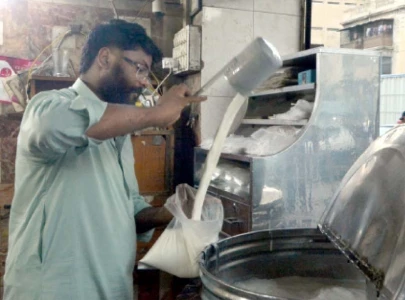
He said an emergency meeting of the association decided to close factories across the country from Saturday. The association, which has 96 members that supply 6,000 tons of edible oil and ghee every day, wants to ensure uninterrupted supply of edible oil to the factories.

However, some members of the association had no knowledge of the closure of industry from Saturday. A senior member told The Express Tribune that the decision to shut factories was not yet final.

Edible Oil Tanker Owners Association Chairman Bakhtawar Khan rejected all allegations, saying the matter of oil supply was sub judice as they had filed a petition in the Sindh High Court. He also denied that the transporters had burnt oil tankers and said their protest was peaceful.

Published in The Express Tribune, February 18th, 2012.


]]>
Oil-CREATIVE COMMONS All Pakistan Vanaspati Manufacturers Association has announced that they will stop supply of unprocessed edible oil and ghee from Saturday throughout the country. CREATIVE COMMONS 2
Beyond MFN: Indian exporters target oil products and tea markets http://tribune.com.pk/story/335973/beyond-mfn-indian-exporters-target-oil-products-and-tea-markets/ Mon, 13 Feb 2012 22:10:35 +0000 http://tribune.com.pk/?p=335973

LAHORE: 

Leading exporters of India, displaying their products at the first-ever Indian trade exhibition in Pakistan, have expressed great interest in selected markets such as petroleum products, tea, spices and fast moving consumer goods.

The exhibitors at the three-day India Show at the Expo Centre Lahore, which ended on Monday, were excited over the overwhelming response to their products from the traders and general visitors. Most of the Indian traders are visiting Lahore for the first time.

Talking to The Express Tribune, leading Indian exporters underscored the importance of streamlining bilateral trade as indirect trade in many valuable products was not only causing huge losses to the exchequer but was also making the products costlier for consumers.

Most of the Indian products come to Pakistan via third countries like Dubai, Thailand, Iran and Afghanistan, costing an additional 30 per cent in freight.

Representatives of the Indian petroleum industry said they were offering products of European Union standards at competitive rates with shipments through the land route.

Indian Petroleum Federation’s representative Yogendra Sahai said Delhi could meet energy demands of Pakistan if bilateral trade normalised in the wake of continuous negotiations between the two governments. “India can supply diesel, furnace oil, lubricants and coal tar through the Wagha land route,” he said.

Surprised by the encouraging response, Hindustan Petroleum Corporation Senior General Manager A Surinder boasted that good standards and quality drove the demand for Indian goods. “Most of the Indian states are using the fuel that is compliant with Euro-III standards. Recently, 13 cities have started consuming Euro-IV standard fuel which ensures low emission levels,” he said, adding Pakistan could also import these high-standard petroleum products.

S Aziz, who represented the Tea Board of India, claimed that they could meet 100 per cent tea demand of Pakistan. Africa was facing drought and the Sri Lankan tea industry was under pressure due to high wages, so India would be the only source to import tea into Pakistan, he said.

A delegation of the Pakistan Tea Association is expected to visit India in April to discuss trade-related issues. “High import duties and taxes at around 35 per cent is the biggest barrier for the Indian tea exporters,” Aziz said.

He suggested that the Wagha-Attari border was the ideal route for tea export to Pakistan which would save time, adding the land route took 15 to 20 days for transportation while shipments through sea took 40 to 45 days.

Indian gems and jewellery exporters were also present in large numbers at the show under the banner of India Gems and Jewellery Export Promotion Council. Over 17 stalls were decorated with Indian jewellery, which attracted visitors, especially women.

Council’s representative Tom Jose estimated that Indian traders exported jewellery worth around $5 billion in 2010-11. He said Pakistan was also importing Indian jewellery via Dubai and Thailand, but it was not working for the benefit of India or Pakistan in terms of direct trade.

He saw vast potential of bilateral trade as Pakistan was rich in precious and semi-precious stones while India had state-of-the-art technology and expertise in value addition.

Published in The Express Tribune, February 14th, 2012.


]]>
The-India-Show-Exhiition-exibhit-fair-PHOTO-AFP Indian exporters underscored the importance of streamlining bilateral trade as indirect trade in many valuable products was not only causing huge losses to the exchequer but was also making the products costlier for consumers. PHOTO: AFP 24
Marble city project revived after five years http://tribune.com.pk/story/304889/marble-city-project-revived-after-five-years/ Sat, 10 Dec 2011 21:39:12 +0000 http://tribune.com.pk/?p=304889

KARACHI: 

The process of setting up a modern marble city has finally started as 300 acres of land have been acquired for the purpose which will house more than 200 processing plants, officials say.

Sindh Stone Development Company, a joint venture between public and private sectors, has taken up the task of mining, processing, value addition and export of marble and other stones in the province.

Zubair Motiwala, Chairman of Sindh Board of Investment, is the chairman of the company while provincial ministers for industries, investment and mining are its members.

A meeting of the company held on Friday decided that foundation stone of the marble city, which had been on the backburner since 2006, would be laid in January. A master plan is being prepared, which will be completed in a month.

Investment Secretary and Company Director Younus Daga told The Express Tribune that the purpose of establishing the marble city was to promote value addition and bring modern technology to the marble industry.

In its budget, the Sindh government has earmarked Rs50 million for the project, of which Rs3.5 million has been spent on the purchase of land while the rest will go towards preparing the master plan and laying the infrastructure.

Daga said the private sector would play an important role in running the marble city, adding plots would be given in a transparent way to real investors only and allotment to those who failed to install plants in the stipulated time would be cancelled. “Lease of the plot will be given only after completion of the project,” he said.

Sindh Stone Development Company Director and Marble Industries Association Chairman Sanaullah Khan said the marble city project would bring prosperity to the province.

It would help increase exports of marble goods with shipments expected to jump to $1 billion in a short period from the present volume of $60 million.

Published in The Express Tribune, December 11th, 2011. 


]]>
Marble-Granite Sindh Stone Development Company, a joint venture between public and private sectors, has taken up the task of mining, processing, value addition and export of marble and other stones in the province. 1