The Express Tribune » Rabia Mehmood http://tribune.com.pk Latest Breaking Pakistan News, Business, Life, Style, Cricket, Videos, Comments Sat, 19 May 2012 22:36:39 +0000 en hourly 1 http://wordpress.org/?v=3.2.1 Out by Royal Park, the ‘soul’ of film lays dying http://tribune.com.pk/story/377170/out-by-royal-park-the-soul-of-film-lays-dying/ Thu, 10 May 2012 19:21:26 +0000 http://tribune.com.pk/?p=377170

LAHORE: On the third floor of Atif mansion in Royal Park Lahore, Ustad Jahangir gets his canvas, colour palate and brushes out, mixes paints and starts finishing the purple colored dress of a woman in a scene from Heer Ranjha.

Film posters. This is what the artist does when he gets time off from his paying side gig – preparing posters of Punjab’s wrestlers.

Once upon a time in Lollywood

Ustaad Jahangir was a commercial artist of film posters during the peak years of Pakistan’s film industry. Although the last film poster Jahangir worked on was in 1992 on a Shamim Ara flick, Munda Bigra Jaye, he is still based in Royal Park.

Once the hub of the film industry in Lahore, where hundreds of producers, directors and distributors including the poster painters were established, Royal Park looks deserted now. What was once a hustle bustle world of over two hundred offices tied to the film industry now bears a bleak look; only a handful of film hoardings and few offices remain. The fate of the art work created by commercial artists for film posters has followed the same trajectory as that of the dying Pakistani film industry.

“It is society’s loss” says Jahangir. “There were many good artists in Royal Park; they’re spending life of helplessness and despair now. By God, it makes me so sad.”

In these hard times, the artist’s only solace comes from his trade. Trained in the basics of water colour painting by Ustaad Allah Bux, Jahangir acquired the art of film poster painting from the best: Ustaad Mustafa Chughtai. Known as the man who pioneered the art of painting posters in Pakistan, Chughtai left his thriving poster painting career in Mumbai and moved back to his hometown Lahore to continue his work with the industry here. Jahangir has some copies of the vintage posters painted by his teacher Mustafa Chughtai – pieces he considers his personal treasure.

The Chugtai line

Not very far from the Royal Park, Rafiq Chughtai, the son of Mustafa Chughtai, sits at his office in Nisbat Road. A graduate of Punjab University’s fine arts program and a renowned former poster artist, Rafiq reminisces about the days when the late Waheed Murad called him “a genius” for his poster of Murad’s first Punjabi film “Mastana Mahi.”

In that golden era, a bright and exaggerated beauty had come to define the signature of Pakistani film posters.

“The heroine of the film had to look exquisite in the poster. It was necessary because everything and everybody in the film revolves around her from the hero to the villain…so we used to make sure she looked more beautiful than reality,” says Chugtai.

Veteran movie director and producer Aslam Dar has similar memories of that bygone era. Having spent 62 years in Pakistan’s film industry with directing credit for the likes of 

Zubaida, Dil Lagi, Dara and Basheera, Dar fondly recalls that, “It was expected that the poster artist would capture the soul of the film in the poster.”

Paying homage to the likes of Mustafa Chughtai, Dar felt that, “The poster makers of that era were stellar, they were true artists. It was an intensely creative process that demanded deep imagination.”

Fond memories are however, overshadowed by today’s reality.

“The tragedy of our work is that it was commercial, so nobody, not even the artists could preserve it,” Chugtai laments.

“The Arts Councils of Lahore should have made a concentrated effort to preserve this slice of cinema history, and made an effort to exhibit this work.”

Back among canvas and paint

Ustaad Jahangir is most animated when he talks about the thrill of preparing a new poster for a local blockbuster.

“It would take 20 to 30 days to complete one poster,” he remembers fondly.

“When shooting for the film would be completed, producers would then give us artists an album of still photographs (of the movie) to choose from. Then we would rework the photographs as sketches, out of which the directors and producers would then select the best one to be made into a poster.”

In those days, the film poster was of paramount importance, being the primary promotional material for the film after its release. The competition in the industry from the 50s to the 70s was such that poster designs were strictly guarded. Artwork by the likes of Noor-ud-Din Azad, Sardar S. Khan and Akhtar Sahib were considered the key to success.

With time and technology, poster art evolved. The method of lithography where colour separation was done manually was left behind when in the late 1960s Packages Limited and Pakistan Times Press introduced off-set printing for posters in Lahore. Photo separation units were installed and the print quality of hand painted posters became sharper. This evolution resulted in the emergence of graphic design in posters by the 90s, where photos were exposed on flex sheets, with additional finishing being done manually by the artist before the final print. But by this time, the film industry was crumbling, and the creativity seen in the earlier years of hand painted posters did not shine through in the new, graphic work.

As of now, pop art continues to draw inspiration from film poster art, but the artists who defined the style are rarely credited, rarely acknowledged and now – rarely seen in the haunts of Royal Park.


]]>
5
Journalist voice: ‘We get abused, but this is our job’ http://tribune.com.pk/story/370189/journalist-voice-we-get-abused-but-this-is-our-job/ Thu, 26 Apr 2012 12:02:23 +0000 http://tribune.com.pk/?p=370189

LAHORE: In the wake of the Bhoja Air crash, a debate began over the coverage by broadcast media, with condemnations pouring in for broadcast journalists from all quarters. The debate was led by social media and then addressed by the English press, while Pemra served notices to 17 TV channels for airing ‘unedited live gory images’.

What was largely left out of the debate was the voice of journalists from the mainstream Urdu TV networks, many of whom were not aware that a debate on ethical reporting was raging, or that their colleagues’ work was being critiqued.

For most, reporting on tragedy in a crisis situation is a challenge on multiple fronts:

“We get verbally abused”

Yasir Muhammad Khan – Camera Man, Samaa TV

Yasir Muhammad Khan has worked with a number of news networks including ARY and Express News in the last 8 years, and now works with Samaa TV.

“So many times, when we are filming the spots after bomb blasts, we get verbally abused by people. Because they are hurt and in pain, it is usually us and police that get to hear all of that, which is ok, it is part of our job. We understand that they are hurt, we have families too and we respect that. But my understanding is that we need to report the facts via our footage, so we try to manage and get our job done regardless.”

Khan says it is not easy to witness tragedy and then stay alert.

“We ignore the blood and gore we see at sites, and control our emotions in situations where people would usually be very emotional, and try not to think about our families and keep working. It is not easy and simple as it looks on the screen and my only priority is to always record footage without coming in the way of rescue efforts.”

If there was a code of conduct formulated for the sake of ethical crisis coverage, Khan says that will be good for journalists, “it will make our job much easier.”

“A sword over heads”

Qazaffi Butt – Senior Correspondent, Geo TV   

Qazzafi Butt – a Lahore based senior correspondent with Geo television who has travelled across Pakistan to document conflict and cover natural disasters like floods – says, “A sword hangs over the heads of reporters and cameramen. They work under extreme fear of what the executives would say if they don’t bring footage the other network aired.”

It is time that editorial policies are defined by the organizations so the quality of reporting improves, Butt insists.

“There is too much sensationalism on our news channels. Sometimes a trivial incident is exaggerated, and then a very important story is completely sidelined just because it does not fit with the current editorial policy of the organization.”

Training is considered the most vital step in improving news coverage.

Butt, who made the transition from print to broadcast news eight years back without any training says, “There is absolutely no training for conflict or disaster let alone for basic craft skills. A loaded gun is handed over to the new anchors or reporters, who lack any training. The journalism schools are not teaching students according to the circumstances either.”

Butt further says that, “It is very difficult to not get emotional when one sees dead bodies and injured people, so only proper training can make reporting unbiased and objective”. He insists that the government should step in and help organize workshops for journalists.

“Frantic due to newsroom coordination”

Fatima Ali – Correspondent, Express News  

Fatima Ali was at Mayo Hospital after the Lahore railway station attack till midnight. A Lahore based correspondent with Express News, Ali has reported on bombings in the city from hospitals where she comes in contact with survivors and grieving families.

She says showing respect to survivors or injured and their attendants, always works. “Some of our fellow workers just walk up to the grieving families, stick a mic in their faces and ask them what they think about the incident. Which of course you cannot do, it does not work like this. You cannot attack people who are traumatized. You have to give them some time, ask respectfully and then take permission.”

While discussing obstacles during live coverage of crisis situations, Ali says, “The coordination between the newsroom and reporter, and then among the sections of the newsroom also makes the on-ground reporter frantic. In an emergency, I may be in the middle of hundreds of people, constantly in-touch with the newsroom, gathering information and because I am a woman I am usually trying to fend off men groping me as well. So it is a very tough situation to manage.”

“We’ll improve over time”

Umar Javed – Correspondent, Dunya News

Umar Javed, currently a Dunya News and former Samaa TV correspondent said that the media will improve with time.

“On the railway station blast in Lahore, I kept saying whenever the information was not verified, that it was not. We also communicate to our desks if information is from an unconfirmed source. Media is still young, so hopefully things will get settled.”

“We are not angels, but…”

Sajjad Shafiq Butt – Senior Crime Correspondent, Express News

Sajjad Shafiq Butt, a senior crime correspondent with Express News says that during live coverage of developing stories involving loss of human life, the margin of error is always there.

“We try our best to not speak irresponsibly. While being careful, one tries to give undiluted information and we make sure there are no lacunae in the information.”

He added, “I am not saying that journalists are angels, because they are not, but we try our best. We need to show the magnitude of the incident, because in our minds our effort might help people get the affected some degree of justice. And as for the critique and debate, that should definitely continue.”

Need for training, rational critique

Zebunnisa Burki taught Media Law and Ethics class to South Asian journalists at the South Asian Media School run by SAFMA in Lahore, and is currently based in New York.

In an email interview she said, “Criticism leveled at the media is fair, but the critique should be moderately rational”. Burki emphasized that, “Practical training workshops for reporters and editorial sections is a must, particularly for a young media such as ours, (also because) the reporters are probably still pretty clueless about conflict and disaster reporting, gender sensitivity and media ethics.”


]]>
reporter blast Reporting on tragedy in a crisis situation is a challenge on multiple fronts. DESIGN: JAHANZAIB HAQUE 7
Glacier tragedy: Eyes yearning for one last look at Siachen martyrs http://tribune.com.pk/story/370030/glacier-tragedy-eyes-yearning-for-one-last-look-at-siachen-martyrs/ Thu, 26 Apr 2012 04:01:23 +0000 http://tribune.com.pk/?p=370030

ISLAMABAD / LAHORE: 

Hameeda Bibi prays, like any mother who lost her son in a similar situation would, for the families of the 138 Siachen avalanche victims to see the bodies of their loved ones one last time.

“I know that will bring peace to them InshAllah – it is the most important thing now,” she says. Otherwise, she adds, peace for them will only be a miracle.

A huge wall of snow crashed into the Giari sector at Siachen Glacier on April 7, trapping troops and civilians from the 6 Northern Light Infantry Battalion.

In 2010, Hameeda Bibi, a resident of Jang Saidan in Islamabad, received the body of her son, Lance Naek Ikhtiyar Husain, a guide to other soldiers serving at Siachen, 11 days after he fell into a gorge, along with three others at Post Mustafa.

Drawing from her loss, she says: “If the bodies (of the Siachen victims) are not recovered, peace will only be a miracle for the families of Giari martyrs.”

Beyond the official statements and political rhetoric, members of military families like Hameeda Bibi continue to suffer and struggle to raise questions about the Siachen conflict.

A serving major in the Pakistan Army, who chose to stay anonymous, recalled his six months at Siachen in 2000 and said that even during the period when tension between Pakistan and India were at their highest, officers would think that the conflict was “illogical” because the area could be left alone.

“We used to sit and say to ourselves that all we’re doing is looking at rocks and ice. To us there was no logic in just sitting there.”

And the severe circumstances of surviving at Siachen sector posts did not help. “Lying down, turning over in bed was an effort. Every breath would feel like we had been running for miles,” he said.

Senior officers who served at Siachen are of the view that politicians need to campaign and mould public opinion against keeping troops at Siachen. Some fear that the concern of the masses will fade away once the tragedy goes out of headlines.

Having served from 1978-1979 in Lipa Valley, Kashmir, before the Siachen conflict began, Major (retd) Joseph Sharaf is of the view that both governments will keep losing men to the weather but political courage will remain an issue.

“It is criminal to deploy soldiers at Siachen. But no politician wants to be responsible for taking the decision to pull out first. They fear that the masses might not forgive them,” he said.

Brigadier (retd) Yasub Ali Dogar, who was the commander designate of the Siachen sector in 1988-1989, says that the “eyeball-to-eyeball position at Siachen is senseless.” But to him, the major concern is environmental degradation. He believes that the avalanches could be connected to the presence of human life. “Thousands of rounds of artillery have been fired in those mountains. Human excreta and garbage is thrown in the snow. Just imagine hundreds and thousands of cans lying around in those glaciers.”

As the rescue efforts for recovering bodies at the Giari sector continue, military families like those of Lance Naek Ikhtiyar Husain feel honoured of their loved ones’ sacrifice for the country but in hushed tones say that the high-ups have to make more of an effort for a resolution.

Husain’s father, Muhammad Riaz, says: “What can we say, it is the government who can resolve this matter. We are proud of our son’s martyrdom but the pain of separation from him is too much to bear.”

Published in The Express Tribune, April 26th, 2012.


]]>
Siachen-bulldozer-lifter-photo-ISPR Families of fallen soldiers feel honoured but urge resolution of conflict. PHOTO: ISPR 2
Chapatis, mysteries and the value of blogging http://tribune.com.pk/story/363051/chapatis-mysteries-and-the-value-of-blogging/ Wed, 11 Apr 2012 15:21:15 +0000 http://tribune.com.pk/?p=363051

LAHORE: With an estimated figure of 20 million internet users in Pakistan, the democratizing effect of the internet has begun to shape discourse in the country, and nowhere is this more evident than in the self-publishing world of blogging.

Citizens who could not penetrate traditional media or outright avoided it have found a way to get their voice across to a global readership. Those abroad also form part of the fast-growing local diaspora, giving Pakistan a multi-dimensional voice in the online space. One such voice has been that of Chapati Mystery – an online blog run by Dr Manan Ahmed, launched in the post Iraq war era.

At the time, raising questions not being addressed by mainstream media through a free online medium gave a platform to voices of dissent across the globe in the post 9/11 world. Ahmed’s writing on imperialism and media criticism could have affected his future as an academic, but Ahmed felt the need to blog his thoughts was critical.

“I believe that there is an ethical way in which we have to engage with the world we live in, and as ethics includes a commitment to seeking truth and explanation of various fundamental issues, we have to fulfill that responsibility whether I was a grad student, whether I had a tenure or not, that would not stop me from being an ethical citizen” said Ahmed.

A trained historian of Islam, in addition to academic blogging in a simpler language, Ahmed began writing long form essays and articles for a various publications international and local, which were eventually published as a book “Where the Wild Frontiers Are: Pakistan and the American Imagination”.

“Concept of space, concept of frontiers and how various empires have always had this tendency to locate physical geography – on which they all project all of their anxieties; I started tracing this from the Umayyad caliphate onwards, seventh and eighth century. It just happened that at that precise moment, for American foreign policy discourse, frontier became this big focus. Obama said that the real war will be in Afghanistan and Pakistan, so I started writing about frontier as a notion of geography,” said Ahmed.

For this academic, Chapati Mystery eventually expanded from a personal blog exploring ideas and topics from Zaid Hamid to minority rights, to tackling the issue of “cultural and historical amnesia”. In the words of Ahmed: ”You need a certain type of political and cultural will to say history is important, historians are important, archiving is important.”


]]>
2
G-B violence: ‘We are all Muslims, no harm will come to me’ http://tribune.com.pk/story/362698/g-b-violence-we-are-all-muslims-no-harm-will-come-to-me/ Tue, 10 Apr 2012 18:23:02 +0000 http://tribune.com.pk/?p=362698

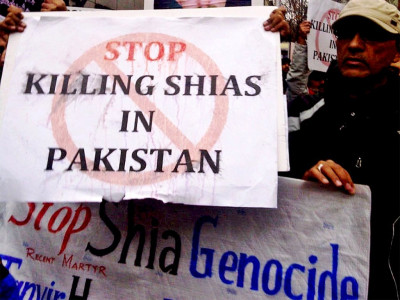
LAHORE: Hundreds from the Shia community protested against the killings in Gilgit baltistan outside Lahore Press Club on Tuesday. Organized by the Majlis-e-Wahdat-ul-Muslimeen (MWM), the speakers called for action to be taken by the Chief Justice of Pakistan regarding the G-B incident.

Women and children from the Shia community, students from Imamia Students Organizations and students from Gilgit-Baltistan participated in the 3 hours long sit-in, which blocked part of Davis road.

Muhammad Ali Johri was at the protest, grieving for his nephew who was killed on April 2 at Chilas. Johri said his nephew Ruhullah Razvi had left him in Islamabad last week and insisting on traveling to Skardu via road and told his uncle “Everything will be fine, we are all Muslims, no harm will come to me.”

Johri said, eye witnesses told him that Ruhullah was stoned and then thrown in the river. The young man’s body was recovered from the river yesterday.

Chanting slogans against government, judiciary and the media, emotionally charged protesters tried to forcibly enter the Lahore Press Club. Speaking to The Express Tribune Sakina Mehdvi from the MWM questioned media silence on the issue.

“Why is the media not covering this incident? Has Pakistan become the next Gaza or the next Bahrain?” she asked.

Haider Ali Musavi, Imam of the Mochi Darwaza mosque in Lahore said “The government should ensure that there is an alternative route, instead of the Chilas town.” Musavi added that “there is no sectarian issue in Pakistan, people live peacefully in their neighborhoods, but there is a small group affiliated with an organization which spreads unrest.”

Security at the protest in Lahore was provided by the police and there were volunteers from the Shia community who formed human chains around the sit-in.


]]>
17
Pakistan’s caste system: The untouchable's struggle http://tribune.com.pk/story/357765/pakistans-caste-system-the-untouchables-struggle/ Sat, 31 Mar 2012 08:44:17 +0000 http://tribune.com.pk/?p=357765

LAHORE: Sabir Arif, a student of finance and cost management in one of Lahore’s private institutions lives in a hut made of wood, cloth and plastic sheets. His only source of income is the private tuitions he provides to others to keep his makeshift home intact.

The son of a daily wager, Sabir is not a typical victim of abject poverty in the city. Reminiscing about how he read Russian literature when he came across old story books while picking garbage in class seven, Sabir says his great challenge in life has been his caste – that he was born a Deendar Changar – Pakistan’s version of the ‘untouchables’.

Contrary to popular belief, caste in Pakistan has been a means of systematic discrimination. The lower castes here are Pakistan’s downtrodden, including Massalis also known as Muslim Sheikhs, Choorahs who are majority Christian and Chamars or Changars who are also called Deendars if they practice Islam. In Punjab and Sindh these include the scheduled Hindu castes that serve as farm workers and bonded laborers.

Sabir admits that he faces greater discrimination than most of his “biradari” because he refused to stick to what is the generally acceptable position and career path of his caste. Living in the slums, and being considered lowest of the low in a society fixated on high and low birth, Sabir was always at the periphery, but his decision to pursue education did not sit well with the local community.

Muhammad Arif, his father who gets labor jobs with the help of his donkey cart, says he struggled with the decision of sending his children to school, “People of our biradari said that education was not for our people, that I should make Sabir help me with daily work, but I decided against it and have not sent my younger children to work as live-in domestic helpers like others in our community or forced them into working only.”

Discouraged, discriminated against and lacking any political identity, the city is now Sabir’s home, as it is easier for people of lower castes to access schooling and get odd jobs in urban hubs as compared to rural settings, where discrimination is far higher.

Abdul Rasheed Dholka, a political activist of Mazdoor Kissan Party in Sargodha has worked with lower caste farm workers, and says that in rare cases when young men from these communities are hired as peons or clerks, they try to cut off ties with their community and hide identity to avoid discrimination.

“Decades of oppression have led to circumstances where these people don’t even know how to stand up for their rights, because there is no representation,” he adds.

Dholka’s words reflect in Sabir’s thoughts, as the young man says he sometimes feels “like the Africans in South Africa or the Jews in Nazi Germany”. However, despite the twin challenges of poverty and his birth into the bottom of the social rung, Sabir manages to remain hopeful, and talks of changing the country into a better home someday.

Haris Gazdar, Director and Senior Researcher, Collective for Social Science Research in his paper “Class, Caste or Race: Veils over Social Oppression in Pakistan” argues that caste based marginalization is common in Pakistan.

“The trouble is that the biradaris and quoms are not all equal, and public silencing of the issue is very much about perpetuating existing hierarchies. The inequality is so severe and deeply embedded in parts of the country that it is hardly even noticed.”


]]>
61
No ban on Ahl-e-Sunnat Wal Jamaat http://tribune.com.pk/story/349444/no-ban-on-ahl-e-sunnat-wal-jamaat/ Tue, 13 Mar 2012 14:11:05 +0000 http://tribune.com.pk/?p=349444

LAHORE: The Difa-e-Pakistan Council has said that Interior Minister Rehman Malik has personally refuted a BBC report that claimed the Ahl-e-Sunnat Wal Jamaat (ASWJ) has been declared a banned outfit in Pakistan.

“Interior Minister Rehman Malik refuted the reports of ban on Ahl-e-Sunnat Wal Jamaat over the phone with me,” Hafiz Tahir Mahmood Ashrafi, Chairman Pakistan Ulema Council and leading member of the Defense Pakistan Council told The Express Tribune. Ashrafi said that he spoke with the Interior Minister because ASWJ is a member of the DPC.

“I spoke with him in detail two nights ago” Ashrafi said, adding that Malik assured him that an investigation into this matter would be conducted. Quoting the interior minister, Ashrafi said that Malik did not know anything about the reported ban.

“Rehman Malik said that his office had not issued any such notification and that he was away in Gilgit and only found out about ban reports in the media on his return”.

Ashrafi added that “We are grateful to Rehman Malik for issuing a timely explanation, although we have always criticized him but in this case we should give him credit for this clarification.”

Was there a notification?

Sources in the Interior Ministry while talking to The Express Tribune on condition of anonymity confirmed the existence of a notification for the ban on ASWJ for involvement in anti-state, terrorist activities and sectarian violence.

An official of the interior Ministry familiar with the matter said that this notification had been issued in the third week of February, 2012 on the basis of intelligence agency reports revealing the involvement of ASWJ in terrorism activities and sectarian violence.

Ubaidulah Usmani, the Media Coordinator ASWJ also confirmed the existence of such a notification but he said the notification had been prepared for barring the entry and participation of ASWJ Chief Allama Ahmad Ludhianvi in an Islamabad protest under the banner of Difa-e-Pakistan Council (DPC). He claimed that this notification was to be used if Ludhianvi had participated in the protest.

Lifting ban on Sipah-e-Sahaba

The ASWJ have also been working towards a lift of the ban on Sipah-e-Sahaba, the proscribed outfit that the ASWJ claims as their own.

“We were from the Sipah-e-Sahaba, and we only changed the organization’s name when General Musharraf banned us” said Allama Muhammad Ahmed Ludhianvi, chief of Ahl-e-Sunnat Wal Jamaat.

Speaking to The Express Tribune via phone from Jhang, Ludhianvi said “We changed the name of the organization out of respect for the law. Our real organization is actually Sipah-e-Sahaba Pakistan.”

“When Musharraf banned Sipah-e-Sahaba, Azam Tariq the former chief named the organization Millat-e-Islamia, which was banned as well, so when Maulana Azam Tariq died, Allama Ludhianvi the next chief started Ahl-e-Sunnat Wal Jamaat,”  Younas Qasmi secretary of Ludhianvi added.

Ludhianvi explained that, “The interior Minister has said that the government is ready for dialogue with those who are not extremist, so we think that our side of the story should be heard.”

Ludhianvi told the The Express Tribune that his organization challenged the government’s decision to declare SSP proscribed in the high court, and that case is still pending.

These statements come after a report by the BBC, published a notification by the Interior Ministry declaring the ASWJ as a proscribed organization. The ASWJ chief Allama Muhammad Ahmed Ludhianvi rejected the ban and said such measures if taken would be on the directives of the US.

Tahir Mahmood Ashrafi, along with Ludhianvi of the ASWJ received co-founder of banned militant outfit Lashkar-e-Jhangvi  responsible for sectarian terrorism across Pakistan, from the Kot Lakhpat Jail, Lahore in 2011. Ashrafi has spoken publicly in favor of Malik Ishaq as well.

Meanwhile, the ASWJ are preparing to participate in the DPC rallies in Peshawar on April 15 and in Quetta on April 26.


]]>
Hafiz Saeed - Difa-e-Pakistan ASWJ is member of the DPC. PHOTO: INP/FILE 32
‘Discreet’ ban: Religious right reject reports of ASWJ ban http://tribune.com.pk/story/348420/discreet-ban-religious-right-reject-reports-of-aswj-ban/ Sun, 11 Mar 2012 05:55:54 +0000 http://tribune.com.pk/?p=348420

LAHORE: 

Ahl-e-Sunnat Wal Jamaat (ASWJ) has hit back at reports of a government ban saying it was slapped at the behest of the United States.

“Attempts at banning ASWJ are on the directives of the US,” Chairperson Maulana Ahmad Ali Ludhianvi told The Express Tribune on Saturday.

The government has not sealed any of ASWJ offices, thus far, Ludhianvi said.

“We have learnt about the ban in a BBC report. We haven’t received any official intimation,” he added.

Earlier, the BBC Urdu reported that the government has discreetly banned the ASWJ, citing a notification issued by the Interior Ministry two weeks ago.

The ASWJ was suspected to have been involved in terrorism related activities of the Sipah-e-Sahaba, the defunct terror group, in the notification.

Meanwhile, a local paper added that the recently issued notification also includes the names Shia Talba Tanzeem, People’s Amn Committee and Tanzeem Naujawanan-e-Ahl-e-Sunnat Gilgit.

ASWJ ‘school of thought’

“In the last few months, we have been peacefully rallying support for the country’s defence with Difa-e-Pakistan (DPC) rallies. Which of our activity warrants a ban,” asked Ludhianvi.

“Ahl-e-Sunnat is a school of thought and not an organisation, so we consider this as a ban on the followers of Ahle-e-Sunnat,” he added.

Meanwhile, Jamaat-e-Islami’s (JI) Information Secretary Anwar Niazi said that his party would condemn any attempt to ban ASWJ. JI is also a component party of DPC.

“Each time a ban is slapped on a religious organisation, it is either on the instructions of the United States or given by pro-US elements in the government,” Niazi told The Express Tribune. “ASWJ are all patriotic Pakistanis,” he said.

Published in The Express Tribune, March 11th, 2012.


]]>
Difa-e-Pakistan Council Islamabad rally Chief says none of their offices sealed yet. PHOTO: AFP/FILE 3
Ahl-e-Sunnat Wal Jamat ban on US directive, says Ludhianvi http://tribune.com.pk/story/348167/ahl-e-sunnat-wal-jamat-ban-on-us-directive-says-ludhianvi/ Sat, 10 Mar 2012 11:44:54 +0000 http://tribune.com.pk/?p=348167

LAHORE: The Ahl-e-Sunnat Wal Jamat (ASWJ) has hit back at reports of a ban imposed by the Government of Pakistan, stating that the action was being carried out on the directives of the United States.

“These attempts at banning ASWJ are on the directives of the USA,” chairperson Maulana Ahmad Ali Ludhianvi told The Express Tribune on Saturday.

Ludhianvi said, “In the last few months, we have been peacefully busy in the defence of Pakistan with the Difa-e-Pakistan rallies, so which activity of ours has been a reason for the ban.”

“Ahl-e-Sunnat is a school of thought and not an organization so we consider this as a ban on the Ahle-e-Sunnat followers.”

None of the offices of the ASWJ have been sealed by the government so far, Ludhianvi told The Express Tribune, adding that no official documentation had been sent to them and they found out about the ban via the BBC Urdu report.

The report states that a notification had been issued by the Interior Ministry two weeks ago, which said the ASWJ was suspected to have been involved in terrorism related activities. According to the notification available with the BBC, authorities in all four provinces had been alerted to the change in status.

ASWJ is a member organization of the Difa-e-Pakistan Council, which has been organising rallies across the country. The Multan DPC rally was hosted by the ASWJ and was also attended by Malik Ishaq, the co-founder of banned Lashkar-e-Jhangvi.

Jamaat-e-Islami’s Information Secretary Anwar Niazi says they will condemn any attempt by the authorities to ban ASWJ. The political party is also a member of the Difa-e-Pakistan Council.

“Every time any such ban on a religious organisation occurs, it is either on the instructions of the US or given by pro-US elements in the government,” Niazi told The Express Tribune. He said the ASWJ were “all patriotic Pakistanis.”

Jamaatud Dawa spokesperson Yahya Mujahid issued a statement condemning the ban and said that it was an attempt to harass the Difa-e-Pakistan Council politically. “If there is any accusation against the ASWJ, it should be presented in the courts and this ban is without any evidence.”

Mujahid also said that the ASWJ had only been banned after the DPC began holding rallies for the defence of Pakistan and it was being done due to “external pressure.”

ASWJ is also allegedly known as the political wing of the banned militant outfit Sipah-e-Sahaba, known for its sectarian ideology and violence.

The secretariat in Lahore, Farooq-e-Azam, has also been host to addresses by several members of ASWJ and speakers affiliated with banned outfit Lashkar-e-Jhangvi.

During a conference on September 7, 2011, banners with the name of Sipah-e-Sahaba were put up on the walls of the secretariat and speeches inciting violence against the Shia community were given by the speakers.

Ludhianvi also went to the Kot Lakhpat Jail in Lahore, with armed ASWJ guards to receive Malik Ishaq on his release after imprisonment of more than a decade.  Members of ASWJ had welcomed Ishaq and showered him with rose-petals at the jail’s gate.


]]>
Difa-e-Pakistan Council Islamabad rally Activists of members of Difa-e-Pakistan Council hold flags as they shout anti-US slogans at the rally in Islamabad on February 20, 2012. PHOTO: AFP/FILE 68
International Women's Day: Punjab’s million voices remain unheard http://tribune.com.pk/story/347045/international-womens-day-punjabs-million-voices-remain-unheard/ Thu, 08 Mar 2012 05:12:58 +0000 http://tribune.com.pk/?p=347045

LAHORE: 

Kanwal started working at a garment’s factory when she was 13. Twelve years later, she was paid Rs4,000, which is Rs3,000 less than the minimum wage. 

“Before I was employed, I was told that I will get Rs6,000, but was only paid Rs1,800 per month,” she says.  She was employed by a middleman and never met the factory’s owner.

At the same factory works Yasmeen Ashraf. At 33, she suffers from domestic violence at the hands of her husband, a heroin addict, and is a heart patient herself. She works a 12-hour shift of cutting extra threads from export-quality pants and stitches buttons.

Yasmeen spends those 12 hours standing and is never able to take a break and step out of the factory’s storeroom. She says she was promised Rs6,000 by the ‘thaikaydar’ (contractor), but would only receive Rs700 to Rs900 every 15 days. “Medical insurance worth Rs150 was deducted regularly, but we never even got a painkiller.”

Home-based workers have the same story. Nasira bibi, 36, says she is losing her eyesight after sewing beads on dresses for 22 years.  However, she is now jobless after her employer refused to increase her salary:  Rs20 for 12 sweaters and Rs10 for one shirt.

According to non-profit organisation Homenet, women home-based workers make up more than 1.2 million of the total urban female workforce in Punjab and 6.5 million of the rural women workforce. However, neither NGOs nor the Punjab labour department has data on the total number of women employed.

Homenet has worked with the Punjab government on drafting a policy on home-based workers, which will initiate the process of recognising these workers as a part of the labour force. But Umm-e-Laila of Homenet doubts this will happen. “Organising domestic workers is an extreme challenge. Identifying these workers needs grassroots administration.” Labour Party Pakistan spokesperson Farooq Tariq says: “Home-based workers are treated like leftovers of the labour force…The government should force investors into opening registered industrial units and then facilitate labourers there.”

The Punjab labour department has no statistics on labourers, let alone gender specific data. The labour department registers factories and social security registers workers. However, workers can only be registered if they have an employment letter, which in the existing ‘thaikaydar’ culture is often not given to people.

Unionisation could help workers in fighting for their rights, but the Punjab Industrial Relations Act 2010 does not permit unionisation if less than 50 employees are working. Also, only workers with employment letters can form unions. Without the right to form a united front, women across the province continue to suffer.

Published in The Express Tribune, March 8th, 2012.


]]>
punjab women afp Labour department has no statistics on labourers. PHOTO: AFP/FILE 0