
Turning the tide: How the idea of the centre was conceived
Majority of institutions for children with cognitive disabilities morphed into daycare centres.
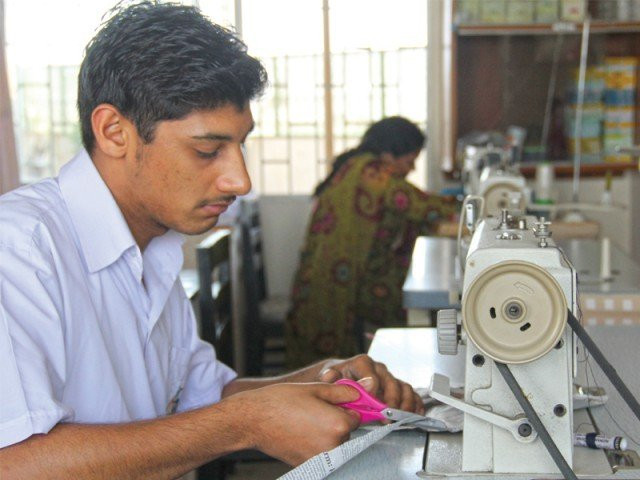
The institute’s students are hard workers. Fawad Hasan, who recently enrolled in the stitching class, learns how to use scissors. PHOTO: AYESHA MIR/EXPRESS
In the beginning of the 19th century, when Italian educationist Maria Montessori was creating an informal method of education, she began the venture with children who had cognitive disabilities.
Up until the late 80s, however, the model was not being used in Pakistan to teach children with cognitive disabilities. Things began to change when Robina Inam, a vocational and industrial therapist, and her late husband, Dr Inamur Rahman, a renowned psychiatrist, returned to the country from the UK around 26 years ago. Since 1973, both had been working with and conducting research on people with cognitive disabilities. Their visits to several Pakistani schools for children with cognitive disabilities were “horrifying”, in Inam’s words. “To put it simply, there was no future for students after the age of 12 at any institution,” she told The Express Tribune.
So upset was the couple that it decided to establish a training centre for children with cognitive disabilities. Inam, who is now KVTC’s principal, recalls that at the time, people with disabilities drew significant attention in Pakistan. “Back then, departments for special education were instituted at universities. Rehabilitation centres were set up for people with disabilities.”
But after a lapse of two decades, the majority of institutions for children with cognitive disabilities morphed into daycare centres where no real training was provided. “All of this happened with no ill-intentions as in absence of specialised training centres, the teachers did not know what to do with students,” said Inam.
“Considering the special education scene [in Pakistan] today, it feels as if we are in living in the 1970s of the UK when people with cognitive disabilities seemed like the most cornered section of society.”
Published in The Express Tribune, February 26th, 2013.
LATEST
Forensic report confirms substance recovered from Matiullah Jan was not drugs
ECC approves Rs19b relief package for Ramazan to support low-income households
Vawda challenges Sanaullah’s claim of ‘deal’ offered to Imran
Pakistan to support Gaza peace efforts, not participate in disarming Hamas: FO
16 killed in Karachi building collapse after gas cylinder blast
Pakistan summons Afghan diplomat over deadly Bajaur security check post attack
MOST READ
Sri Lanka removes Pakistan from negative visa lists after Naqvi meeting

Punjab’s quiet acquisition of luxury Gulfstream jet spurs scrutiny

Apple to manufacture iPhones in Pakistan
Workplace harassment: SHC disposes of KE ex-CEO's plea

'The cheater has finally been exposed': Sannia Ashfaq fires back at Imad Wasim





COMMENTS
Comments are moderated and generally will be posted if they are on-topic and not abusive.
For more information, please see our Comments FAQ