
PM contempt case: Aitzaz argues the PM faced a catch-22 situation
Bench says writing a letter to Swiss authorities is a civil right, not a move against president.
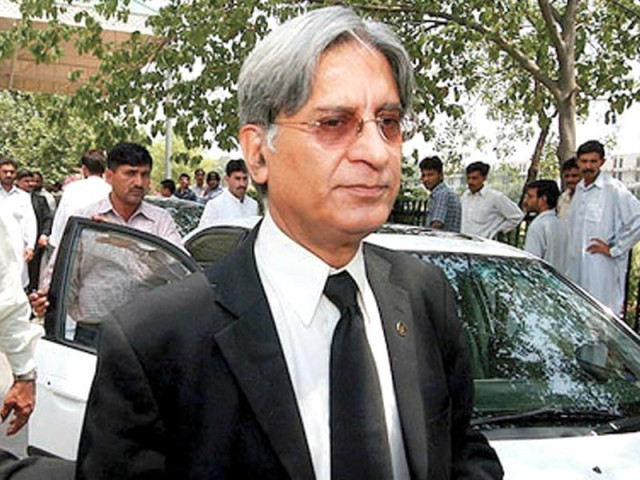
It was his last chance to speak for the prime minister, and it didn’t go very well.
The prime minister’s counsel, Aitzaz Ahsan, admitted before a seven-judge bench of the Supreme Court (SC) on Friday that writing a letter to Swiss authorities had nothing to do with presidential immunity.
But in a last-ditch attempt to defend the premier’s actions, he added that writing a letter would humiliate the supreme commander of the armed forces, President Asif Ali Zardari.
The court, however, was not willing to see things from Aitzaz’s point of view. The bench observed that writing a letter to the authorities was a matter of civil rights – it should not be taken as a move against the president.
Non-responsive bench
A sceptical Justice Nasirul Mulk, presiding over the bench, observed that the SC’s verdict had stated clearly that a letter must be written immediately to authorities to reopen graft cases against the president, and that the prime minister was fully aware of this order. “Is this not wilful disobedience of the court’s order? Is the prime minister not entitled to contempt, as even today he is not ready to implement the same?” asked Justice Mulk.
Aitzaz pointed out that records do not confirm that the prime minister was aware of court orders – he had acted upon summaries and advice, he said.
Justice Ejaz Chaudhry expressed concern over the precedent set by the prime minister’s reluctance to implement court order by merely saying it was not implementable.
The bench also observed that it was not the SC that had levelled graft charges against President Zardari, but the Swiss authorities themselves. Aitzaz’s reply to this was that heads of states do not surrender their sovereignty in front of another country’s magistrate.
He also brought into question why the proceedings were being held in the apex court in the first place. According to the premier’s counsel, it was in violation of Article 10 A of the constitution for the same bench which had initiated contempt proceedings to conduct the trial. Aitzaz also said that the trial should have been conducted by session court, saying proceedings in the case were started even before relevant material was collected.
This argument did not hold well with Justice Ejaz Chaudhry, who told Aitzaz to not “drag 10A into the case anymore”.
Sum-up of arguments
Aitzaz’s concluding arguments reiterated that the prime minister held the court and the judiciary in the highest respect. The counsel was keen to point out the prime minister’s catch-22: On the one hand, he must implement the judgment of the court, and on the other hand, respect the dignity owed to the office of the president of Pakistan – irrespective of who occupied the office.
Aitzaz also outlined the president’s role: He is a symbol of the federation, a prominent component of parliament and supreme commander of its armed forces. To expose him in any manner to jeopardy before a foreign magistrate was a humiliation, not only to the office but to the sovereignty of the state.
He did accede, however, that the judgment and order to the SC needs to be implemented – but only upon the relinquishment of the incumbent president’s office. In this case, the prime minister’s behaviour was therefore not contemptuous, as he only seeks for the letter to be written after the president leaves office.
The apex court adjourned the hearing till April 24. The attorney general, who is also prosecutor in the case, will start his arguments.
Published in The Express Tribune, April 21st, 2012.
LATEST
1724319076-0/Untitled-design-(5)1724319076-0-208x130.webp "medical team concludes imran khan s check up at adiala jail")
Medical team concludes Imran Khan's check-up at Adiala jail

1,104 recruits pass out from FC Balochistan training centre

SUPARCO launches 'Pak-SBAS' navigation system at Cholistan Rally

Opposition sit-in enters third day over Imran Khan’s medical care

Autism in our classrooms

Imran Khan’s prison medical record sent to Punjab Home Dept
MOST READ

Gold rises Rs7,000 in Pakistan, $70 on world markets

Petrol, diesel prices likely to increase from February 16

LHC declines to stay net metering reversal

Strategic opportunity for Pakistan

Jeffrey Epstein: Polio work, intelligence briefings and a shadowy presence in Pakistan’s tribal belt










COMMENTS
Comments are moderated and generally will be posted if they are on-topic and not abusive.
For more information, please see our Comments FAQ