Air pollution accelerates deterioration of historic buildings
Updated 2 hours ago

Agreement allows Pakistan and Bangladesh to import and export essential commodities, agricultural products, and inputs
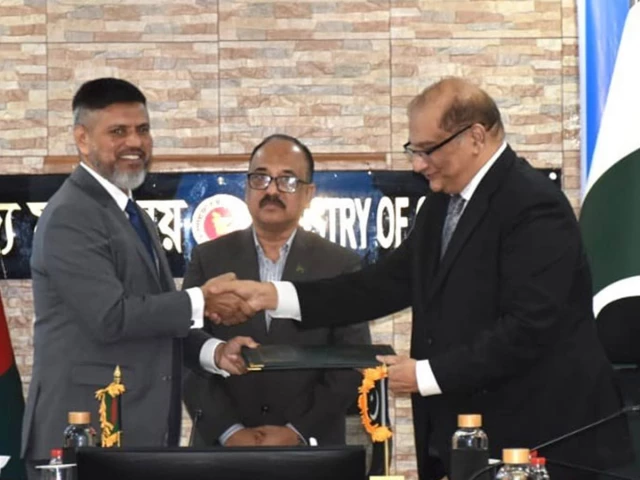
Pakistan and Bangladesh have signed a memorandum of understanding (MoU) to strengthen cooperation in the supply of essential commodities, agricultural products and inputs on a government-to-government basis.
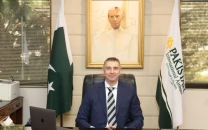
The MoU between the Trading Corporation of Pakistan (TCP) and the Trading Corporation of Bangladesh (TCB) was signed at the Ministry of Commerce in Dhaka by Pakistan's High Commissioner Imran Haider, on behalf of the TCP, and TCB Chairman Brigadier General Mohammad Foyshol Azad.
Under the agreement, the two countries will be able to import and export essential commodities, agricultural products and agricultural inputs.
Read: PM Shehbaz reaffirms commitment to stronger Pakistan-Bangladesh ties
Bangladesh Commerce Ministry Secretary Sharf Uddin Ahmed Choudhury was present at the signing ceremony, along with officials from the ministry and Pakistan's High Commission.
Under the agreement, the two countries will establish a direct institutional mechanism for procuring and supplying essential commodities according to their respective needs. It will also facilitate the import and export of agricultural products and inputs.
According to the Pakistan High Commission, the arrangement is expected to strengthen food security, improve supply chain resilience, support domestic market stability and create mutually beneficial economic opportunities.
Speaking on the occasion, Mr Haider said relations between Pakistan and Bangladesh were moving in a positive direction, with growing cooperation in several sectors, including trade and commerce.
He expressed confidence that the agreement would further strengthen bilateral economic engagement and translate the goodwill between the two countries into practical cooperation.
The high commissioner also called on Bangladesh Commerce, Industries, Textiles and Jute Minister Khandakar Abdul Muktadir and thanked him for his support in facilitating the agreement.
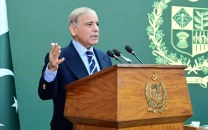
The signing came two days after Prime Minister Shehbaz Sharif reaffirmed Pakistan's commitment to strengthening bilateral relations with Bangladesh, highlighting shared history, cultural ties, parliamentary cooperation and people-to-people contacts.
He made the remarks while hosting a dinner at the Prime Minister's House in honour of Bangladesh Parliament Speaker Hafiz Uddin Ahmad Bir Bikram and his accompanying parliamentary delegation.
Referring to the two countries' shared historical background and cultural affinity, the prime minister stressed the need to strengthen institutional cooperation and expand people-to-people contacts.
He said the engagements and meetings held by the visiting Bangladeshi parliamentary delegation reflected significant potential for greater cooperation in the parliamentary sphere.
A Memorandum of Understanding (MoU) between the Trading Corporation of Pakistan (TCP) and the Trading Corporation of Bangladesh (TCB) on Cooperation in the supply of essential commodities on Government-to-Government (G2G) basis was signed today at the Ministry of Commerce,… pic.twitter.com/FIo4Dy34T9
— Pakistan High Commission Bangladesh (@PakinBangladesh) November 29, 2026
The premier emphasised that regular exchanges of parliamentary delegations could provide a strong foundation for closer bilateral cooperation in areas of mutual interest.
Relations between Pakistan and Bangladesh, which had reached a low point during former prime minister Sheikh Hasina's rule, have been improving since her ouster and the formation of an interim administration in Dhaka.
Following a popular uprising that toppled Hasina's government in August 2024, ties between Islamabad and Dhaka have witnessed a thaw, with trade and bilateral engagement recording a marked improvement.
In December 2024, Prime Minister Shehbaz Sharif met Bangladesh's Chief Adviser Professor Dr Muhammad Yunus on the sidelines of the D-8 Summit in Cairo, where the two leaders agreed to expand and deepen bilateral cooperation across areas of mutual interest.
Nearly a year after the interim administration took over, then foreign minister Ishaq Dar visited Bangladesh, marking the first visit by a Pakistani foreign minister to Dhaka in 13 years.
Bilateral exchanges have since increased, with the two countries also agreeing in principle to allow visa-free entry to holders of diplomatic and official passports as part of efforts to strengthen relations.
Earlier this month, Pakistan offered to share its experience in managing the global energy crisis with Bangladesh amid concerns over fuel supply challenges and disruptions in international energy markets. The matter was discussed during a meeting between Petroleum Minister Ali Pervaiz Malik and Bangladesh's Adviser on Finance Rashid Al Mehmood Titumir.









This material may not be published, broadcast, rewritten, redistributed or derived from. Unless otherwise stated, all content is copyrighted © 2026 The Express Tribune.




COMMENTS
Comments are moderated and generally will be posted if they are on-topic and not abusive.
For more information, please see our Comments FAQ