Bunny's enduring legacy
Updated 17 minutes ago

'Dil Mein Tum' immortalises late singer's place in Pakistani pop, but his contribution extends beyond a hit
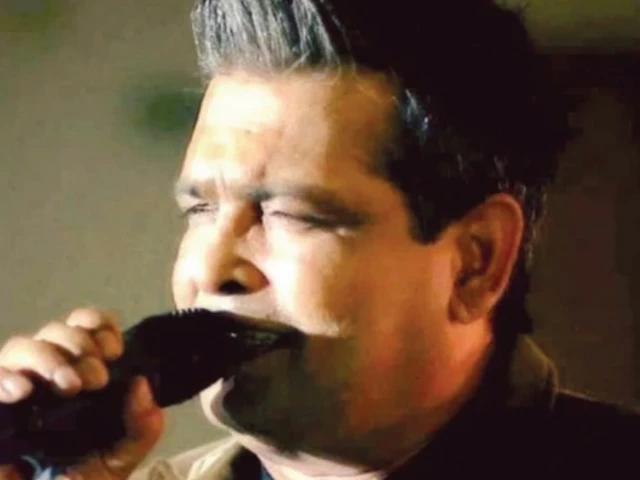
Some singers leave behind a catalogue of songs, while others become inseparable from a particular era in a country's cultural life.
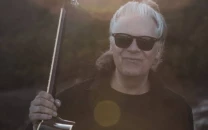
Mohsin Raza Khan, better known as Bunny, belonged to the latter category, with his distinctive voice and romantic hit 'Dil Mein Tum' securing him a place in the memories of Pakistani pop music lovers.
Bunny, who died on Monday in Karachi at age 74, rose to national prominence in the late 1980s, when Pakistani pop was finding a new identity and reaching increasingly wider audiences. His music became a regular feature of the country's emerging pop culture, particularly among young listeners who grew up with television music programmes and album releases.
Released in November 1989, 'Dil Mein Tum, Honton Pe Tum, Aankhon Mein Jaan-e-Jaan' became his signature song and one of the memorable romantic numbers of its time. Its infectious rhythm, prominent bass guitar and Bunny's distinctive vocal texture gave it an appeal that endured well beyond its initial popularity.
The song's success also made Bunny a familiar face on television, where he became a regular feature of pop music programmes, most notably 'Music Channel Charts'. Although he subsequently released several songs that found appreciative audiences, none managed to eclipse the extraordinary popularity of 'Dil Mein Tum'.
His other popular numbers included 'Ho Jaunga Deewana', 'Raasta Naya', 'A Bhi Ja', 'Nasheeli', 'Zakhmi Jigar' and 'Pehla Pyar'. Across four albums he developed a musical identity that blended Western pop influences with Urdu romantic lyrics and elements of local musical traditions.
Born in Lahore in 1953, Bunny developed an interest in music during his student days at Government College Lahore. His father gave him the nickname Bunny, inspired by the cartoon character Bugs Bunny, a name that eventually became more familiar to music lovers than Mohsin Raza Khan itself.
His musical journey began in 1973, when he joined a band in Lahore as a guitarist and vocalist. He subsequently performed at hotels and venues across Pakistan before travelling to Europe, where he worked with musicians and performed in countries including Germany and Italy.
After returning to Pakistan in 1988, he began developing the melody that would eventually become 'Dil Mein Tum'. He approached lyricist Master Manzoor to write the words, while the song was recorded in Karachi. Musician Arshad Mahmood further refined its arrangement before its release.
The track's popularity was not merely a personal breakthrough. It arrived at a time when Pakistani pop was developing its own character, with young musicians experimenting with contemporary sounds and Urdu songwriting. Bunny's success placed him among the voices that helped define that transition.
His musical interests, however, were not confined to romantic pop. He also recorded patriotic and motivational numbers, demonstrating a willingness to explore themes beyond love and relationships.
Among them was 'Hum Bhi Jeetain Hain Aur Kamyaab Hain', recorded for the 1996 Atlanta Olympics, which gained popularity among listeners. His patriotic number 'Aik Qoum Zinda Qoum, Pakistani Qoum' was broadcast on Pakistan Television after Pakistan conducted nuclear tests in 1998.
Bunny also used his experience and resources to encourage younger musicians, an aspect of his career that deserves recognition alongside his recordings. In 1996, he established a recording studio on Karachi's Tariq Road, providing emerging artists with a space to practise, record and develop their musical abilities.
The studio became particularly significant for musicians, who were still finding their feet in the industry. Members of the band 'Mizmaar' were among those who benefited from access to its facilities without charge during their early years. Imran Momina and Shalom Xavier were also among the musicians who received his encouragement and support.
That willingness to make room for younger talent offered another dimension to Bunny's relationship with music. While his own recordings had earned him recognition, he also helped create opportunities for others trying to establish themselves in an increasingly competitive musical landscape.
His career later became less visible, with illness keeping him away from the public eye for extended periods. He had been diagnosed with cancer but cured it, according to people close to him, as he continued to live a largely private life while retaining his interest in music and composition.
Despite his prolonged absence from the limelight, his name remained a familiar reference whenever the most productive years of Pakistani pop music were discussed. His best-known song also found a second life in 2011, when Lahore-based band Roxen and vocalist Mustafa Zahid reworked 'Dil Mein Tum' into a rock version.
Actor Khaled Anam, announcing his death, remembered him as a "wonderful musician and singer", praying for his eternal peace. Tributes from admirers and members of the entertainment fraternity have similarly recalled the voice behind one of Pakistani pop's memorable romantic songs.
Yasir Akhtar, who has directed several music videos that hit the 'Music Channel Charts', including Bunny's song 'Ho Jaunga Deewana' praised the late singer as his "mentor and brother". Akhtar got nostalgic, while recalling the early days of their private productions.
"I [also] cast him in my TV serial 'French Toast' as he was quite fond of acting," Akhtar recalled. "Working on shoestring budget, we even used his house for the production. Whenever there was an issue, he was the person to go to."
Bunny may not have remained a constant presence on TV or in the recording studios, but his contribution cannot be measured simply by the number of songs he released or the length of his public career. His legacy also lies in the musicians he encouraged and the memories his recordings continue to evoke.









This material may not be published, broadcast, rewritten, redistributed or derived from. Unless otherwise stated, all content is copyrighted © 2026 The Express Tribune.



COMMENTS
Comments are moderated and generally will be posted if they are on-topic and not abusive.
For more information, please see our Comments FAQ