Naqvi says govt has no intention of curtailing freedom of expression, warns against crossing 'red lines'
Updated 56 minutes ago

Says freedom of speech can not be used as a shield by those crossing the stated red lines
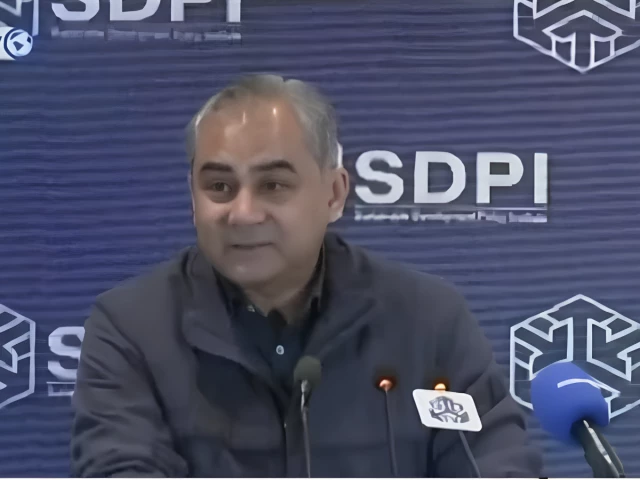
Interior Minister Mohsin Naqvi on Tuesday said the government had no intention of curtailing legitimate freedom of expression, including criticism of the government, but warned that there would be no compromise on four red lines for social media platforms: terrorism, hate speech, incitement to violence and child sexual exploitation.
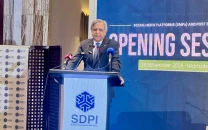
Speaking at a seminar organised by the Sustainable Development Policy Institute (SDPI) in Islamabad, the minister identified four red lines for social media platforms: terrorism, hate speech, incitement to violence and sexual exploitation of children.
“There will be no compromise on these four points,” he said, while clarifying that the government had no intention of curtailing legitimate freedom of expression.
“Journalists must report. Citizens must question. Dissent must be heard, including against the government,” he said, adding that freedom of speech could not be used as a shield by those crossing the stated red lines.
The Interior minister said the establishment of the Social Media Protection Regulatory Authority (SMPRA) would help the government address online crimes and ensure social media platforms respond promptly to complaints from victims.
Naqvi added that social media platforms, over-the-top (OTT) services and major content creators would initially be required to register with the authority.
He clarified that registration was “not a licence to silence anyone” but was intended to establish accountability and identify those responsible if something went wrong.
Naqvi said major social media platforms would also be expected to nominate empowered country representatives authorised to make decisions on complaints, rather than merely act as intermediaries. He added that the SMPRA would oversee that the platforms responded to victims' complaints and ensure that requests for assistance were addressed in a timely manner.
Global and national voices come together at SDPI's international seminar, "Social Media Platforms (SMPs) and Post-truth Era", to discuss disinformation, public trust and digital accountability.#SDPIPakistan #PostTruthEra #MediaLiteracy pic.twitter.com/73ZpifGNki
— SDPI (@SDPIPakistan) November 24, 2026
Outlining the proposed mechanism, the minister said the authority would follow a standard operating procedure of “engagement, notice and then penalties”, adding that blocking an entire platform would remain a last resort.
Naqvi criticised social media platforms for acting on only 47% of the government's requests to curb terrorism-related content. He said terrorist organisations were using online platforms for recruitment, fundraising and promoting their narratives.
Read: Nine women among 130 held by NCCIA
The minister also said the government lacked the manpower, resources and technology required to tackle digital crime on its own. Citing the limited capacity of the National Cyber Crime Investigation Agency (NCCIA), he said Punjab had only 61 personnel in the agency, including clerical staff and drivers, despite having a population of around 140 million.
He said the government had plans for the capacity building of the organisation as well as moving the complaint platform under it on the PakID app to facilitate ease of access.
Social Media Platforms (SMPS) and the Post-truth Era https://t.co/0L6j1absLV
— SDPI (@SDPIPakistan) November 24, 2026
Referring to cases of online harassment, the minister said five female victims of cybercrime had recently met him during an open court hearing. Three women had expressed fears of ending their lives over the possible circulation of their objectionable personal photographs, while two others were survivors of suicide attempts.
He said the victims had complained about the absence of an effective mechanism to approach social media platforms and seek relief.
Naqvi also cited a recent case involving an international gang allegedly involved in the online sale of sexually explicit material featuring children. He thanked Google for its cooperation in helping authorities trace a child sex offender in Abbottabad.
“When a platform acts, a child is protected,” he highlighted.
Earlier in the seminar, Khyber-Pakhtunkhwa (K-P) Governor Faisal Karim Kundi underscored the growing challenge of distinguishing fake news from authentic information in the digital age.
Also Read: Kundi seeks Italian support for skills
He said his province had experienced the consequences of narratives built around hatred, extremism and misinformation.
“Violence does not always begin with weapons; it is often preceded by the spread of hatred, extremism and misleading narratives,” he said, referring to the security situation in K-P and the fight against terrorism.
Kundi cautioned against the misuse of social media for negative propaganda and anti-state activities, stressing the need to maintain a balance between freedom of expression and responsibility.
He said it took years to build the image of a region that can be destroyed within seconds of a single fake viral post.
The governor said tourists, investors and business owners increasingly relied on social media to form perceptions about destinations and markets, making it necessary to address the spread of misinformation.
Kundi also called for justice and prompt action on complaints of online crime, urging civil society, media organisations and academia to work with the government to identify those involved in digital offences.
“We do not want a digital world where falsehood, hatred and terrorism enjoy a free hand, nor do we want an environment where unnecessary restrictions silence the voices of citizens,” he said.
Kundi said he wanted to transform the negative perception of K-P into a positive image centred on tourism, trade and technology.
Highlighting the province's historical and economic significance, he referred to its roots in the Gandhara civilisation, its tradition of hospitality and its position as a trade gateway connecting South and Central Asia.
He also emphasised the need to guide young people towards technological advancement and greater participation in the digital economy.








This material may not be published, broadcast, rewritten, redistributed or derived from. Unless otherwise stated, all content is copyrighted © 2026 The Express Tribune.






COMMENTS
Comments are moderated and generally will be posted if they are on-topic and not abusive.
For more information, please see our Comments FAQ