'Total failure': Sanaullah blames Naqvi for mishandling new provinces issue
Updated 32 minutes ago

Blames Naqvi’s failure to take PPP on board for controversy over new provinces
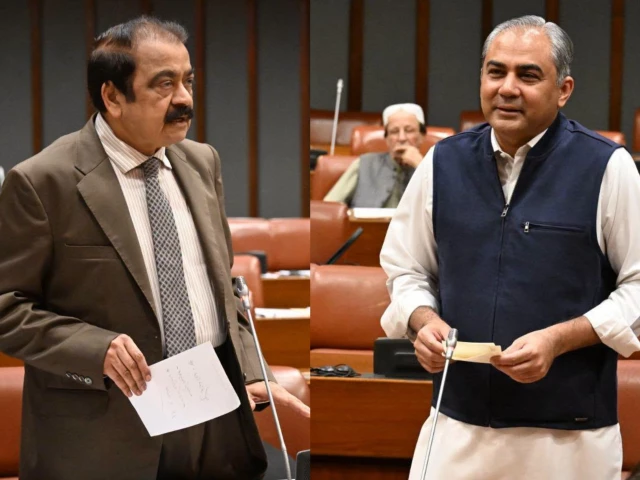
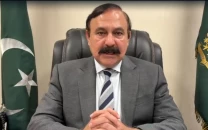
Adviser to the Prime Minister on Political Affairs Rana Sanaullah on Monday accused Interior Minister Mohsin Naqvi of mishandling the issue of new provinces, saying he had failed to bring the PPP leadership on board despite having four months to do so, calling it a "complete failure" on his part.
Speaking on a private television programme, Aaj Shahzeb Khanzada Kay Sath, Sanaullah said Naqvi should have consulted PPP Chairman Bilawal Bhutto-Zardari and President Asif Ali Zardari on the matter, adding that his failure to do so was a “total failure”.
His remarks came a day after Naqvi warned a fellow cabinet member against repeatedly criticising him, saying the minister would not be able to show his face if he responded to the remarks.
Read: Naqvi warns fellow minister against repeated criticism
Speaking informally to journalists in Lahore, Naqvi, without naming the minister, had said he had been patiently listening to the latter's comments for the past two and a half years.
Sanaullah acknowledged today that Naqvi was referring to him, saying: “Mohsin Naqvi can comment on me as much as he likes; I will welcome it.”
Expressing surprise at Naqvi's anger over the criticism, he said: “I have never spoken about his personality and I never will. However, the fact is that, in my view, he is what he is, and there is no need for any comment on that. We have never even thought about it."
Sanaullah rejected the notion that Naqvi's position as interior minister made him immune to criticism, saying that as a political worker and colleague, he and others had the right to express their views on his performance.
“Whenever I have expressed an opinion about him, I have done so while keeping his dignity and respect in mind. I have never called him anything less than a ‘worthy interior minister’, nor have I ever called him the PCB chairman,” he said.
Sanaullah said Naqvi had wrongly attributed remarks about the issue of new provinces to the prime minister and Field Marshal Asim Munir, describing it as a red line for them.
The adviser said he had only maintained that the matter would have to be brought before Parliament, where a consensus would need to be developed before it could move forward.
“I believe he complicated the matter by making irrelevant statements at an irrelevant forum. The issue has now become extremely controversial. If it comes to Parliament in this situation, it will arrive there as a controversial matter. However, we will make every effort to build consensus on it,” he said.
Asked why he appeared to hold a different position from other PML-N ministers who had also endorsed the idea of a referendum, Sanaullah said he respected their views, as well as Naqvi's, but had an equal right to express his own opinion.
“If other ministers are expressing their views, I respect their opinions. I also respect Mohsin Naqvi's opinion, but I have the right to express my own,” he said.
He reiterated that parliament was the appropriate forum for discussing the issue and that a consensus would have to be developed there.
“I am still saying with confidence that this matter will come before parliament and consensus will be built there,” he said, adding that discussing it at forums and seminars would only make it controversial.
Sanaullah also criticised Naqvi for failing to take the PPP leadership into confidence, saying Bilawal and President Zardari had recently indicated that the matter had not been discussed with them.
“If the PPP is not on board and Bilawal Bhutto-Zardari is saying, four months later, that nobody even spoke to him, while President Zardari is also saying that the matter was never discussed with him, then what have you been doing for four months?” he asked.
“You are present where they are, and they consider you close to them. If you could not even take them into confidence, then this is your total failure,” he said.
Sanaullah added that he had every right to express this view respectfully.
“If he has a counterargument to what I have said, he should present it. Threatening me in this manner is not going to silence someone like me. Why is there a need to be so short-tempered?” he said.
Defending his earlier description of Naqvi as Zardari's son, Sanaullah said he had personally heard the president refer to the interior minister in those terms on more than one occasion.
“I have heard Zardari sahib himself say more than once that Mohsin is my son. He should deny that this is incorrect and that we have made it up ourselves,” he said.
Sanaullah said that if Naqvi had not spoken to the PPP leadership between July 30 and Nov 22, he was entitled to question the failure.
“If he has not spoken to them from July 30 until today, Nov 22, then I will certainly raise questions about it. He has every right to respond,” he said.
Sanaullah further accused Naqvi of mishandling the issue of new provinces through his public statements, saying he had chosen the wrong forum and adopted an inappropriate approach.
He said the interior minister's initial speech had created a situation in which “the system collapsed”, and the subsequent debate had focused on that breakdown rather than on a healthy discussion of the issue itself.
Sanaullah said the matter had been complicated and made controversial over the past four months, adding that Naqvi, whom he described as the “worthy minister” who had led the initiative, should take responsibility for the situation.
Asked about Naqvi's claim that political parties received billions of rupees in funding from businessmen, Sanaullah challenged the interior minister to substantiate the allegation against him personally or the PML-N.
“Other parties may be receiving such funds, and other politicians may be doing so. I challenge anyone to prove that my party, the PML-N, or I have received billions, millions or even a hundred rupees from any businessman. Let them bring forward the person who gave the party such funds,” he said.
Sanaullah again maintained that Naqvi had mishandled the issue of new provinces and that, now that it had become controversial, a way forward could perhaps be found through a referendum.
However, he stressed that any such discussion and decision would have to take place in parliament, with proper debates in both the Senate and the National Assembly, rather than at an economic forum.
He said the PPP's only possible reservation about a referendum might be that the process could be used to obtain approval from a constitutional court and take the matter forward.
“If the PPP is assured that the Constitution will be followed and guidance will also be sought from the people, I believe a consensus could emerge on that point,” he said.
The debate over new provinces gained momentum on July 31, when Naqvi called for the creation of additional provinces or administrative units, arguing that Pakistan's existing governance structure was outdated and required a comprehensive overhaul. He renewed his proposal in November, suggesting that political parties hold a referendum to gauge public opinion on the issue, while maintaining that no decision would be taken without the consensus of coalition partners.
The proposal has drawn differing responses from political parties, with the PPP strongly opposing any move to divide Sindh, while the MQM-P has continued to advocate the creation of additional provinces, particularly in the province. The Sindh Assembly also passed a resolution on September 4 rejecting attempts to divide the province or alter its geographical boundaries.
Meanwhile, Defence Minister Khawaja Asif has supported the idea of creating as many as 12 provinces, arguing that smaller administrative units could improve governance and service delivery.
The demand for new provinces is longstanding, with calls for separate provincial status in South Punjab, Bahawalpur and Hazara based on arguments concerning administrative convenience, political representation and development disparities. The Punjab Assembly had previously passed resolutions supporting the creation of South Punjab and the restoration of Bahawalpur province in 2012, but the proposals did not translate into constitutional changes.




This material may not be published, broadcast, rewritten, redistributed or derived from. Unless otherwise stated, all content is copyrighted © 2026 The Express Tribune.




COMMENTS
Comments are moderated and generally will be posted if they are on-topic and not abusive.
For more information, please see our Comments FAQ