Pakistan, Oman seal $200m energy deal
Updated 24 minutes ago

Apparently responds to Rana Sanaullah's recent remark on new units debate
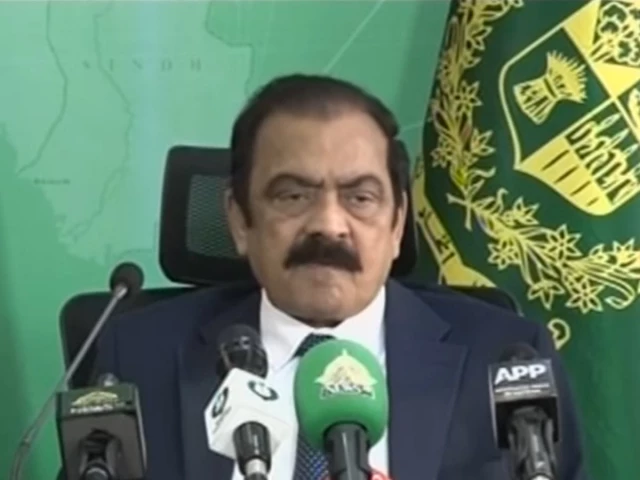
In a clear sign of widening differences within Prime Minister Shehbaz Sharif's cabinet, Interior Minister Mohsin Naqvi issued a stern warning to an unnamed federal minister for repeatedly criticising him "for television exposure", saying that if he responded, the minister would not be able to show his face in public.
The remarks, presented as an informal interaction with journalists in Lahore on Sunday, were circulated through a journalist considered close to the interior minister. Although Naqvi did not name the minister, his comments appeared to be directed at Rana Sanaullah, the PM's adviser on political matters.
The latest confrontation followed Sanaullah's criticism of the origins of the debate over creating new provinces and administrative units.
In a programme on a private TV channel, Sanaullah questioned the motives of businessmen who attended an economic forum where Naqvi made the proposal of new province on July 31.
He alleged that some businessmen from Karachi and Punjab had a history of approaching successive governments and army chiefs, portraying them as potential saviours of the country.
Clarifying that he was not referring to the entire business community, he said certain individuals had questionable interests and backgrounds.
Naqvi, in response, defended the businessmen, describing them as respectable citizens who had served as office-bearers of chambers of commerce and were among the country's highest taxpayers.
He questioned why political parties accepted billions of rupees from them in election funding if they considered them undesirable.
Sanaullah also distanced the PML-N from statements made by Defence Minister Khawaja Asif, Planning Minister Ahsan Iqbal and Information Minister Attaullah Tarar, describing their positions on the proposed restructuring as personal opinions rather than an agreed party stance.
He questioned the need to initiate a debate on new provinces through an economic forum, arguing that the country's parliamentary democratic system, given to it by Quaid-e-Azam, should not be undermined.
After Naqvi's July 31 speech, Sanaullah had questioned how he could criticise a system through which he had risen to the position of interior minister in just three-and-a-half years, making a pointed reference to Naqvi having achieved what he described as possible after a 30-year political career.
The latest confrontation, however, has acquired significance beyond the personal differences between the two government figures.
It has brought into focus the growing discord within the ruling camp, with ministers and senior party leaders increasingly taking positions against one another and even publicly questioning the policies of their own governments.
The friction is not confined to the Naqvi and Sanaullah. Some federal ministers have also taken potshots at the Maryam Nawaz-led Punjab government, with Nawaz-camp ministers coming to defend the provincial administration against criticism from within his own party.
Planning Minister Ahsan Iqbal, for instance, triggered controversy after posting remarks on extravagance by public office-holders, widely interpreted as a veiled reference to the Punjab chief minister and her family following reports about her daughter's wedding.
Although Iqbal denied targeting Maryam, the episode exposed underlying tensions between the federal and provincial leaderships. Rana Sanaullah subsequently came to the Punjab government's defence, describing the criticism as unwarranted.
Recently, Chaudhry Salik Hussain and Aleem Khan, both federal ministers took swipes at the Maryam Nawaz government yet the PM did not intervene to address concerns of allied parties.
This latest diatribe against Sanaullah by Naqvi, who is considered to be on the establishment quota in the cabinet, seems to signal that influential quarters are growing increasingly impatient with the PML-N government for trying to stall the new administrative unit plan.
The emerging message, as interpreted in political circles, appears to be that the government needs to put its house in order rather than allow differences among its ministers and coalition partners to spill into the public domain.
The developments have consequently raised questions about PM Shehbaz Sharif's ability to maintain authority over his cabinet and keep the various power centres within the government on the same page.






This material may not be published, broadcast, rewritten, redistributed or derived from. Unless otherwise stated, all content is copyrighted © 2026 The Express Tribune.








COMMENTS
Comments are moderated and generally will be posted if they are on-topic and not abusive.
For more information, please see our Comments FAQ