Sania Saeed opens up about playing Khushbakht in 'Dar-e-Nijaat'
Updated 5 hours ago

Actor discusses generational trauma, parenting, other themes explored in drama
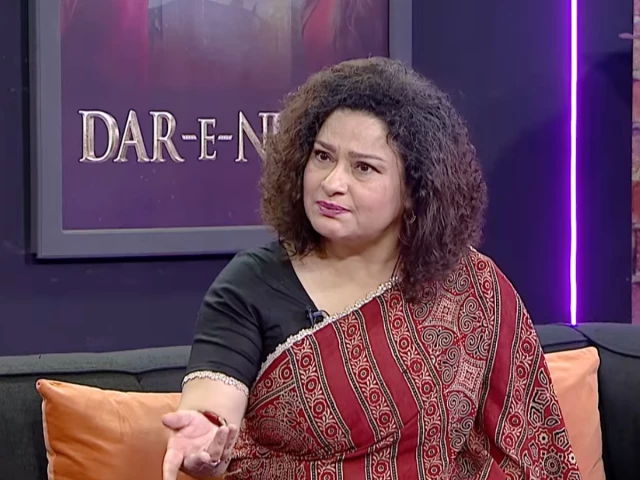
Actor Sania Saeed sat down for an interview, reflecting on her experience playing Khushbakht in Dar-e-Nijaat, the complexities of the drama's characters and the larger conversations the story brought to the surface. From generational trauma and parenting to women's choices and societal perceptions of good men and women, the actor offered her perspective on the themes explored in the drama.
Describing what she appreciated about Khushbakht, Sania said, “The character was very resilient. She has seen so much in her life and even went through an illness. She spent life alone and raised her child alone. She has also given her son a certain set of values which is reflective of her own upbringing. I really appreciated that.”
She highlighted the importance of Khushbakht's decision not to transfer her pain to the next generation. “Khushbakht's most important thought is that she breaks the cycle of the trauma being passed on across generations,” Sania said.
“She was like, 'I went through it but my daughter-in-law will not,'” she added.
“She chooses not to spill the pain over to the next generation,” Sania said, highlighting how Khushbakht decided that the hardships she experienced should not become the inheritance of those who came after her.
A notable part of the conversation was Sania's take on Abubakr and the appreciation his character received. While acknowledging that the character had been somewhat dramatised, she was careful about calling him an angel. “Abubakr is not an angel, though. We have dramatised it a bit. I feel that he is a decent human being just how men should be. If you call him an angel, you take away from that normalisation,” she said.
The actor also pointed out that many women displayed qualities depicted through Abubakr, but without receiving the same recognition. “This is becoming more popular just because he is a man. I know a lot of women just like him. They have basically written the story of a girl and given it to a guy,” Sania observed.
She added that there was almost always such a woman like Abubakr in a household. “You have taken for granted good women and that does not strike you as much as a man doing such good does,” she remarked.
The actor further discussed the influence of parents on their children's personalities, arguing that values were not simply taught through words but demonstrated through everyday behaviour.
“Parents' set of values is what they practice, how present they are,” she said.
Using the characters as examples, she pointed out how Zaryab's parents' absence affected her upbringing, while Zamil's parents were seemingly unaware of what he was going through. In contrast, she noted, Abubakr grew up watching his mother engage in social work and practise spirituality.
“It became a part of his daily life to be kind and give or share with people,” Sania said.
Sania also made a distinction when discussing Zaryab. While Zaryab may have inherited materialistic values and displayed classist behaviour, Sania did not believe that made her an inherently bad person.
“Zaryab saw her parents be materialistic. However, she is not a bad person,” she said. “Maybe in behaviour she was classist but she was never a bad woman. She was committed to one man since her childhood and she tried to maintain it and that is why she crossed the line. She was not all over the place,” the actor added.
During the interview, Sania also discussed the way women perceived their own worth and achievements.
She spoke about a form of impostor syndrome among women whereby they struggled to believe they deserved the things they had achieved because of the way society responded to their success. According to the actor, women wouldn't only question their professional or financial achievements but also found themselves wondering whether they were good wives, mothers, friends and siblings.
Sania connected the idea to Khushbakht, who, even after fighting for her choices, expressed hope that her son wouldn't end up with a woman like herself.
For Sania, this reflected how difficult it could be for women to let go of their past. “It is very hard to let go of your past,” she said, adding that it was “always in your head that your society is not accepting you.”
Sania concluded by discussing how stories needed to evolve with time, particularly in how they portrayed women's decisions and relationships.
“There are small things such as the fact that many women should be shown that if they make decisions for themselves, they could be wrong. Until they do not fully submit, it is shown that they won't get love,” she observed.
She argued, “There are intelligent and ambitious women who make mistakes and need people who can guide them,” emphasising that women's journeys should be allowed to influence the decisions they made later in life, rather than being reduced to whether they conformed to societal expectations.
One of Pakistan's most notable actors, Sania has built a career across television, theatre and film. Known for her nuanced performances and willingness to take on layered characters, she has consistently brought depth to stories centred on women, relationships and social realities. Her recent work includes Aap Ki Izzat, Dil Manay Na and Sang-e-Mah.









This material may not be published, broadcast, rewritten, redistributed or derived from. Unless otherwise stated, all content is copyrighted © 2026 The Express Tribune.






COMMENTS
Comments are moderated and generally will be posted if they are on-topic and not abusive.
For more information, please see our Comments FAQ