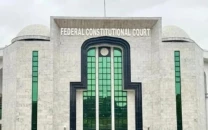
Justice lies in conscience, not buildings
Updated 18 minutes ago

.
Two successful litigations to the context of Israeli atrocities on Palestinians – one in Switzerland and the other in the UK – carry a stark message for the judiciary in Pakistan: if people in positions of authority stop in dutifully discharging their primary function (justice), the buildings they occupy lose their institutional ethos. Moreover, the cases also demonstrated that even the mightiest of Israeli-US lobbies within the judiciary, media and politics cannot buy or influence conscientious judges. These two cases also raise a basic question: can and should the executive and its judicial arm move against a person/persons without a tangible of wrongdoing? Does a dissenting opinion warrant punishment at all?
Ousman Noor, a British barrister and human rights advocate of Pakistani origin, should serve as a beacon of light for all the apologists of the status quo anywhere.
The UK Lawyers for Israel (UKLFI), a Zionist lobby group, had complained to the regulator – the Bar Tribunal and Adjudication Service (BTAS) – to punish Noor for an X post about international law, Hezbollah and the legal right to armed resistance in the context of Israel's genocidal actions in Palestine and Lebanon. The UKLFI said the post amounted to support for a proscribed organisation, contrary to the Terrorism Act 2000.
Through his tweet Noor had essentially challenged the often touted notion (Israel has the right to defence). He had simply raised a question of international law: "When Israel occupies, bombs and invades, do those on the receiving end have the right to use armed force to resist? International law has never required a people under attack to submit quietly."
The BTAS eventually dismissed the charge against Noor in September this year. And it came on the back of pressure from hundreds of jurists, academia and social and political activists within the UK.
Earlier, the Geneva-based Stop Killer Robots, a human rights organisation, had fired Noor for speaking out at the UN against Israeli occupation and genocide of Palestinians in Gaza that had begun after the Hamas October 7 attacks.
Ironical as much as hypocritical that an organisation publicly avows opposition to Israel using Palestinians as "guinea pigs to test these weapons ( killer robots)" but punishes its own employee for calling out Israeli atrocities.
The action actually blew the lid off anti-war NGOs such as Human Rights Watch and Amnesty, who pretend to be anti-war NGO and support the Stop Killer Robots organisation too.
Noor sued them for unfair dismissal and breach of freedom of expression and won that case too.
Noor's case also exposed as to who gets to speak about Palestine, and whether a lawyer can challenge the thus far predominant consensus on Israeli apartheid and genocide without risking their livelihood.
In the UK, jurists such as Dr Ralph Wilde and Dr Maung Zarni, stuck their neck out, examined the legal and moral questions surrounding Hezbollah's use of military force against the IDF and the wider framework of international law governing armed conflict and resistance, and lent their names and expertise to a politically controversial case when it would have been easier to stay silent. Among them were 575 professionals who wrote to the Bar Standards Board urging it to drop the case.
And nearly 770 people contributed to Noor's CrowdJustice fundraiser to help him fight his case
An essential distinction, however, is not out of place. In the words of analyst Javed Hassan: "No honest account can omit the murder of Israeli civilians or the taking of hostages. No honest moral judgment can turn those crimes into permission for the destruction of Palestinian civilian life. To defend Palestinian freedom is not to endorse Hamas. To insist upon Israeli security is not to grant a government an unlimited licence to kill. Nothing justifies genocide."
The readiness of all these individuals who stood by Noor bespeaks defiance of an undeclared consensus on the "untouchability" of subjects related to Israel. The common baton used to cower down such behaviour had usually been "anti-semitism". Not any more, it seems. Conflating an individual's opinion with or against laid-down statutes is subject to scrutiny by legal minds and not by regulators.
Noor's case also underscored that anyone may complain to a regulator, but a complaint itself is not proof of wrongdoing, and a disciplinary system cannot automatically become a tool for punishing opinions that challenge powerful, deeply-entrenched political ideologies like Zionism. Nor do judges in societies standing on judicial strength cave in to administrative coercion. Another shining example is the senior US judiciary. The US Supreme Court has thus far rejected or blocked 29 out of 33 Presidential executive orders. Data analysis by Hearst Television found that roughly one-third of Trump's formal executive orders have faced direct legal challenges naming the order. The United Democracy Center notes that multi-state coalitions of attorneys general have challenged at least 314 specific executive orders.
Bottomline: One can hope for justice as long as conscientious judges exist and are ready to take on state institutions very much in line with the oath of their duty. If they don't, they are just part of the towering concrete monuments and torch-bearers of justice.











This material may not be published, broadcast, rewritten, redistributed or derived from. Unless otherwise stated, all content is copyrighted © 2026 The Express Tribune.
COMMENTS
Comments are moderated and generally will be posted if they are on-topic and not abusive.
For more information, please see our Comments FAQ