Unrest rocks BD ahead of Hasina's return
Updated 14 minutes ago

XI, Trump, Putin urge nuclear talks, UN reforms
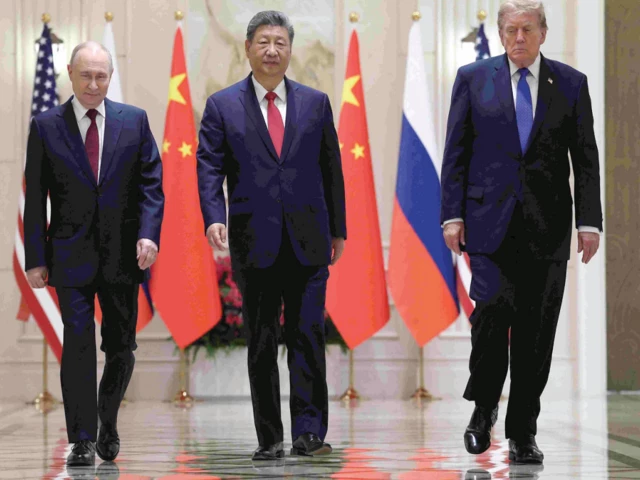
The leaders of the United States, China and Russia on Thursday issued a joint 'Declaration towards Peace' after an unprecedented trilateral summit, pledging to strengthen international security, reform the United Nations and engage in dialogue on reducing nuclear risks, but offering few concrete steps towards resolving major global conflicts.
US President Donald Trump, Chinese President Xi Jinping and Russian President Vladimir Putin held the historic meeting in the southern Chinese city of Shenzhen, bringing together the leaders of the world's three biggest nuclear powers amid continuing tensions over Ukraine, the Middle East and international security.
The declaration reaffirmed that "a nuclear war cannot be won and must never be fought", with the three countries committing to dialogue on reducing nuclear risks and preventing the proliferation of nuclear weapons. However, it provided no timetable for the proposed engagement or commitment to negotiations on a trilateral nuclear arms reduction treaty.
The leaders also pledged to pursue reforms of the United Nations to make it more effective in responding to global challenges and fulfilling its fundamental responsibility for maintaining international peace and security. All three countries are permanent members of the UN Security Council.
On energy, the declaration said the three powers planned to increase the production and supply of refined petroleum products for the benefit of all nations, while reaffirming the importance of stable energy flows.
Another significant provision concerned the immunity of state officials and the jurisdiction of international courts. The leaders recognised state consent and respect for officials' immunities as paramount principles, adding that the International Criminal Court and similar bodies must not abuse their jurisdiction.
The provision comes more than three years after the ICC issued an arrest warrant for Putin and other Russian officials over alleged war crimes in Ukraine. Moscow has rejected the allegations.
Despite the declaration's emphasis on international security, it made no reference to Russia's war in Ukraine or the conflict involving Iran. Nor did it announce any mechanism or specific initiative to address the conflicts.
Speaking after the meeting, Putin acknowledged that the declaration did not set ambitious goals and said no country would be forced to comply with its decisions. He described the summit as a new page in diplomatic history.
Trump, meanwhile, gave the gathering an emphatic endorsement, telling NBC News that it had gone exceptionally well. "On a scale of zero to 10, I think it was a 12," he said, describing the relationships established at the summit as fantastic.
Chinese Foreign Minister Wang Yi said the three countries would maintain coordination at the working level following the meeting. He said the leaders had exchanged their strategic intentions in person and established a new paradigm for interaction among the major powers.
However, the summit also raised concerns among Washington's European allies about the growing closeness between Trump and Putin, particularly as Russia's war in Ukraine continues. European leaders met in Berlin on Thursday to reaffirm their support for Kyiv and express unease over their exclusion from the Shenzhen discussions.
German Chancellor Friedrich Merz warned against any arrangement resembling the 1945 Yalta Conference, saying peace could not be achieved without European participation. "The United States know without us there will not be peace," he said.
Putin rejected comparisons with Yalta, arguing that the conference had not divided the world into spheres of influence but had recognised existing realities. He suggested that resolving present-day conflicts would similarly require accepting realities on the ground.
The summit drew sharp criticism from US Democrats, with Senate Democratic leader Chuck Schumer calling it a historic embarrassment and accusing Trump of offering political legitimacy to Washington's adversaries.
The meeting, held at a villa in Shenzhen, lasted around an hour and 20 minutes behind closed doors. It followed separate bilateral engagements between Trump and the other two leaders, marking an unprecedented gathering of the three powers at a time of heightened geopolitical uncertainty.







This material may not be published, broadcast, rewritten, redistributed or derived from. Unless otherwise stated, all content is copyrighted © 2026 The Express Tribune.



COMMENTS
Comments are moderated and generally will be posted if they are on-topic and not abusive.
For more information, please see our Comments FAQ