Fazl left without security as JUI-F sounds alarm
Updated 33 minutes ago

Two leaders review current political situation Reaffirm consensus on past constitutional tweaks Meeting follows
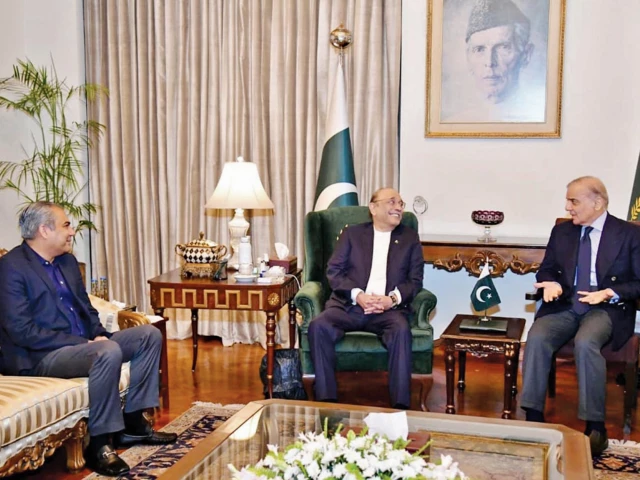
Prime Minister Shehbaz Sharif and President Asif Ali Zardari on Thursday agreed to resolve all outstanding issues through dialogue and mutual consultation as political tensions mounted following Pakistan Peoples Party (PPP) Chairman Bilawal Bhutto-Zardari's critical remarks about the government.
The understanding was reached during a meeting at Aiwan-e-Sadr, where the two leaders discussed the country's political situation and regional developments, particularly the crisis in the Middle East, according to a statement issued by the President's Office Media Wing.
"Prime Minister Shehbaz Sharif and President Asif Ali Zardari held a meeting to discuss the current situation," the media wing said in a post on X. It added that the current political situation was reviewed in detail and the Middle East situation was also discussed.
"It was stated during the meeting that all matters will be resolved through dialogue," the statement said, adding that the previous constitutional amendments had been introduced through mutual consultation among all coalition parties. The leaders also agreed to discuss all matters collectively and find solutions through consultation.
Interior Minister Mohsin Naqvi also attended the meeting. He has been at the centre of Bilawal's criticism over the debate on creating new provinces and administrative units, having repeatedly argued that the country's existing governance system has collapsed.
This was the second meeting between the two leaders, following Zardari's meeting with Shehbaz in Lahore on November 14. According to the Prime Minister's Office, they had agreed to strengthen cooperation among coalition partners, maintain consultations and advance public welfare initiatives.
The debate gained momentum on July 31 when Naqvi called for additional administrative units to overhaul what he described as an outdated governance structure. Addressing the Pakistan Economic Summit 2026 in Islamabad, he argued that the existing model had failed to deliver after decades of operation.
The Muttahida Qaumi Movement-Pakistan (MQM-P), which has repeatedly advocated carving new provinces out of Sindh, also expressed interest in the proposal. On Thursday, the party reiterated its demand, declaring that its resolve to pursue additional administrative units was final.
However, the Sindh Assembly passed a resolution on September 4 rejecting attempts to divide the province or create new administrative units. Chief Minister Syed Murad Ali Shah declared that there would be no compromise on Sindh's geographical unity.
The controversy intensified after Bilawal warned during a speech at the Karachi Press Club on Tuesday that an administrative division of Sindh could trigger a bloodbath. He also suggested that the government was considering a 28th Constitutional Amendment for the purpose.
Bilawal further claimed that the 27th Amendment had been forced upon PPP lawmakers. While acknowledging that the system had collapsed, he called for a political reset through political interventions. His remarks drew a strong reaction from government representatives.
He subsequently defended his position in several television interviews, urging government officials to "calm down" and listen to his views as a major political stakeholder. He rejected calls for a referendum, saying it had never historically been used for democratic purposes, and reiterated his opposition to dividing Sindh.








This material may not be published, broadcast, rewritten, redistributed or derived from. Unless otherwise stated, all content is copyrighted © 2026 The Express Tribune.


COMMENTS
Comments are moderated and generally will be posted if they are on-topic and not abusive.
For more information, please see our Comments FAQ