Pakistan must look beyond US-China rivalry
Updated 58 minutes ago

German professor says countries will look for 'best offer'

Pakistan would need to forge alliances and partnerships with "like-minded" middle powers to navigate the emerging world order and resist pressure to pick sides in the US-China rivalry.
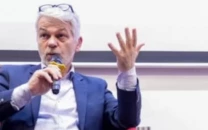
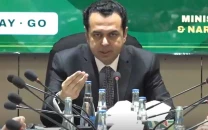
These remarks were made by professor of security and defence policy at the University of the Federal Armed Forces in Munich, Germany, Carlos Masala, in a seminar entitled "The Evolution of the International Order and Current Structural Changes", organised by the political science cluster at the IBA City Campus in Karachi.
Masala is the author of a provocatively titled 2025 book "If Russia Wins: A Scenario", which has become a best-seller at a time when the war in Ukraine has caught the attention of the global media and readers alike. The book explores a hypothetical scenario in which Russia attacks a small Estonian town, and NATO fails to respond under its Article 5 obligation.
The professor explained that in an increasingly bipolar international system where China and the US were superpowers, the pressure on Pakistan to "pick a side" would be "extremely high" because great powers have "tools of coercion for dragging countries into their orbit". The only way out for Pakistan to withstand this pressure, Masala argued, was to create as many "alliances and partnerships" with middle powers that did not want to be pressured to side with either Beijing or Washington on a permanent basis.
The professor expounded: "Pakistan needs to form alliances with like-minded countries to be able to withstand pressure from great powers. In the recent Makkah pact, Pakistan saw a strategic vacuum which could elevate its own role and bring the country out of this kind of squeeze between India and China. Now, Pakistan hopes to play a more independent role in the Persian Gulf and the Middle East."
Speaking about Pakistan's "tragedy of geography", Masala mused that Pakistan, with a population of around 260 million, would have been a "superpower" if it had been geographically situated somewhere in Europe. Sandwiched between much larger neighbours, India and China, Pakistan was "unfortunately" only a middle power, the professor said. Describing himself as a "structural realist", Masala pointed to the tectonic shifts that have accelerated over the past decade, which were part of what he described as the "fight for a new world order".
The professor demarcated the world into two camps: "status quo powers and revisionist powers", explaining that the dividing line in the present era was not, as conventionally understood, between "democracies and authoritarian countries".






This material may not be published, broadcast, rewritten, redistributed or derived from. Unless otherwise stated, all content is copyrighted © 2026 The Express Tribune.


COMMENTS
Comments are moderated and generally will be posted if they are on-topic and not abusive.
For more information, please see our Comments FAQ