French muralist invites visitors to become part of his art
Updated 18 minutes ago

Featuring unique interactive concept, renowned artist Chifumi's exhibition opens in Karachi
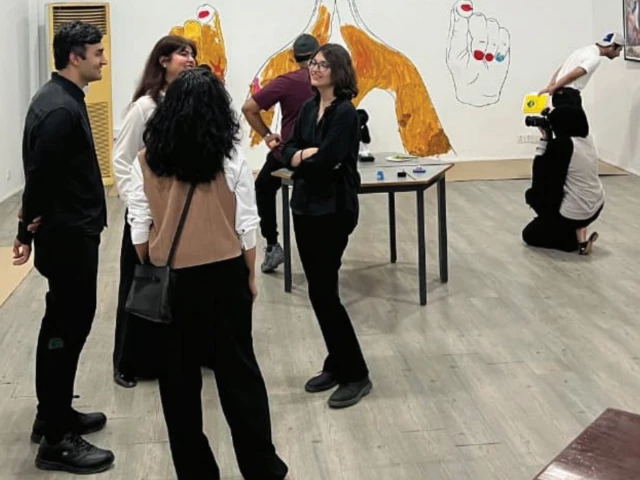
French muralist Chifumi believes art is a powerful medium of communication that allows people to express themselves and connect beyond language barriers.
Speaking to The Express Tribune, Chifumi said travelling to different countries and experiencing diverse cultures had been a major source of inspiration for his work. He added that Pakistani culture particularly attracted him, especially its traditional clothing, food and the hospitality of its people.
Chifumi's retrospective exhibition, titled Chifumi – Vous Laissez La Main (Let's You Take the Lead), opened at Alliance Française Karachi on Thursday, November 12, offering visitors an opportunity to become active participants rather than simply observe the artwork.
The exhibition came with an interactive concept, encouraging visitors to pick up paintbrushes and add colours to murals drawn directly on the exhibition room's walls.
Explaining the idea behind the exhibition, Chifumi said he had deliberately left his drawings unfinished so people could complete them using their imagination and preferred colours.
"We have only drawn the outlines and left the murals for people to complete. We want everyone to participate, choose their favourite colours and add whatever they like," he said.
He explained that the purpose was to turn the exhibition into a shared creative experience, allowing visitors from different backgrounds to contribute to the artwork.
Recalling his previous visit to Pakistan last year, Chifumi said he had also worked on a mural painting at the Arts Council of Pakistan Karachi. Returning to the country this year, he brought another opportunity for people to engage with mural art through a more participatory approach.
Speaking about his experience in Pakistan, he said he had thoroughly enjoyed his visits and was particularly impressed by the warmth and hospitality of Pakistani people.
Chifumi has become most well-known for his majestic and intricate large-scale murals that are scattered across the globe. His unique style of art blends mythological stories, ethnic paterns and hands signs communications. His passion for using his creative voice to raise awareness for important societal and environmental issues has also built him a reputation for being an engaged artist, driven by a desire make an impact. Born in France, Chifumi moved to Cambodia after he graduated from art school; a move that sparked a lifelong fascination with Asian ancient heritage and mythology. It is his passion for art in public spaces that brought him into the Cambodia Urban Art Festival; since 2015 he has organized yearly the first and major event around street creativity and pushed young local artists to express themselves. Over the course of a year, he had created impactful murals in far-reaching places such as Cambodia, California, India, France, Denmark, Croatia, Thailand, Nepal and Italy.
Traditionally, French art has consisted of the visual and plastic arts (including French architecture, woodwork, textiles, and ceramics) originating from the geographical area of France. Modern France was one of the main centres for the European art of the Upper Paleolithic, then left many megalithic monuments, and in the Iron Age many of the most impressive finds of early Celtic art. The Gallo-Roman period left a distinctive provincial style of sculpture, and the region around the modern Franco-German border led the empire in the mass production of finely decorated Ancient Roman pottery, which was exported to Italy and elsewhere on a large scale. With Merovingian art the story of French styles as a distinct and influential element in the wider development of the art of Christian Europe begins.
Romanesque and Gothic architecture flourished in medieval France with Gothic architecture originating from the Île-de-France and Picardy regions of northern France and soon expanding in all of Europe. From the 16th century, the Renaissance led to Italy becoming the main source of stylistic developments until France became the leading artistic influence in France during the late phase of Louis XIV's reign, especially during the Rococo and Neoclassicism periods.
During the 19th century and up to mid-20th century France, and especially Paris, was considered the center of the art world with art styles such as Impressionism, Post-Impressionism, Cubism, Fauvism originating there as well as movements and congregations of foreign artists such as the École de Paris.
The French Revolution and the Napoleonic Wars brought great changes to the arts in France. The program of exaltation and myth making attendant to the Emperor Napoleon was closely coordinated in the paintings of David, Gros and Guérin. In architecture and decorative arts, the Empire style was created for imperial residences by architects Pierre Fontaine and Charles Percier, drawing heavily on references to Roman and Egyptian Antiquity. Cabinet-maker Jacob Desmalter created original furniture in the Empire style, mainly employing mahogany veneers with heavy gilt-bronze mounts. Seats, made in mahogany when they were not painted or gilded, were inspired from seats and thrones designs of Antiquity, derived from details on ancient reliefs and Greek vases. Jean-Auguste-Dominique Ingres was the main figure of neoclassicism in painting until the 1850s and a prominent teacher, giving priority to drawing over color. Meanwhile, Orientalism, Egyptian motifs, the tragic anti-hero, the wild landscape, the historical novel, and scenes from the Middle Ages and the Renaissanceall these elements of Romanticismcreated a vibrant period that defies easy classification. The most important romantic painter of the period was Eugène Delacroix, who had a successful public career and was the main opponent of Ingres. Before him, Théodore Géricault opened the path to romanticism with his monumental Raft of the Medusa exposed at the Salon of 1819. Camille Corot tried to escape the conventional and idealized form of landscape painting influenced by classicism to be more realist and sensible to atmospheric variations at the same time.
Romantic tendencies continued throughout the century, both idealized landscape painting and Realism have their seeds in Romanticism. The work of Gustave Courbet and the Barbizon school are logical developments from it, as is the late nineteenth century Symbolism of such painters as Gustave Moreau, the professor of Henri Matisse and Georges Rouault, as well as Odilon Redon.











This material may not be published, broadcast, rewritten, redistributed or derived from. Unless otherwise stated, all content is copyrighted © 2026 The Express Tribune.





COMMENTS
Comments are moderated and generally will be posted if they are on-topic and not abusive.
For more information, please see our Comments FAQ