A tilak, a prayer that celebrates sibling love
Updated 49 minutes ago

Young engineers develop electrolysis generator to produce hydrogen from water

Amid Pakistan's persistent energy crisis, rising imported fuel costs and increasing industrial production expenses, a group of young engineers in Karachi has introduced a locally-developed solution that could potentially play an important role in the country's future energy landscape.
The startup, PakHydro, has developed an electrolysis-based generator that produces hydrogen gas from water. The hydrogen can then be used to generate flames and heat for industrial, commercial and domestic use, potentially reducing reliance on conventional gas and fossil fuels.
The prototype works by using electrolysis to split water into hydrogen and oxygen. The hydrogen produced can be used immediately as fuel, making the system an alternative source of heat for various applications.
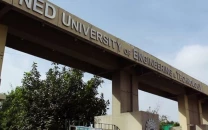
The project is led by Muhammad Ayan, an electrical engineering student at Sir Syed University of Engineering and Technology and founder and chief executive officer of PakHydro. The team also includes Dr Usman Alauddin, co-founder and chief technology officer, who is a professor in the Department of Mechanical Engineering at NED University, and Amir Ali, co-founder and chief operating officer, who serves as an assistant professor in the Department of Electrical Engineering at Sir Syed University.
According to Dr Usman Alauddin, the current prototype is claimed to have the capacity to produce one kilogramme of hydrogen gas in approximately six to eight minutes, using around eight to 10 litres of water. However, electricity consumption and production costs would depend on the generator's capacity and operating conditions. He said the system could also be powered by renewable energy if its electricity requirements were met through solar power.
The startup's potential significance extends beyond the development of an experimental machine. Pakistan's small-scale manufacturing units, metal fabrication and welding businesses, textile industry, bakeries, traditional ovens and other commercial sectors require a continuous supply of heat. Rising prices of LPG, natural gas and other fuels have increased operating costs for these businesses.
The PakHydro team believes its hydrogen torch system could provide a locally-manufactured alternative for such applications.
Dr Usman Alauddin said the commercial introduction of the technology could create an entirely new domestic industry involving the manufacturing, installation, maintenance and servicing of hydrogen torch systems. According to his preliminary estimates, the potential market could reach Rs40 billion to Rs50 billion and generate between 8,000 and 10,000 employment opportunities.
Founder Muhammad Ayan said the team had conducted several experiments and worked on different designs before developing the current prototype. The initial research focused on various cell technologies, followed by continuous research and development that eventually resulted in a locally developed system capable of producing hydrogen according to demand.
He said one of the project's major strengths was that all its basic components had been manufactured or sourced locally. This could enable Pakistan not only to introduce a new technology but also to develop domestic expertise and supply chains for its manufacturing, maintenance and eventual industrial-scale production.
According to Ayan, the system operates on the principle of "gas on demand", producing only the quantity of hydrogen required at a particular time. This could reduce the need to store large quantities of fuel gas, unlike conventional systems.
The PakHydro team plans to expand the technology beyond industrial torches and explore its application in domestic and commercial appliances, including cooking stoves, heating systems and other equipment requiring flames or heat. The possibility of supplying heat through smaller units in remote and mountainous regions is also being explored.






This material may not be published, broadcast, rewritten, redistributed or derived from. Unless otherwise stated, all content is copyrighted © 2026 The Express Tribune.









COMMENTS
Comments are moderated and generally will be posted if they are on-topic and not abusive.
For more information, please see our Comments FAQ