SME financing doubles to Rs1.2tr in 2 years
Updated 48 minutes ago

Senate body bars further releases to 17 ministries, warns finance ministry

The federal government has "unconstitutionally" spent over Rs5 trillion on ministries functioning in the provincial domain since the 18th Amendment, according to proceedings of a Senate functional committee panel that on Tuesday barred the release of any further funds for them.
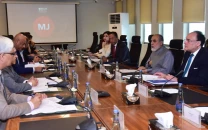
During the meeting, the subcommittee of the Senate's Functional Committee on Devolution also gave a final deadline to the Prime Minister's Office (PMO) to issue orders winding up these ministries, warning that it may have to send a notice to the office if there is no compliance. The office of the auditor general submitted details of spending for the 2011-26 period by ministries functioning in the provincial domain.
More than Rs5 trillion, or $18 billion, has been spent on ministries established in violation of the Constitution since the 18th Amendment, which is more than the $15 billion borrowed from the International Monetary Fund (IMF) during this period, said Senator Zamir Hussain Ghumro, chairman of the committee. He said that had the federal government followed the Constitution and not spent money in areas that are not its responsibility, the country could have avoided the IMF programmes.
The committee instructed the Ministry of Finance, the auditor general and the accountant general to stop releasing funds to ministries working in violation of the Constitution. The proceedings reinforced that Pakistan's problem was not mere taxation but illegal and unconstitutional spending by the federal government, which has been borrowing while continuing to spend in areas that may give it political advantage but add to the debt burden.
According to the details, Rs48.8 billion was unconstitutionally spent over the past 16 years on the Ministry of Climate Change, Rs1.1 trillion on the Ministry of Education, Rs651 billion on the Ministry of Health, Rs398.4 billion on the Ministry of Housing, Rs313 billion on the Ministry of Industries, Rs51.7 billion on the Ministry of Inter-Provincial Coordination, Rs35 billion on the Ministry of Narcotics, Rs270 billion on the Ministry of National Food Security, Rs32 billion on the Ministry of Petroleum, Rs185 billion on the Ministry of Planning, Rs687 billion on the Ministry of Railways and Rs935 billion on the Ministry of Water Resources.
"We are restraining ourselves by not referring the matter of allocating budget to ministries functioning in devolved areas to the National Accountability Bureau under Section 9 for misuse of authority by the Ministry of Finance," Ghumro remarked.
He said the Constitution provided no basis for retaining ministries on the grounds of fulfilling international commitments, adding that under Article 173 provincial governments could also enter into international agreements.
The committee had given the government two weeks to wind up the ministries of health, education, national food security, water resources, climate change, housing, special initiatives, culture and heritage, railways, industries, statistics, petroleum, inter-provincial coordination, narcotics and planning and development.
The committee chairman observed that the panel and the prime minister were aiming at the same thing, saving taxpayers' money and reducing expenditure.
Noreen Bashir, representing the finance ministry, could not give a satisfactory reply and asked Finance Joint Secretary Rashid Zubari to answer the question about the legal authority to release funds to ministries working in devolved areas. He too could not give a satisfactory reply. "You will land in trouble for spending money against the country by allocating budgets to the subjects that have been devolved," Ghumro said, warning the finance ministry representatives.
Cabinet Division Secretary Kamran Afzal also could not report compliance with the committee's instructions to wind up 17 ministries functioning in violation of the Constitution. In light of the committee's instruction a summary had been sent to the Prime Minister's Office, but no instructions had been received, he said.
He acknowledged the committee chairman's knowledge of the Constitution but argued that "there are additional things on the ground". The cabinet secretary was of the view that these ministries are retained because of the practical problems of the "paternalistic role of the federal government and for international coordination".
Ghumro rejected the reply as the "law of necessity", which the committee did not agree to.
For one minister and one federal secretary a ministry is retained in devolved areas, which resulted in over Rs5 trillion of spending in 16 years in violation of the Constitution, he said. The committee noted that under the Constitution international coordination is the responsibility of the Ministry of Foreign Affairs, while inter-provincial coordination is the mandate of the Council of Common Interests (CCI). The prime minister heads the CCI while the four chief ministers are its members.
There are also issues, as some provinces are not ready to take responsibility, Afzal said. The cabinet secretary said that for the past two years the federal government has been trying to hand over Sheikh Zayed Hospital, Lahore, and two health institutions in Rawalpindi to the Punjab government, which is refusing to take ownership. The committee chairman said that under the Constitution borrowing is the mandate of the CCI, but the government has not convened a CCI meeting since 2025 and the country was sinking into a debt trap.
The finance ministry is also reluctant to appoint a permanent director general of debt, and the debt office's affairs are run on an ad hoc basis.













This material may not be published, broadcast, rewritten, redistributed or derived from. Unless otherwise stated, all content is copyrighted © 2026 The Express Tribune.







COMMENTS
Comments are moderated and generally will be posted if they are on-topic and not abusive.
For more information, please see our Comments FAQ